Global health · Gaza · Humanitarian assistance
WFP Cuts Monthly Gaza Aid for 500,000 People, Citing Funding Shortages
WFP says a funding gap is reducing Gaza assistance. What fewer recipients, smaller rations and reduced hot-meal services mean—and what remains unclear.
By Health Politics Daily News Desk · October 19, 2026 at 6:00 a.m. ET
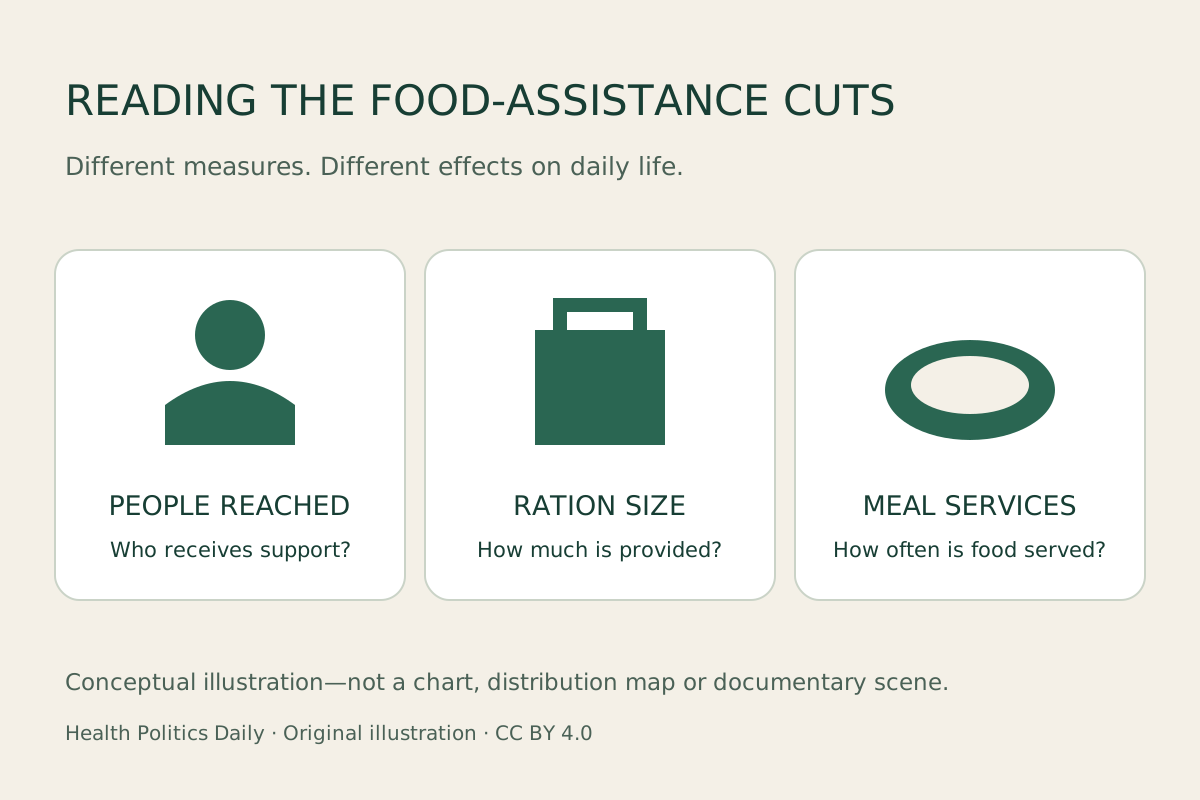
The World Food Programme says a funding shortfall is forcing it to remove about half a million people from monthly assistance in Gaza. Its country director Shaun Hughes described the reduction to AFP, whose October 19 report is carried by The Times of Israel. The cut is not evidence that the affected families no longer need food.
What is changing
Reuters reports that monthly recipients are being reduced from 1.6 million to 1.1 million. It also reports halved food rations and fewer daily hot meals, falling from 250,000 to 150,000. These are separate measures: people reached, food quantity and meals served should not be added together into a single count of those affected.
AP’s October 18 reporting independently records acting WFP executive director Carl Skau’s account of the reduction during his Gaza visit. It also reports reduced cash assistance for 75,000 families. That household figure is not a count of additional individual recipients that can simply be added to the headline number.
Why food being available is not the same as being affordable
WFP’s official Palestine overview describes food insecurity as fragile despite improvements since the October 2025 ceasefire. Its September 30 funding announcement says those gains largely reflect humanitarian assistance rather than a recovery of livelihoods, markets and local food systems. That earlier statement is background, not an updated tally of today’s recipients.
Analysis: Food on a shop shelf answers an availability question. Whether a family can pay for it is a different question; whether it can reach a distribution point or cook a food parcel is another. A cash transfer, a bag of flour and a prepared meal help with different constraints. Losing one form of support cannot automatically be offset by pointing to another service somewhere else.
For families relying on a recurring allocation, reduced support can require another source of food or money. This article does not infer a particular household’s circumstances or provide nutrition or medical advice. Nor does it publish unverified collection routes, distribution times or eligibility promises.
Funding, access and responsibility are different questions
Analysis: The immediate explanation WFP gives for these programme cuts is funding. That should not be blurred into a claim that money is the only constraint on Gaza’s humanitarian response. Equally, a wider argument about the conflict does not establish how much a specific programme can finance this month.
Accountability requires checking funding received, allocations, delivery and remaining needs separately. A newly announced donation is not proof that these cuts have been reversed; a smaller recipient list does not demonstrate that hunger has fallen. Restored coverage would need an explicit operational update.
Our Yemen hunger-data explainer illustrates why geographic coverage and definitions matter when reading aid statistics. Our COP17 financing explainer examines the separate distinction between funding promises and delivery. Neither report supplies evidence about Gaza’s current distributions.
What remains uncertain
The reviewed reporting does not establish the decision for every individual family, a full location-by-location implementation schedule or when funding will restore previous coverage. This edition does not declare a new famine classification or predict a death toll. Those would require separate evidence and appropriate assessment.
Source limit: The current cut figures are attributed to WFP officials through AFP, Reuters and AP. The directly reviewed WFP webpages provide background but do not reproduce all of those new operational figures; their earlier reach totals should not override the newer attributed announcement.
Bias Lens: humanitarian impact and the funding explanation
Verified baseline: Multiple reputable reports attribute the assistance reduction to WFP officials and identify funding shortages as its immediate explanation.
Left-leaning—El País: Its October 19 report places the cuts within a broader account of humanitarian need, conflict and aid restrictions.
Center—Reuters: The linked report leads with the operational cuts and funding shortage. Its narrower lead does not establish that other humanitarian constraints are absent.
Additional regional coverage—The Times of Israel: Its linked AFP item emphasizes the monthly reduction and Hughes’s explanation. We identify the wire source rather than count the host publication as another independent reporting team.
Right-leaning comparison: No directly relevant mainstream right-leaning report was verified for this edition. An older opinion about Gaza aid is not a factual response to today’s programme change and is not substituted here. These framing observations do not assign views to all journalists or readers, and humanitarian need does not require a partisan counterclaim.
Sources and media
WFP’s official overview and September funding release are linked for primary-source context; AFP, Reuters and AP corroborate the current announcement. The original conceptual illustration is licensed CC BY 4.0 and is not a documentary scene or a map of distribution sites. No directly relevant authorized video was verified, so none is embedded.