Global affairs · Biodiversity · Public finance
COP17 Opens in Yerevan With Nature Protection and Funding Under Review
The October 19–30 biodiversity talks will review delivery of global nature goals. What conservation targets and financing promises mean for communities.
By Health Politics Daily News Desk · October 19, 2026 at 1:58 a.m. ET
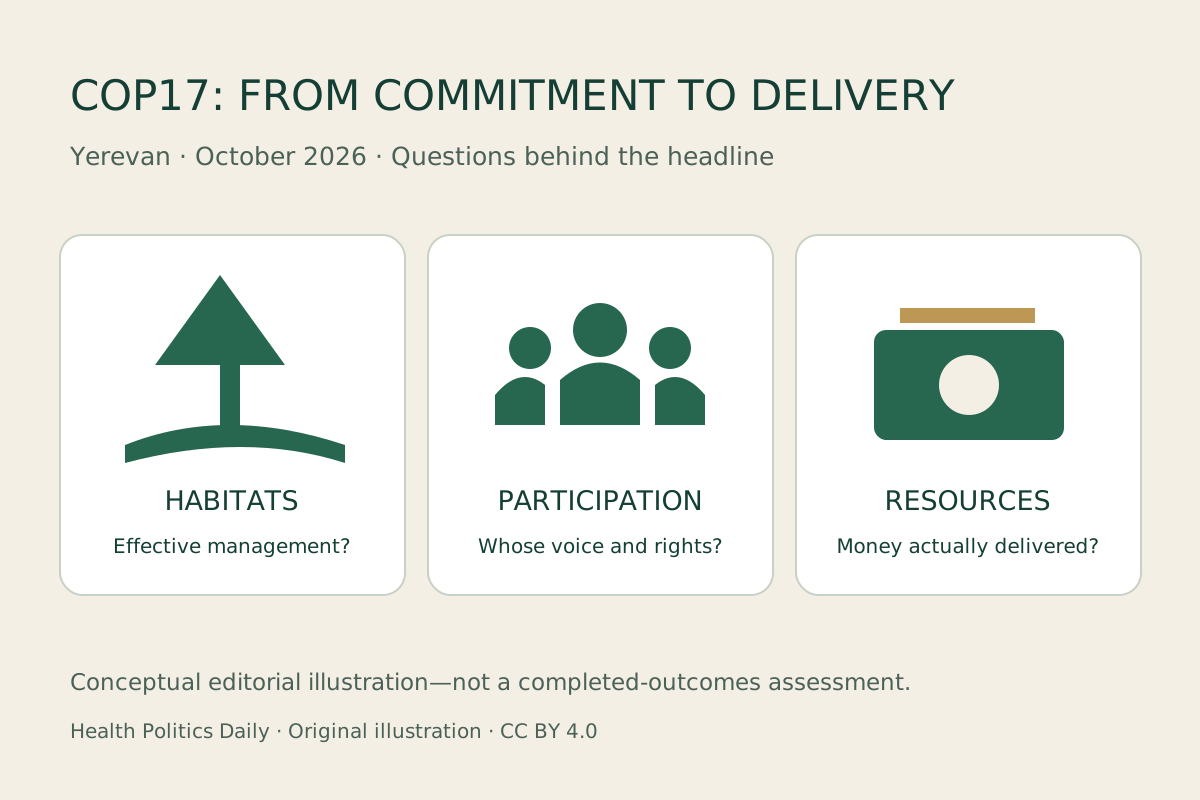
The UN biodiversity conference opens its formal meeting in Yerevan, Armenia, on October 19 with a practical question: how much of the world’s agreed nature-protection agenda is being delivered? The talks run through October 30 and will conduct the first global review of collective progress under the Kunming-Montreal Global Biodiversity Framework, according to UNEP’s official conference briefing.
This is an opening-day explanation, not a report of a final agreement. UNEP says countries will negotiate a Yerevan Pathway to accelerate action. Its contents and adoption should not be assumed in advance.
What is being tested
Reuters’ October 19 preview describes lagging progress and unresolved funding divisions. AP’s advance reporting likewise focuses on the gap between financing ambitions and resources raised.
Analysis: A review is useful only if readers can tell what was measured, over which period and against which promise. A national plan, a projected future conservation area and a demonstrated improvement in an ecosystem answer different questions. Treating them as equivalent would make an apparent success impossible to check.
“30 by 30” is not just a boundary on a map
The framework’s Target 3 calls for effective conservation and management of at least 30% of land and inland waters, and of coastal and marine areas, by 2030. Its conditions include ecological representation, connections between areas, equitable governance and respect for Indigenous peoples’ and local communities’ rights.
The CBD guidance recognizes different conservation arrangements, including some that permit sustainable use consistent with conservation outcomes. The target is therefore not a simple statement that every designated area must exclude all human activity.
Analysis: For a fishing community, farmer or nearby resident, who participates in decisions and how an area is managed can matter as much as its size. A percentage alone cannot establish whether a habitat is functioning, whether management has resources or whether affected people were heard. Those questions deserve evidence alongside the headline area total.
What the funding numbers actually mean
Target 19 seeks at least $200 billion annually by 2030 from all sources, including domestic, international, public and private resources. Within that ambition, specified international financing to developing countries is to reach at least $20 billion a year by 2025 and $30 billion by 2030. These are different scopes, not three interchangeable estimates of the same pot.
Analysis: A pledge is not a payment, and a payment is not yet evidence of a successful project. Useful follow-up reporting should identify the provider, recipient, timing, financing terms and intended result. It should also distinguish new money from a relabelled existing programme and explain whether a figure measures commitments or actual disbursements.
The financing debate sits alongside broader public-budget pressures. Our IMF fiscal-buffers report explains that wider context; our World Bank minerals-financing explainer examines another case where a headline target should not be confused with money already delivered. Neither is evidence of a COP17 outcome.
What matters beyond the meeting rooms
Analysis: The people-first test is whether decisions translate into accountable local work, with clear responsibilities and participation. For residents following a specific project, the relevant documents will be its management plan, funding terms and consultation record—not a global conference headline alone.
No opening-day announcement reviewed here establishes a new local access rule, a guaranteed grant or a completed conservation result. The final decisions, financing arrangements and subsequent implementation remain to be assessed. This article makes no forecast that the summit will either rescue or abandon the 2030 agenda.
Bias Lens: delivery, finance and framing
Verified baseline: The official agenda is a review of collective progress. Target 3 includes management and rights safeguards; Target 19 distinguishes overall resources from international financing.
Left-leaning—The Guardian: Its October 19 explainer emphasizes weak progress and the need for delivered funding.
Center—Reuters and AP: Reuters foregrounds progress and funding disputes; AP leads with the financing shortfall. Both are reporting angles, not proof of disagreement over the framework.
Right-leaning comparison: No directly relevant report from a mainstream right-leaning publisher was verified for this edition. We do not invent an opposing position, substitute an unrelated argument or infer a reporter’s views from an outlet label. Conservation effectiveness, affordability and community rights can all be examined without assigning them to partisan camps.
Sources, image and video
Primary sources are UNEP’s conference briefing and the CBD’s Target 3 and Target 19 texts, linked above. The original conceptual illustration is credited and licensed CC BY 4.0. For video, AP’s publisher-hosted advance report includes its video produced by Kieran Stover; it is linked, not embedded, downloaded or rehosted.