U.S. politics · 2026 elections · Polling
AP-NORC Poll: Voters Want Congress to Prioritize Costs and Ending Iran War
Broad majorities of registered voters say the next Congress should make affordability and ending the war among its highest priorities. The survey measures opinion at one point in time; it does not forecast who will win on November 3.
By Health Politics Daily News Desk · October 23, 2026 at 5:59 a.m. ET

Watch in this article
Pumpjack operating at the Kern River Oil Field
A short CC0 field video provides visual context for reporting on oil production and fuel supply.
Thomas Farley / Wikimedia Commons · CC0 1.0 · License and source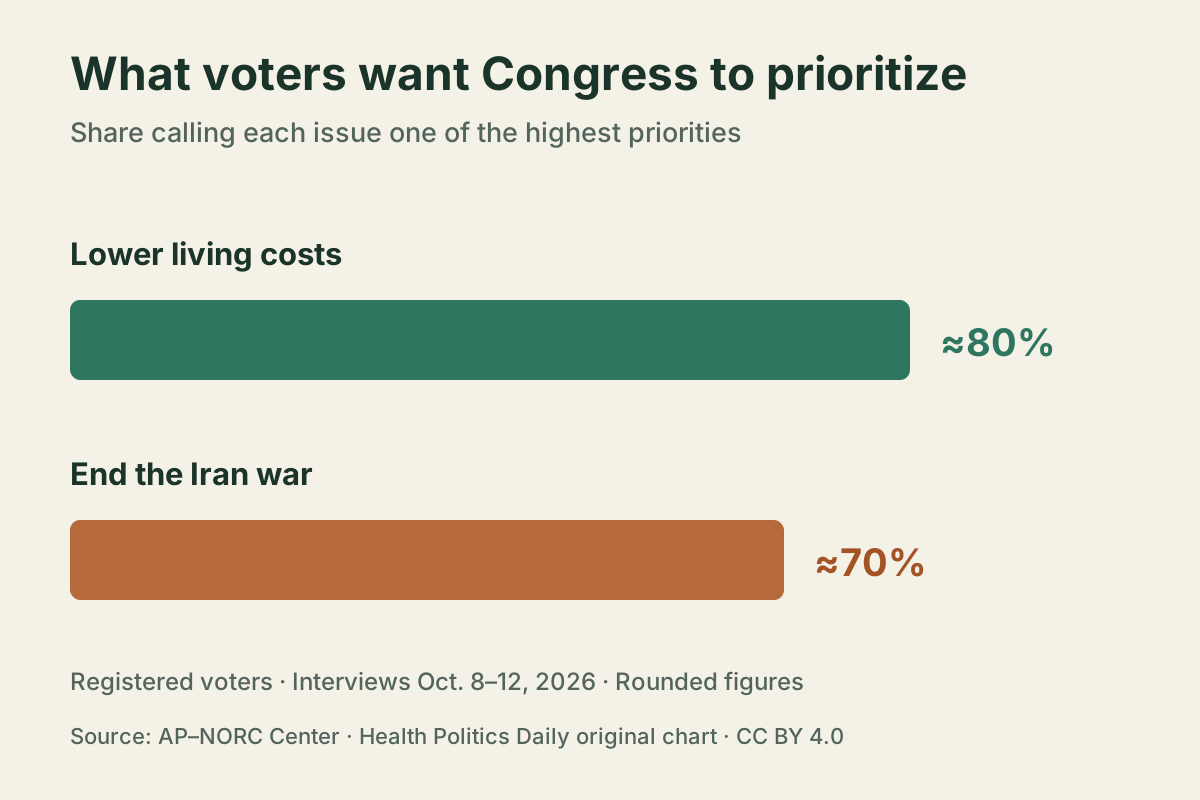
About eight in ten registered voters want the next Congress to make lowering the cost of living one of its highest priorities, while roughly seven in ten say the same about ending the war in Iran, according to a national AP–NORC survey released ahead of the November 3 midterm election.
Those issues outranked explicitly Trump-centered goals. About four in ten voters prioritized investigating President Donald Trump's administration, while roughly two in ten prioritized advancing his agenda. Around half gave high priority to reducing the federal budget deficit or finding bipartisan common ground.
Affordability and the war cross party lines
The poll found that large shares of both Republican and Democratic voters wanted Congress to address living costs and the Iran conflict. That agreement does not mean voters share the same preferred policies. One person may favor subsidies or price regulation, another tax or spending cuts; support for ending a war also does not identify an agreed diplomatic or military path.
The survey therefore measures desired outcomes more clearly than it measures the legislation voters would support to reach them. Congress can influence taxes, spending, sanctions, military authorization and oversight, but the executive branch retains substantial authority over diplomacy and military operations.
What the poll can—and cannot—tell us
AP–NORC interviewed 1,119 U.S. adults from October 8 through October 12 using NORC's probability-based AmeriSpeak panel. The margin of sampling error for all adults was plus or minus 3.9 percentage points. Subgroups have larger margins of error, and wording, nonresponse and events after the interviews can also affect interpretation.
Practical implication: voters comparing candidates can look beyond whether a campaign names affordability or the war and examine the proposed mechanism, cost, timeline and legal authority. A national poll cannot describe every state or congressional district and should not be used to infer an individual voter's preference.
Fact, analysis, forecast and opinion
Verified fact: roughly 80% prioritized lowering living costs and roughly 70% prioritized ending the Iran war. Analysis: the cross-party agreement is stronger on broad goals than on the policies needed to achieve them. Forecast: candidates are likely to emphasize affordability and foreign policy in the campaign's closing days, but the poll does not predict turnout, seat totals or control of Congress. Opinion: coverage should publish methodology and distinguish issue priority from support for a specific bill or candidate.
For related context, see our reporting on rising employer health-insurance costs, the limits of the mortgage-cost executive order and the regional economic damage tied to war.
Bias Lens: pocketbook priorities, presidential accountability and the war
Verified baseline: AP–NORC found broad support for prioritizing affordability and ending the Iran war. Smaller shares prioritized investigating Trump or advancing his agenda. The survey does not assign a policy solution or predict election results.
Left-leaning context — The Guardian: connects the war to household costs and questions about presidential accountability. Center — Associated Press: leads with the cross-party priority findings and details divisions within both parties. Center-right business and election context — The Wall Street Journal: emphasizes how affordability and war concerns complicate Republican messaging about Democrats. Only AP directly reports this specific priority question; the other links provide framing context rather than independent measurements.
What remains uncertain
The survey cannot determine whether respondents will vote, which issue will decide their choice, or how rapidly opinion may change. National agreement on a broad goal may disappear when lawmakers consider specific taxes, spending cuts, military limits or diplomatic concessions. Election results will also depend on district-level candidates, turnout and rules—not only national issue rankings.
Principal sources
- AP–NORC Center — October 2026 topline and methodology
- AP–NORC Center — project findings and public-use files
- Associated Press — congressional priority analysis
- Reuters — broader midterm issue context
No suitable directly relevant official or publisher-authorized video with clear embedding permission was available, so none was embedded.