U.S. POLITICS — FINANCIAL REGULATION — ELECTIONS
Poll Finds Bipartisan Opposition to Betting on Elections and Government Events
A new Reuters/Ipsos poll finds broad resistance to prediction-market wagers on elections, military actions and government decisions, sharpening the debate over whether event contracts are financial products, gambling or both.
By Health Politics Daily News Desk · Published Monday, October 12, 2026 at 12:04 p.m. America/New_York · Approximately 9 minutes
Verified Baseline
Majorities in both parties oppose election betting
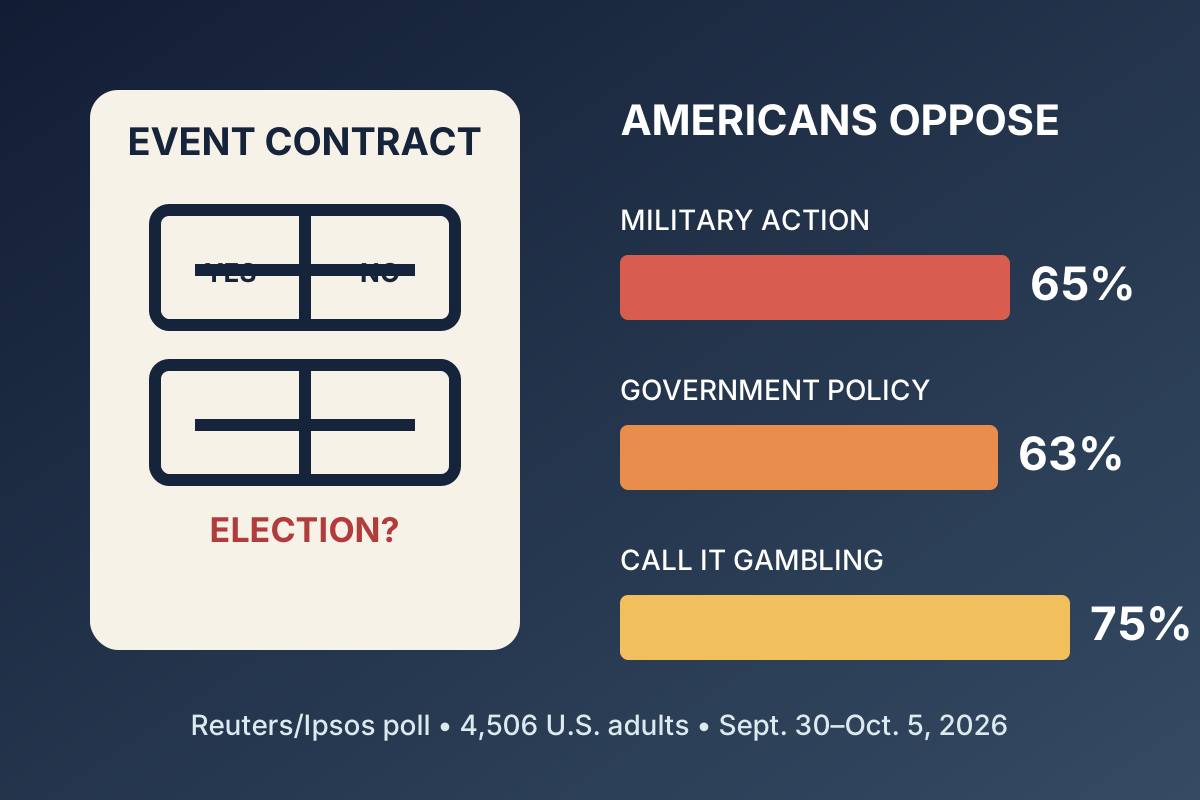
A nationally representative Reuters/Ipsos survey of 4,506 U.S. adults found that 69% of Democrats and 61% of Republicans opposed using prediction markets to bet on election results. Across all respondents, 65% opposed wagers on U.S. military actions and 63% opposed wagers on government policy announcements or decisions. Only 8% and 9%, respectively, supported those two categories.
Three-quarters of respondents said wagering on real-world outcomes through prediction markets is a form of gambling; 8% said it is not. An even larger bipartisan majority said it was inappropriate for members of Congress or their staff to bet on political events: 93% of Democrats and 89% of Republicans.
The Ipsos topline and methodology show interviews were conducted from September 30 through October 5 using the probability-based KnowledgePanel. The reported margin of sampling error for the full sample is ±1.5 percentage points at the 95% confidence level; subgroup margins are larger. Reuters published the findings Monday.
What Prediction Markets Are
Contracts pay according to whether an event occurs
Prediction markets let customers buy and sell contracts whose value depends on a future event, such as an election result, economic release or sports outcome. Prices are often described as a crowd-based forecast, though they reflect the money and beliefs of participating traders—not a representative public-opinion sample.
Platforms including Kalshi and Polymarket argue that markets aggregate information, can forecast efficiently and may help users hedge unusual risks. Reuters reported that both companies say they monitor suspicious accounts and refer concerns to authorities. Kalshi says it does not list wagers on military operations and bars political candidates from betting on their own races.
Those safeguards do not settle the central legal question. Federal regulators treat qualifying event contracts on registered exchanges as derivatives, while several states argue that many offerings function as gambling and should face state licensing, age limits, taxes and consumer-protection rules.
Why It Matters
The public view could influence an unsettled regulatory fight
The Commodity Futures Trading Commission is developing a framework for event contracts while states and courts contest the scope of federal authority. In June, the CFTC proposed a contract-by-contract review framework for activities involving war, terrorism, assassination, gaming or unlawful conduct. In September, agency staff warned that “mention markets” tied to a person's words or actions can present heightened manipulation risk.
The new poll does not create law and does not itself ban any contract. It does show that the industry's rapid visibility has not translated into broad public approval for wagers tied to government power. That matters as lawmakers consider insider restrictions and as regulators decide where financial innovation ends and public-interest limits begin.
The concern is not theoretical. The CFTC has announced enforcement cases involving misuse of nonpublic information and fraud in event contracts, and reporting has identified wagers tied to sensitive government or military information. Markets can provide useful signals while still creating incentives for insiders to trade on facts unavailable to the public.
Practical Implications
What voters, traders and policymakers should know
- Market odds are not polls: a contract price reflects traders and liquidity, not a demographically representative sample of voters.
- Federal registration is not a guarantee: it does not eliminate market risk, manipulation risk or disputes over whether a specific contract is lawful.
- Rules vary by product and jurisdiction: a platform may restrict military, candidate or insider trading even while offering other political contracts.
- Public opposition does not equal prohibition: the survey measures attitudes; Congress, the CFTC, states and courts determine the legal framework.
- Consumers can lose money: event contracts settle under platform rules, and ambiguity about sources or wording can create disputes.
This article provides general regulatory context, not investment or gambling advice.
What Remains Uncertain
Courts may ultimately decide who regulates which contracts
It remains unresolved how broadly federal commodities law preempts state gambling rules, especially for sports and political contracts. Different contract designs can also present different risks: a nationwide election result is externally verifiable, while a contract on a named official's words or attendance may be easier for a small group to influence.
The poll also captures attitudes at one point in time. Public understanding may change as the industry grows, enforcement cases emerge or platforms explain their controls. The survey does not measure whether respondents would support specific alternatives such as a complete ban, federal-only regulation or joint federal-state oversight.
Verified fact: majorities of Democrats and Republicans surveyed oppose prediction-market betting on elections. Analysis: the result strengthens the political case for stricter guardrails but does not resolve jurisdiction. Forecast: litigation and rulemaking are likely to continue, with contract type and market design shaping outcomes. Opinion: Health Politics Daily takes no position on whether lawful prediction markets should be prohibited.
Bias Lens: how prediction markets are framed
The Reuters/Ipsos survey measured public attitudes, while CFTC records confirm that event contracts are regulated under federal commodities law in some settings and can face manipulation and public-interest review.
Left-leaning coverage: The Guardian emphasizes gambling-like risks, insider information and political conflicts. Center coverage: Reuters foregrounds the bipartisan survey result and gives both platform safeguards and regulatory concerns; AP focuses on election officials' concern that market odds could be mistaken for polls or influence public confidence. Right-leaning coverage: Fox News has presented live market odds as a campaign-tracking tool, highlighting federal regulation and forecasting utility.
The differences are primarily emphasis: consumer and ethics risks, the current regulatory contest, or the markets' information value. None changes the poll methodology or the distinction between trading prices and representative survey data.
Principal Sources
Polling, regulation and independent reporting
- Reuters/Ipsos — topline and methodology
- Reuters — findings, platform responses and regulatory context
- CFTC — proposed event-contract framework
- CFTC Staff Advisory 26-27 — manipulation concerns in mention markets
No directly relevant official or publisher-authorized video with clearly established embedding permission was identified, so this article does not embed or rehost one.
Related Coverage