International politics · Ukraine · Diplomacy
Norway Confirms Witkoff and Kushner Participation in Oslo Ukraine Talks
Norway confirms October 20 talks with Zelenskyy and U.S. envoys. What is established, why it matters for civilians, and why a meeting is not a ceasefire.
By Health Politics Daily News Desk · October 20, 2026 at 8:07 a.m. ET
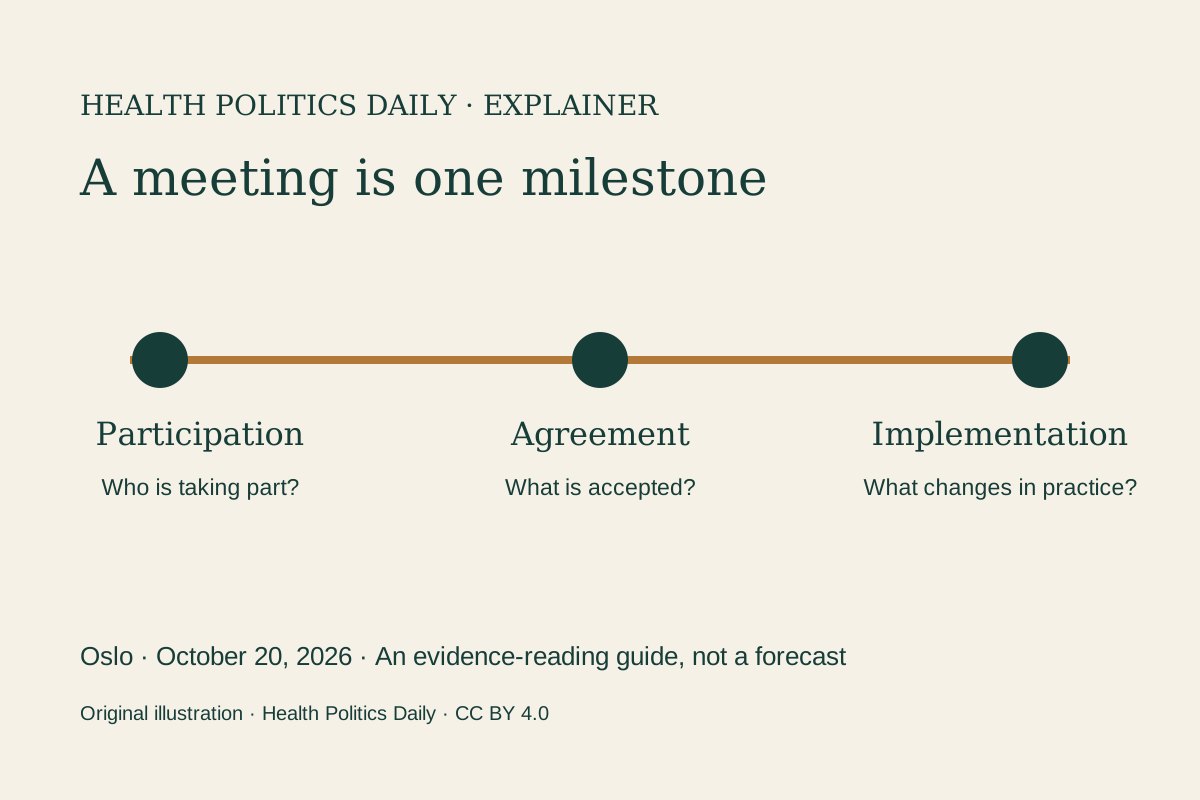
Norway confirmed on October 20 that U.S. special envoys Steve Witkoff and Jared Kushner would take part in Oslo discussions on Ukraine with President Volodymyr Zelenskyy and the leaders of Norway and Finland. The announcement establishes a diplomatic meeting—not an agreed ceasefire, a weapons-delivery decision or a settlement with Russia.
For people living through the war, the distinction matters. A meeting can create a route toward decisions, but it does not itself change an air-raid warning, restore electricity or make a damaged neighborhood safe. This report covers the confirmed agenda and participation; it does not report a concluded agreement.
What the host government has confirmed
The Norwegian prime minister’s office says Ukraine requested U.S. participation. Witkoff is to attend in Oslo, while Kushner participates remotely. The host describes the purpose as making diplomatic work more constructive, rather than announcing that the parties have resolved their differences.
A separate Norwegian release identifies Prime Minister Jonas Gahr Støre and Finnish President Alexander Stubb as participants alongside Zelenskyy. It also announces a joint press conference. Neither reviewed release supplies a signed settlement text or a ceasefire implementation timetable.
Reuters reports the meeting against deteriorating U.S.–Ukrainian relations. Its account connects the diplomacy to disagreements over Washington’s approach to Moscow. That context helps explain the attention, but a tense relationship does not by itself establish what the participants will agree.
Why the next document matters more than the meeting photograph
Analysis: Three separate tests will determine whether this round changes conditions beyond the negotiating room. First, do the participants publish concrete commitments? Second, who has accepted those commitments, including any party whose cooperation is needed? Third, what mechanism and dates would make implementation observable?
A statement of intent can be significant without being enforceable. A pause in a particular category of attacks is also different from a comprehensive ceasefire. Any future announcement should specify geographic scope, covered conduct, start time, monitoring and how alleged violations are handled before readers treat it as a general reduction in danger.
Our earlier coverage of energy-ceasefire claims and subsequent strikes explains why those distinctions matter. The report on satellite-service restrictions addresses a separate operational dispute; the Oslo participation notice does not establish that it has been resolved.
Practical implications for civilians and aid planning
Analysis: For households, local emergency instructions and verified service updates remain more actionable than speculation about a negotiating breakthrough. For organizations planning aid or repairs, a diplomatic statement should be checked against actual access arrangements and conditions on the ground. This is not a claim that access has improved or worsened because of today’s meeting.
The key information to look for next is specific: an agreed text, clearly attributed statements from the participants, confirmed changes to aid or defense arrangements, and independently observable implementation. The absence of those details in an initial participation notice is a limit on what can be concluded—not evidence that talks are certain to fail.
What remains uncertain
At publication, the primary announcements reviewed for this report do not establish the outcome of the talks, the content of any proposed settlement or whether Russia would accept it. Nor do they establish a change in battlefield conditions. Predictions about an imminent deal, a lasting breakdown or effects on energy prices would go beyond that evidence.
Bias Lens: confirmed participation, different emphases
Verified baseline: Norway confirms U.S., Ukrainian, Norwegian and Finnish participation, with Kushner remote. Participation is not proof of an agreement.
Left-leaning—The Guardian: Its briefing leads with Zelenskyy’s allegations about delayed missiles, foregrounding tensions over military support.
Center—Reuters: Its headline juxtaposes the meeting with Trump’s contrasting treatment of Russia and Ukraine, emphasizing the diplomatic relationship.
Right-leaning publisher—WELT’s dpa dispatch: It leads with the meeting and diplomatic objective; its account also pairs the weapons-delay allegation with an official rebuttal. This is agency reporting carried by WELT, not evidence that the publisher’s opinion stance determines every news item.
Reading the difference: These are specific choices about what to put first, not three incompatible sets of established facts. Allegations about motive require attribution and evidence; the host’s participation notice does not adjudicate them. The ideological labels are broad orientation aids, not verdicts on accuracy.
Sources and official video
The two October 20 Norwegian government releases anchor the confirmed facts; Reuters corroborates the diplomatic context. The original illustration separates announcement, agreement and implementation. Norway’s official event page links its press-conference broadcast. Readers can watch there; no protected footage is downloaded, embedded or rehosted here.