BANKING — CONSUMER ACCESS — FINANCIAL REGULATION
OCC Finds Nine Large Banks Used Policies That Enabled Political Debanking
The regulator says subjective standards allowed lawful customers and industries to be denied or restricted for political, religious or reputational reasons. The report announced no penalties, and the total number of affected customers remains uncertain.
By Health Politics Daily News Desk · Published Wednesday, October 14, 2026 at 2:00 p.m. America/New_York · Approximately 8 minutes
Verified Baseline
All nine banks had policies the OCC says could enable debanking
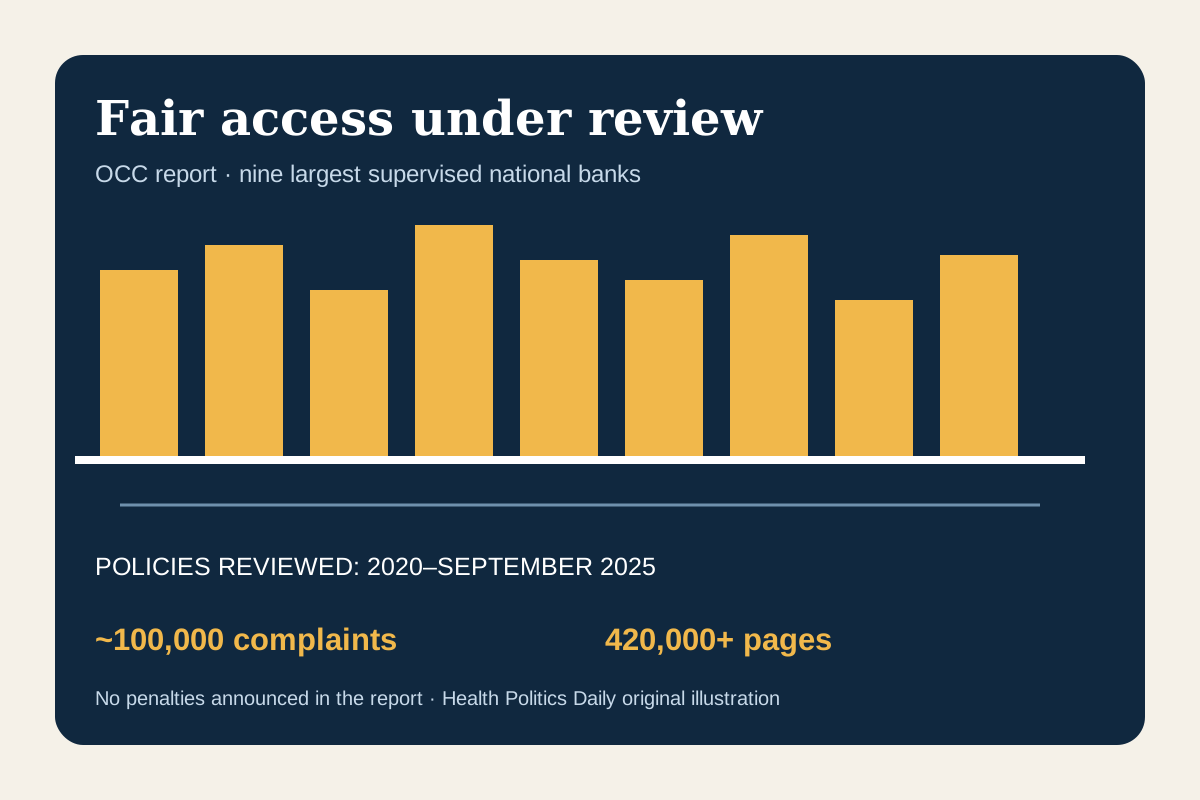
The Office of the Comptroller of the Currency said Wednesday that all nine of the largest national banks it supervises had policies between 2020 and September 2025 that could deny or limit financial services because of political or religious beliefs or otherwise lawful business activities. The banks were JPMorgan Chase, Bank of America, Citibank, Wells Fargo, U.S. Bank, Capital One, PNC, TD and BMO.
The OCC said broad “reputation risk” standards often lacked objective criteria. Its review covered nearly 100,000 complaints and about 420,000 pages of bank records. It documented restrictions involving oil and gas, coal, firearms and ammunition, private detention, tobacco and e-cigarettes, digital assets and other politically sensitive activities.
Important limit: the finding is about policies and selected decisions during a five-year period. It does not establish that every account closure was politically motivated, that all customers in those sectors were rejected or that every cited policy remains in force.
What the Evidence Shows
Examples crossed ideological lines
The report describes a payment account closed for a merchant selling Trump and MAGA merchandise, service denied to a public-education organization aligned with Democratic priorities and restrictions affecting lawful firearms businesses. The Wall Street Journal reported those examples together, underscoring that viewpoint-based access problems did not run in only one ideological direction.
Some decisions were linked to outside pressure or anticipated public reaction rather than a documented customer-specific financial risk. That is why the OCC distinguishes ordinary compliance decisions—such as fraud, money-laundering or credit risk—from exclusions driven by vague reputational judgments.
Bank Responses
Banks say risk controls, not politics, drive account decisions
Banks have denied discriminating on political or religious grounds and say they must manage legal, fraud, sanctions, money-laundering and safety risks. Reuters reported that JPMorgan said its policies prohibit political and religious discrimination and that the report covers a limited number of historical interactions among roughly 90 million customers and small businesses. The bank said it has improved its procedures.
Those defenses matter, but they do not negate the regulator’s policy findings. A bank can have a legitimate duty to decline a risky customer while still needing clear, consistently applied standards and a meaningful way to correct mistakes.
What Changes Now
The CFPB opened a follow-up investigation; penalties are not yet part of the record
The OCC said it is considering regulatory and supervisory changes and will continue examining whether anti-money-laundering and counterterrorism requirements contributed to debanking. It did not announce a fine, consent order or customer compensation program.
The Consumer Financial Protection Bureau separately announced an investigation into possible violations of federal consumer-finance laws, including rules governing equal credit opportunity, credit reporting and unfair or deceptive practices. That is an investigative step, not a finding that any named bank violated those laws.
Practical implication: a person or lawful business denied banking should keep notices, account agreements and communications; ask for the specific reason and review process; and use the bank’s complaint channel. The OCC’s HelpWithMyBank complaint portal covers national banks. This is general information, not individualized legal or financial advice.
Analysis and Uncertainty
The report identifies a governance failure but not its full scale
Analysis: the central policy issue is not whether banks must accept every customer; they do not. It is whether lawful customers are assessed through explainable financial-risk criteria instead of shifting political preferences or unbounded reputation concerns.
What remains uncertain: the OCC has not published a bank-by-bank count of improper denials, a reliable denominator showing how common the problem was, a remediation schedule or a complete account of current policies. Axios noted that the overall scale and impact remain unclear.
Forecast: banks are likely to tighten documentation, escalation and appeal processes as the OCC and CFPB continue their work. That is an inference, not an announced industrywide mandate. Opinion: Health Politics Daily takes no position on the administration’s policy; fair-access rules should protect lawful customers while preserving evidence-based controls against financial crime.
Bias Lens: whose exclusion gets emphasized?
The OCC found all nine reviewed banks had relevant policies during 2020–September 2025, documented examples affecting groups across ideological lines and announced no penalties. The overall prevalence remains unclear.
Left-leaning coverage: no major left-leaning national outlet had published a directly comparable same-day report by publication time. Forcing an older or only loosely related article into this lens would create false symmetry. Center coverage: Reuters leads with the regulatory finding, absence of penalties and banks’ risk-based defense; Axios emphasizes that liberal and conservative organizations were affected and that the scale is unclear. Right-leaning coverage: Fox Business foregrounds the regulator’s accusation and examples involving disfavored lawful industries.
The factual overlap is substantial. The main framing difference is whether the lead emphasizes proven policy failures, evidentiary limits and bank responses, or political discrimination and industry impact.
Principal Sources
Primary records and corroborating reporting
- OCC — report release and bank list, October 14
- OCC — full report
- CFPB — announced follow-up investigation
- Reuters — bank responses and enforcement context
A directly relevant Fox Business publisher video page is linked in its coverage, but clear permission for third-party embedding was not established, so no video was embedded.
Related Coverage