U.S. politics · Immigration · Travel
State Department Says More Than 300,000 U.S. Visas Have Been Revoked
The headline number marks a rapid expansion in cancellations, but the government has not published a category-by-category accounting. A revocation ends a visa’s validity for travel; it does not by itself describe every affected person’s immigration status or case.
By Health Politics Daily News Desk · October 21, 2026 at 2:02 a.m. ET

Watch in this article
Pumpjack operating at the Kern River Oil Field
A short CC0 field video provides visual context for reporting on oil production and fuel supply.
Thomas Farley / Wikimedia Commons · CC0 1.0 · License and source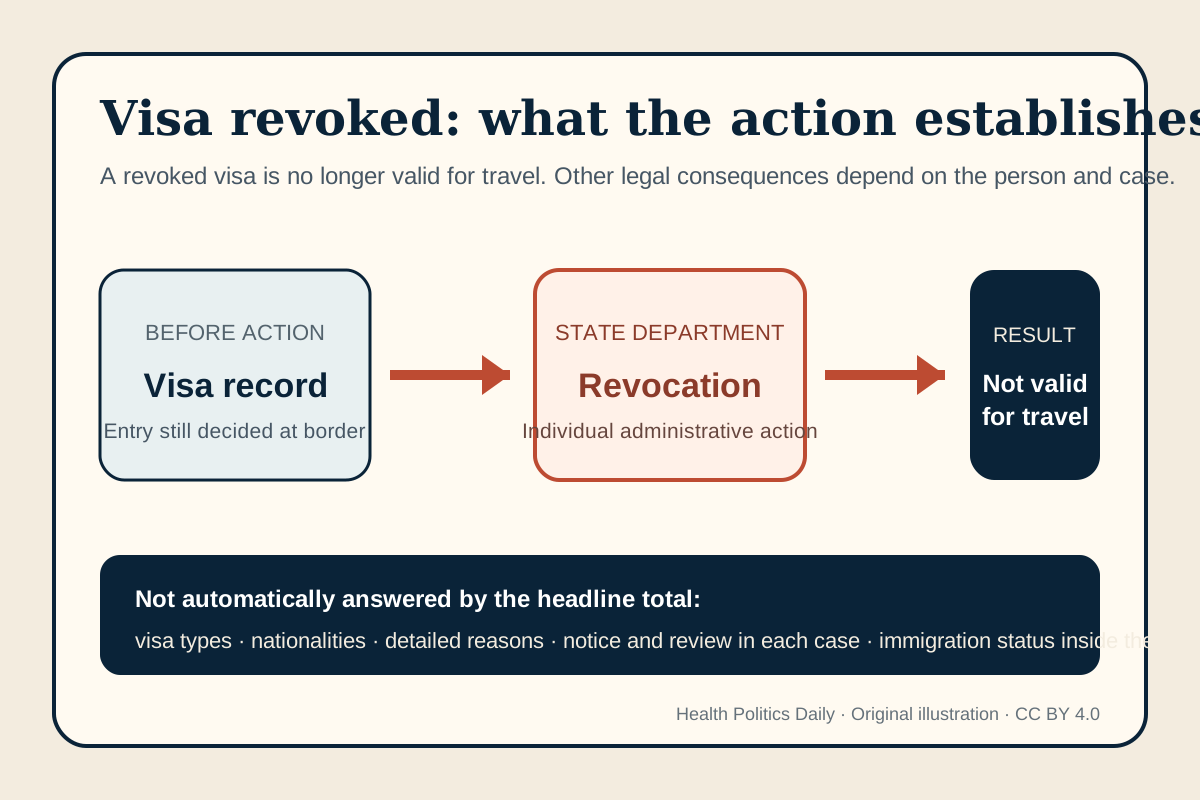
The U.S. State Department said on October 20 that the Trump administration has revoked more than 300,000 visas since President Donald Trump returned to office in January 2025. Department spokesperson Tommy Pigott described the pace as faster than under any previous administration and cited lawbreaking, fraud and national-security concerns.
The total is significant, but it is also incomplete as a public accounting. The department did not release a table showing the affected visa categories, nationalities, detailed legal grounds, how many people were inside the United States when action occurred or how many revocations were later reconsidered.
What a visa revocation means
The State Department’s official glossary defines revocation as cancellation: the visa is no longer valid for travel to the United States. A visa is a travel document that lets a person seek admission; it does not guarantee entry, which Customs and Border Protection decides at a port of entry.
Revocation and removal are not interchangeable. For someone already in the United States, the consequences can depend on the visa category, the person’s underlying immigration status, whether the revocation is immediately effective and whether another agency begins separate enforcement proceedings. A person who receives a notice should rely on the notice and qualified case-specific advice rather than the aggregate headline.
Why the new total draws scrutiny
Reuters reported that the department had announced more than 175,000 revocations as of August 10. Moving above 300,000 in roughly ten weeks signals a substantial acceleration in administrative action, even though the two public figures do not provide enough detail to calculate an exact weekly rate or compare like-for-like case categories.
The administration presents the campaign as continuous vetting designed to protect public safety and national security. Rights advocates argue that opaque standards and actions tied to political speech can burden due process and free expression. Those are competing policy and legal claims; the new numerical announcement alone cannot resolve them.
What affected travelers can verify
- Read the exact notice: the legal basis, effective date and available review may be case-specific.
- Check the issuing post: use the embassy, consulate or State Department contact listed in official correspondence, not an unsolicited intermediary.
- Do not assume travel remains authorized: the department’s definition is explicit that a revoked visa is no longer valid for travel.
- Separate visa validity from status: people in the United States may need qualified immigration counsel to understand their individual position. This article is general information, not legal advice.
What remains uncertain
The government has not published a complete breakdown of the 300,000-plus actions or enough historical data to independently test its claim of an unprecedented pace. It is also unclear how many cases involved alleged crimes, fraud, status violations, speech-related concerns, public-benefit allegations or other grounds.
Analysis: the practical importance of the announcement lies less in the round number than in the breadth and speed of continuing review. Without disaggregated data, readers should not infer that every revocation arose from the same conduct or received the same process.
Forecast: lawsuits and congressional oversight are likely to focus on notice, statutory authority, speech-related decisions and disclosure of aggregate categories. That is an evidence-based expectation, not a confirmed proceeding in every case. Opinion: Health Politics Daily takes no position on an individual revocation; publishing category-level data would make the policy easier to evaluate without exposing personal records.
Related reporting includes our explanation of the 10-day process for refugees contesting status termination and the U.S.–Myanmar talks on scam-center operations and diplomacy.
Bias Lens: security enforcement, legal process and the missing breakdown
Verified baseline: The State Department says it has revoked more than 300,000 visas since January 2025. Its official glossary says a revoked visa is canceled and no longer valid for travel. The department has not published a complete category-by-category dataset for the new total.
Left-leaning — The Guardian: Earlier coverage foregrounded civil-liberties concerns, speech-related cases and the lack of transparency. This framing asks who is affected and what process exists.
Center — Reuters: The report leads with the new total and its acceleration, then presents the administration’s security rationale alongside rights advocates’ objections.
Right-leaning — New York Post: Coverage emphasizes criminal activity, immigration violations and the administration’s enforcement statistics, placing less weight on procedural criticism.
How the framing differs: The outlets differ mainly in which consequences they foreground—government enforcement, the scale of administrative action or civil-liberties risk. None of those emphases substitutes for the unpublished case breakdown.
Principal sources
- State Department: visa glossary and revocation definition
- State Department: expanded screening and vetting announcement
- Reuters: October 20 report on the State Department total
No suitable directly relevant official or publisher-authorized video with clear embedding permission was available.