Climate · Global affairs · Public health
UNEP Says Current Climate Policies Put World on Course for 2.8°C of Warming
The UN’s annual emissions assessment says existing policy remains far from the Paris goals. Its temperature figures are conditional scenarios—not a claim that one precise outcome is inevitable.
By Health Politics Daily News Desk · October 21, 2026 at 3:58 a.m. ET

Watch in this article
Pumpjack operating at the Kern River Oil Field
A short CC0 field video provides visual context for reporting on oil production and fuel supply.
Thomas Farley / Wikimedia Commons · CC0 1.0 · License and source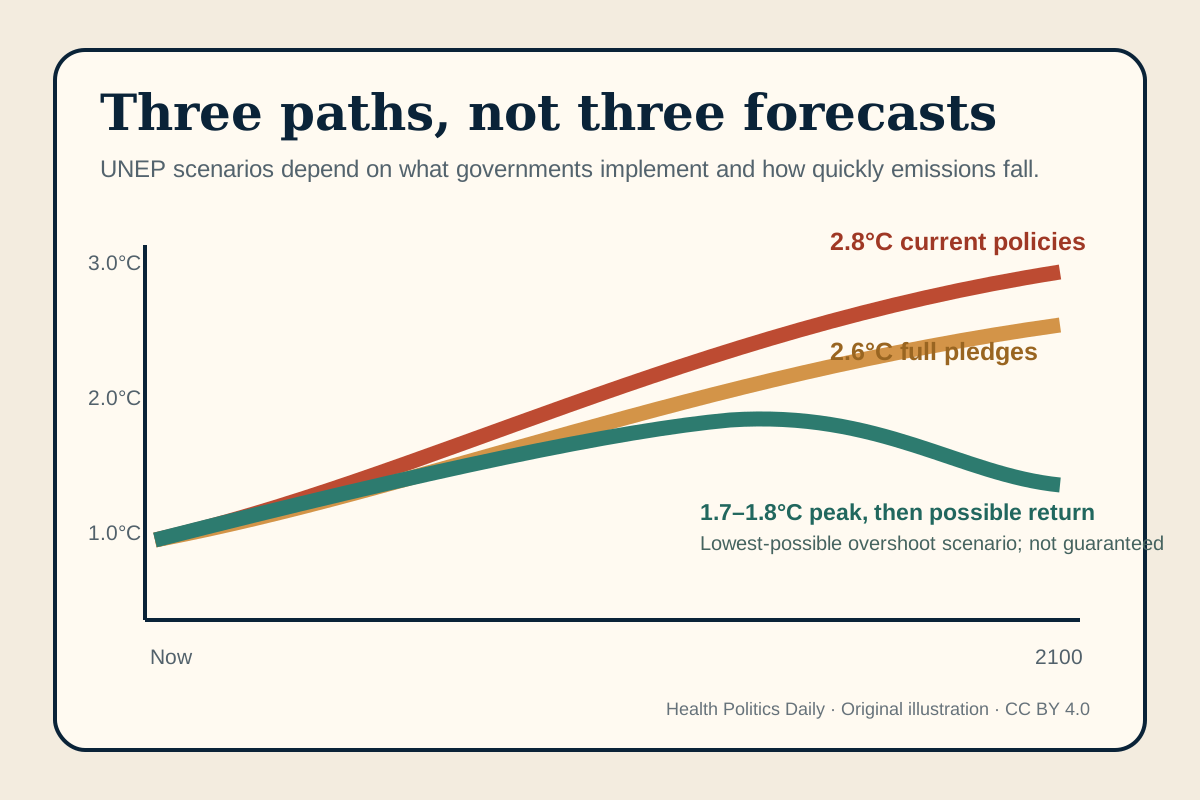
The United Nations Environment Programme’s new Emissions Gap Report 2026 says current government policies put the world on a path toward about 2.8°C of warming this century above the 1850–1900 average. Full implementation of countries’ climate pledges would reduce that estimate to roughly 2.6°C.
Neither figure is a weather forecast for a particular year or place. They are modeled global pathways conditioned on policy, emissions, technology and how the climate system responds. Decisions made after publication can change the outcome.
The emissions cuts behind UNEP’s lowest-warming pathway
UNEP examined a “lowest possible” overshoot scenario that gives roughly a 50% chance of returning global warming to or below 1.5°C by 2100. In that pathway, warming peaks around 1.7°C to 1.8°C near mid-century before declining.
Achieving it would require global greenhouse-gas emissions to fall 18% from 2025 levels by 2030, 45% by 2035 and 69% by 2040. By comparison, current national plans imply reductions of only about 5% to 8% by 2030 and 11% to 15% by 2035, according to the report.
Why “overshoot” does not mean impacts disappear
Returning a long-term global average toward 1.5°C would not undo every effect experienced during a hotter period. Heat exposure, ice loss, sea-level rise, ecosystem damage and economic disruption can persist, and some changes may be irreversible on human timescales.
The pathway also depends on large-scale removal of carbon dioxide from the atmosphere alongside rapid emissions reductions. Reforestation can help, but industrial removal remains costly and small relative to the scale contemplated. UNEP therefore treats carbon removal as part of the scenario—not a substitute for cutting fossil-fuel and methane emissions.
What the numbers mean for households and governments
The report does not prescribe one household action or predict a specific local disaster. Its practical message is about risk: every fraction of a degree avoided reduces exposure to dangerous heat, heavy rainfall, drought, wildfire conditions, crop stress and health-system pressure.
For public officials, the near-term test is whether national targets translate into enforceable standards, energy investment, methane controls, efficiency and resilient infrastructure. For individuals, local emergency alerts and health guidance remain more useful for immediate decisions than a global 2100 scenario. This article provides general information, not personalized medical or investment advice.
Why this year’s estimate changed
UNEP says the higher pledge-based estimate reflects revised historical emissions assessments and the United States’ withdrawal from the Paris Agreement. That does not mean one country alone determines the global result; the report evaluates the combined effect of policies and pledges across major emitters.
Renewable energy has expanded rapidly and policies have reduced emissions in some economies and sectors. The report’s conclusion is not that progress has stopped, but that its speed and coverage remain insufficient for the lowest-risk pathways.
What remains uncertain
Long-term temperature estimates include ranges because future emissions, policy implementation, technology, carbon-cycle responses and climate sensitivity cannot be known exactly. The feasibility, cost and social acceptance of rapid coal retirement, methane cuts and carbon removal also vary sharply across countries.
Analysis: the report’s central policy gap is between announcements and implementation. The 2.6°C pledge pathway assumes governments deliver promises that current policies do not yet support.
Forecast: COP31 negotiations are likely to focus on the 2035 gap, climate finance and whether wealthy and high-emitting countries accelerate implementation. That is an informed expectation, not a negotiated outcome. Opinion: Health Politics Daily takes no position on a particular national policy mix; transparent milestones and measured annual progress are more useful than treating a century-end number as destiny.
For related reporting, see our examination of the Supreme Court case that could reshape state climate lawsuits and the modeled heat-health risks of the current El Niño.
Bias Lens: urgency, feasibility and political responsibility
Verified baseline: UNEP projects about 2.8°C of warming under current policies and 2.6°C if climate pledges are fully implemented. Its lowest-possible overshoot pathway requires cuts of 18% by 2030, 45% by 2035 and 69% by 2040 from 2025 levels.
Left-leaning — The Guardian: Coverage foregrounds the scale of near-term cuts, methane action and the political failure to convert long-term targets into policy.
Center — Reuters and Associated Press: Both lead with the revised temperature pathways and explain why the outlook worsened, while AP gives additional attention to the U.S. contribution.
Business-focused — Financial Times: It emphasizes continued fossil-fuel emissions, policy implementation and the economic and technical difficulty of carbon removal.
No comparably detailed, timely report from a mainstream right-leaning outlet was available at publication, so this lens does not force a partisan counterpart. The meaningful framing difference is between urgency, national responsibility and implementation feasibility; the UNEP figures are the shared factual baseline.
Principal sources
- UNEP: Emissions Gap Report 2026 findings
- UNEP: official report launch page
- Reuters: independent report coverage
- Associated Press: scenario context and U.S. contribution
The article links UNEP’s official report-launch page. No separately verified, directly relevant video with clear embedding permission was added.