Global Health · Climate Policy · COP31
WHO Says Six Climate-Health Actions Could Prevent 1.6 Million Deaths a Year
The estimate arrives as the World Health Organization launches a voluntary resilience initiative before COP31. It is a modeled result under ambitious global scale-up—not an observed death count, a funding commitment or a guaranteed outcome.
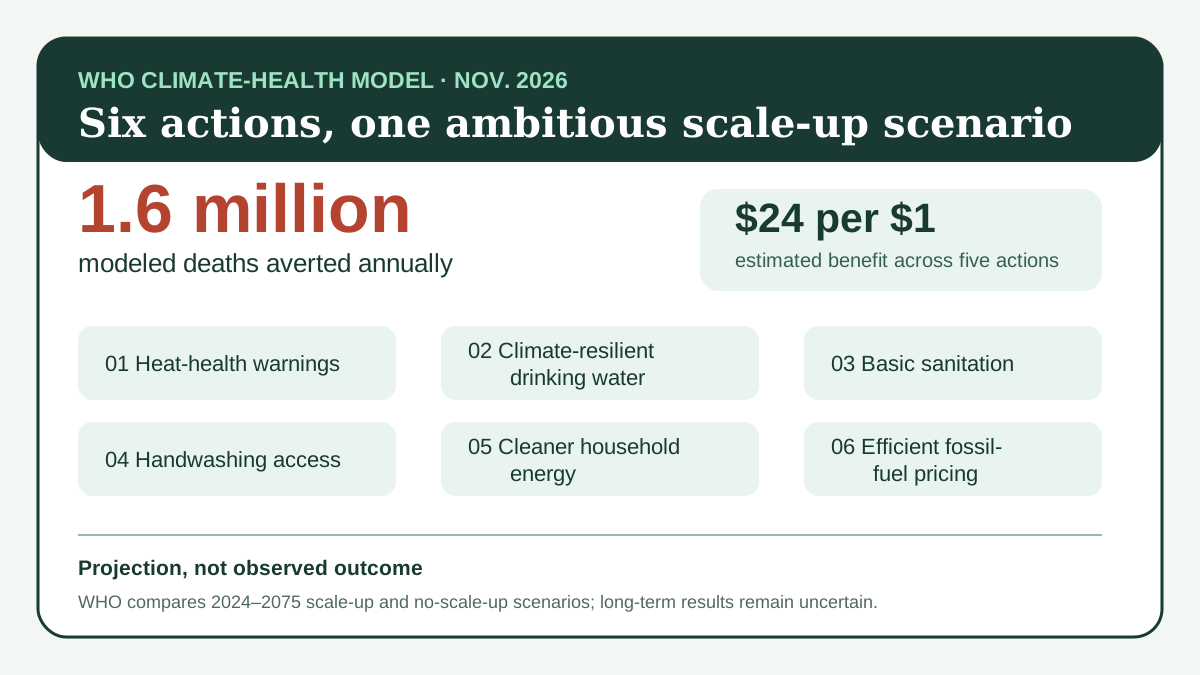
Verified baseline: a model, not an observed result
A new World Health Organization technical analysis estimates that scaling six climate-and-health interventions globally could avert about 1.6 million deaths each year. WHO says that is roughly one in every 40 deaths worldwide. The analysis also estimates $3.9 trillion in annual economic-welfare benefits and $5.4 trillion in annual fiscal benefits.
Those numbers describe a comparison between modeled scale-up and no-scale-up scenarios extending from 2024 through 2075. They are not a measured reduction, an appropriation by governments or a prediction that every country will adopt the policies. WHO identifies aspirational coverage assumptions, limited evidence and uncertainty in long-range projections among the report's constraints.
Why this is news now
The report was released Wednesday before the COP31 climate conference opens Monday in Antalya, Türkiye. On Friday, WHO also announced the Antalya Initiative for Health Resilience, or AIR, as a way for countries to share case studies, practical experience and peer learning through an existing health-and-climate alliance.
AIR is voluntary and nonbinding. It does not itself provide the trillions of dollars described by the model, require countries to change policy or settle negotiations over climate finance. Its immediate significance is institutional: it gives health ministries a forum to compare implementation as COP31 begins with a dedicated Health Day and more than 60 health events.
The timing also reflects high public and policy attention. Associated Press coverage ahead of the summit centers on implementation, fossil fuels, energy prices and who pays, while the United Nations describes COP31 as a test of cooperation amid record heat and growing energy insecurity.
The six actions WHO assessed
- Heat-health warning systems that link forecasts to public-health action.
- Climate-resilient drinking-water services designed to withstand climate hazards.
- Basic sanitation services that reduce exposure to disease.
- Handwashing facilities with water and soap.
- Cleaner household fuels and technologies for cooking and heating.
- Efficient fossil-fuel pricing, including removing inefficient subsidies and appropriately taxing fuels.
The report places unlike policies in one portfolio, so the headline total should not be read as six equal contributions. WHO estimates fossil-fuel pricing accounts for about 1.2 million of the 1.6 million avoided deaths and all of the modeled $5.4 trillion fiscal benefit. Heat-warning systems have a very high estimated benefit-cost ratio because they can use existing forecasting and communications infrastructure at relatively low cost.
What the dollar figures do—and do not—mean
Across the five actions for which WHO calculated both benefits and implementation costs, the model estimates about $24 in benefits for each $1 spent. That ratio combines monetized health, environmental and economic effects. It is not the same as $24 returned directly to a health department's budget.
The $3.9 trillion economic-welfare estimate and $5.4 trillion fiscal estimate also measure different things. Welfare benefits include the monetary value assigned to changes in mortality, emissions, productivity and efficiency. Fiscal benefits primarily reflect changed government revenue from fossil-fuel pricing. Presenting the figures side by side is useful, but simply adding them can obscure their different categories and distributional effects.
Pricing fossil fuels may reduce pollution and raise public revenue, but it can also raise energy or transportation costs before households and businesses adapt. Whether a policy is progressive or regressive depends on design, including rebates, public services and support for lower-income households. The WHO model establishes a global benefit case; it does not choose those domestic policy details.
Practical implications
- For health systems: heat alerts, safe water and resilient facilities can be budgeted as health protection rather than treated only as environmental programs. Local capacity and reliable financing still determine whether they work.
- For households: the report supports cleaner air, safer water and heat preparedness at population scale. It does not replace local public-health guidance or provide personalized medical advice.
- For governments: the model supplies a common economic framework, but AIR creates no legal duty and COP31 does not automatically convert the estimates into funded projects.
- For workers and consumers: fossil-fuel pricing can change prices and jobs. Distributional safeguards and transition policy matter even when the modeled net benefit is positive.
- For investors: the estimates may inform long-term policy analysis but are not revenue forecasts for particular companies or personalized investment advice.
Fact, analysis, forecast and opinion
Verified fact: WHO published a model covering six interventions and estimates 1.6 million fewer deaths annually under its scale-up scenarios; AIR is a voluntary knowledge-sharing initiative launching before COP31. Analysis: the report's strongest practical contribution is to connect familiar public-health measures with economy-wide energy policy, while showing that most modeled mortality benefit comes from one intervention. Forecast: delegates may cite the $24-to-$1 estimate in negotiations, but whether it changes national budgets or COP31 text is unknown. Opinion: Health Politics Daily does not endorse a party, negotiating bloc, tax design or fuel policy.
What remains uncertain
The analysis depends on how quickly and widely countries scale each intervention, the baseline chosen for comparison, the monetary value assigned to health outcomes and the quality of underlying evidence. WHO says some interventions were modeled separately rather than as interacting policies, so overlaps or synergies may differ in practice. Costs and benefits will also vary by country, and results projected decades ahead become less certain over time.
COP31 outcomes are uncertain too. A voluntary exchange can spread useful practice, but it cannot substitute for money, staffing, legislation or accountability. The clearest near-term test is whether governments publish specific, funded implementation plans—not whether they repeat the global headline number.
Bias Lens: health payoff, fossil-fuel conflict or implementation test?
Verified baseline: WHO modeled six actions under ambitious global scale-up and estimated 1.6 million fewer deaths per year. The result is not observed, and AIR is voluntary rather than binding or funded.
Left-leaning — The Guardian: its COP31 preview foregrounds the fossil-fuel dependence of the summit's hosts and pressure for a coal phaseout. That framing makes WHO's fuel-pricing intervention the political center of the story. Center — Associated Press: emphasizes the summit's combined pressures—warming, energy-price shocks, implementation and finance—placing health benefits inside a wider negotiation over affordability and responsibility.
Right-leaning coverage: a search at publication did not identify substantial original coverage from a mainstream right-leaning outlet focused on this WHO model. We do not substitute an unrelated climate article or fringe source to manufacture symmetry. The absence is itself a coverage difference, not evidence for or against WHO's estimates.
The framing gap matters: a health-benefit lens highlights preventable deaths; a fossil-fuel lens highlights the biggest modeled lever; an implementation lens asks who pays and whether policies survive energy-price politics. None changes the model's assumptions, which should be checked in the technical report.
Principal sources
- WHO — Global benefits and costs of prioritized actions on climate change and health
- WHO — technical report summary and methodology note
- WHO — COP31 Health Day and Antalya Initiative update
- United Nations — COP31 dates and official overview
- Associated Press — COP31 negotiation and energy context
No directly relevant official or publisher-authorized video with clear embedding permission was available at publication, so no video was embedded.
No comments yet.