International Policy · Climate Finance · COP31
UN Says $28–32 Billion in Adaptation Finance Trails $305 Billion Need
The figures are not a same-year budget comparison: the first measures international public flows in 2024; the second estimates developing countries' annual needs in 2035. The gap still shows why adaptation will dominate negotiations at COP31.
By Health Politics Daily News Desk · November 4, 2026 at 6:00 p.m. ET

Watch in this article
Pumpjack operating at the Kern River Oil Field
A short CC0 field video provides visual context for reporting on oil production and fuel supply.
Thomas Farley / Wikimedia Commons · CC0 1.0 · License and source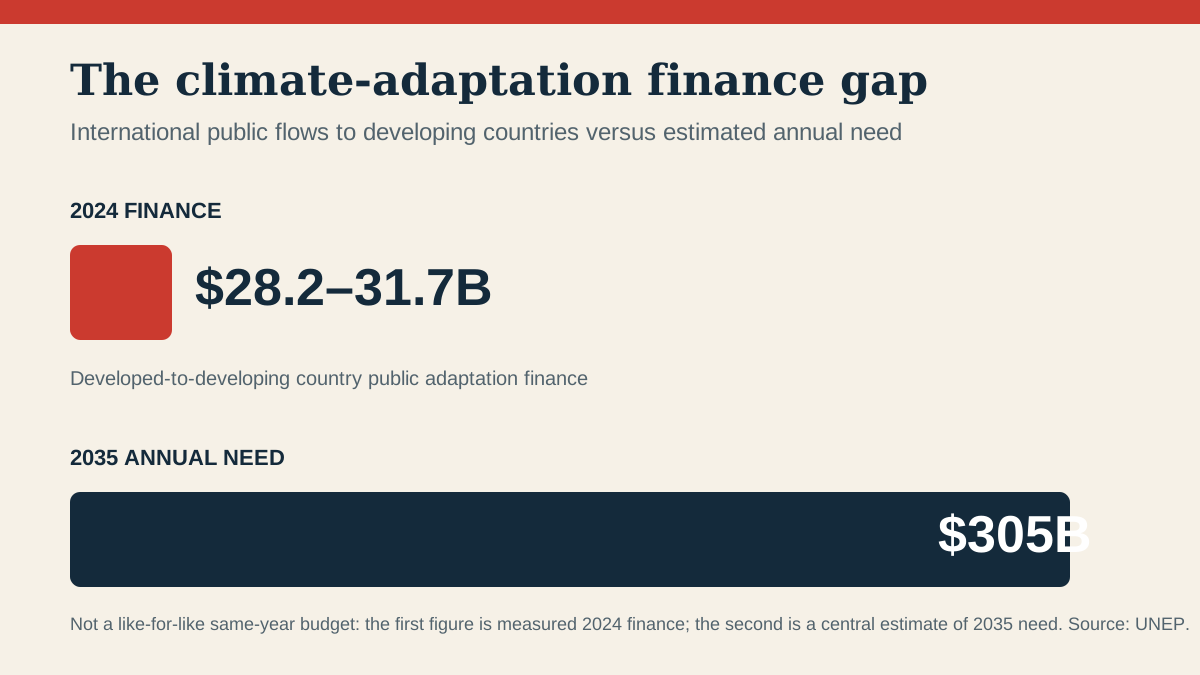
Verified baseline
International public finance from developed to developing countries for climate adaptation reached an estimated $28.2 billion to $31.7 billion in 2024, the United Nations Environment Programme reported November 4. UNEP's central estimate says developing countries will need about $305 billion a year by 2035 for adaptation measures.
The 2026 Adaptation Gap Report, released days before COP31 opens in Antalya, Türkiye, finds that even a tripling of international public adaptation finance by 2035 would produce roughly $85 billion to $120 billion a year after inflation adjustments—only 20% to 29% of estimated need.
What adaptation finance pays for
Adaptation reduces damage from climate hazards that can no longer be avoided. Depending on local priorities, projects can include heat-warning systems, flood defenses, drought-resilient crops, water storage, wildfire planning, disease surveillance, stronger buildings and cooling in schools and hospitals.
This is distinct from mitigation, which reduces greenhouse-gas emissions, and from loss and damage funding, which responds when climate harms occur despite—or in the absence of—adaptation. The three categories can overlap in practice, but they serve different policy purposes and use different financing channels.
How UNEP arrived at $305 billion
The estimate synthesizes costs identified in national climate plans with model-based studies of future adaptation needs. It is a central estimate for 2035, not an exact invoice and not a claim that every listed project would produce equal benefits. UNEP says the figure largely excludes the private sector's own adaptation needs, which could nearly double the total.
The reported 2024 finance range also reflects uncertainty. Different accounting methods can treat loans, grants, private mobilization and projects with multiple objectives differently. Comparing $28.2–31.7 billion in 2024 with $305 billion in 2035 illustrates scale, but it does not measure a same-year shortfall dollar for dollar.
Why tripling still leaves most needs unmet
At COP30, governments called for efforts to at least triple adaptation finance by 2035. The outcome depends on the baseline: tripling recent flows produces less than tripling the earlier Glasgow target. UNEP estimates either path would leave more than 70% of needs uncovered.
Least-developed countries and small-island developing states face particularly high risks and limited borrowing capacity. The report says tripling flows directed specifically to those groups could cover 49% to 84% of their estimated needs, a much larger share than the global developing-country figure.
What the gap means for people
Funding totals become tangible when a city cannot expand drainage before heavier rain, a health system lacks cooling during extreme heat or farmers cannot obtain drought-resilient seed and water infrastructure. Delayed adaptation can increase emergency spending, insurance losses, displacement and interruptions to schools, clinics and livelihoods.
Money alone does not guarantee protection. UNEP identifies permitting, staffing, project preparation, cross-government coordination and complex access rules as barriers. A well-funded project can still fail if affected communities are excluded, maintenance is unfunded or benefits do not reach the people most exposed.
Loss-and-damage demand adds another pressure
The first funding round for the Fund for responding to Loss and Damage received requests worth $2.8 billion against an initial envelope of $342 million. UNEP says this demonstrates substantial unmet demand but does not yet establish a global loss-and-damage finance gap.
That distinction prevents double counting. Adaptation aims to reduce future harm; loss-and-damage support addresses harms that occur. Neither total should be assumed to substitute fully for the other.
Practical implications ahead of COP31
- Negotiators: must decide what counts toward the tripling aspiration, which baseline applies and how finance will be divided among grants, concessional loans and other instruments.
- Developing-country governments: need project pipelines and institutions capable of accessing funds while avoiding unsustainable debt.
- Communities: may gain more durable protection when they help set priorities and monitor delivery, rather than being consulted after design.
- Businesses and households: public adaptation can reduce shared risks, but it does not eliminate private insurance, resilience or relocation decisions.
Fact, analysis, forecast and opinion
Verified fact: UNEP estimates $28.2–31.7 billion in 2024 international public adaptation finance and $305 billion in annual developing-country needs by 2035. Analysis: the gap reflects both insufficient money and difficulty converting plans into maintained projects. Forecast: adaptation finance will be a central COP31 dispute; no negotiated outcome or future flow is guaranteed. Opinion: Health Politics Daily takes no position on a preferred financing formula. Claims about success should track accessible funding and completed protections, not pledges alone.
Bias Lens: obligation, investment or accounting problem?
Verified baseline: UNEP reports a wide gap between current international public finance and modelled future adaptation needs, while warning that institutions and implementation matter alongside funding.
Left-leaning — The Guardian: emphasizes historical responsibility, debt costs and demands for grant-based support. Center — Reuters: foregrounds the funding totals, COP commitments and the limited coverage even after tripling. Right-leaning coverage: no substantial original report on this specific release was available at publication, so adding an unrelated or fringe source would create false symmetry.
The Guardian's justice frame and Reuters' finance-and-negotiation frame answer different questions. Neither changes the report's accounting caveats or proves which mix of grants, loans, domestic spending and private investment is optimal.
What remains uncertain
The eventual 2035 need will depend on warming, development, exchange rates, project costs and how quickly adaptation is built. The report cannot establish how much private finance will be mobilized, whether the 2025 doubling goal was met or which COP31 commitments will be implemented. Estimates also cannot capture every informal or locally funded resilience measure.
Principal sources
- UNEP — Adaptation Gap Report 2026 and executive summary
- UNEP — November 4 report release and key findings
- Reuters — COP31 and finance context
- United Nations — adaptation and 1.5°C context
No suitable directly relevant authorized video with clear persistent embedding permission was available at publication.
No comments yet.