Finance · Canada · Federal Budget
Canada Budget 2026 Projects C$62.3 Billion Deficit With Housing and Energy Investments
Ottawa’s plan pairs a smaller near-term deficit with major housing, electricity and investment commitments. The headline figures are projections, and most new measures still depend on legislation, regulations or delivery agreements.
What the budget says
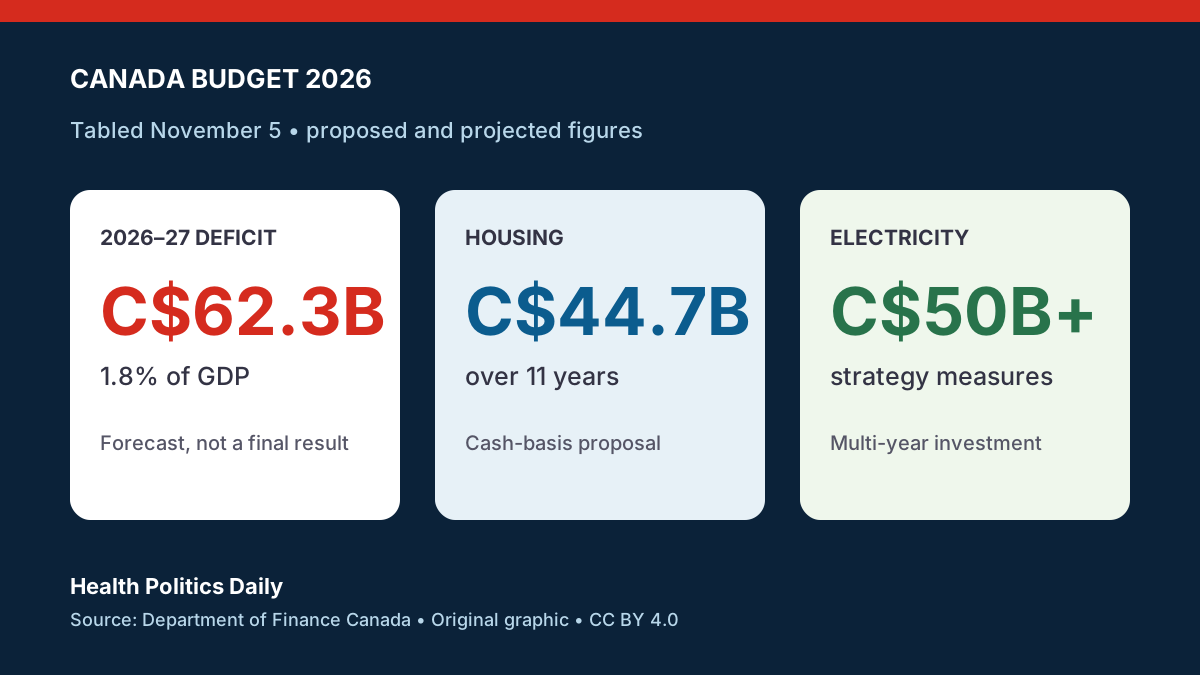
Finance Minister François-Philippe Champagne tabled Budget 2026 on Thursday. The government projects a C$62.3 billion deficit in fiscal 2026-27, equal to 1.8% of GDP. It forecasts the deficit at C$62.5 billion next year before it declines to C$52.9 billion in 2030-31, or 1.3% of GDP.
The plan says stronger nominal growth and fiscal developments created C$21.5 billion of room this year compared with the spring update. New policy actions and budget measures then use C$18.4 billion of that room. Those are accounting projections, not cash already collected or spent.
What could change for households
- Groceries and essentials: a one-time 50% increase in the 2026-27 benefit, delivered in early 2027, would pay up to C$339 for a single person without children and C$679 for a couple with two children.
- Caregivers: a proposed refundable Canada Caregiver Credit would provide up to C$1,260 annually in 2027, indexed afterward.
- Housing: the budget describes C$44.7 billion over 11 years on a cash basis for non-market housing, homelessness reduction and housing supply.
- Home energy: more than C$2 billion is proposed for heat-pump rebates, with the government saying as many as 820,000 households could receive help.
- Health services: C$1.2 billion in 2027-28 would extend federal agreements for mental-health, addictions, and home and community care.
Eligibility, timing and provincial participation will determine what any household actually receives. This article is general reporting, not personal financial or benefits advice.
Growth and infrastructure are the larger bet
The government proposes more than C$50 billion for a national electricity strategy, C$44.7 billion in housing measures and C$2.3 billion for critical minerals. It also makes its Productivity Mega Deduction central to the plan, saying the tax change would lower the projected marginal effective tax rate on new business investment from 13% to 6.4%.
The budget’s own modelling estimates the full package could lift the level of real GDP by 0.9%, real GDP per person by about C$800 and employment by about 50,000 jobs by 2030. Those are government model results, not observed outcomes. They depend on private investment, project execution and assumptions about trade, energy prices and productivity.
How the fiscal claims should be read
The government says its operating budget will balance in 2027-28 and that the deficit-to-GDP ratio will decline across the planning horizon. The independent Parliamentary Budget Officer had projected a C$63.3 billion deficit for this year before seeing the new budget, but warned that under the earlier policy set the deficit ratio would not fall every year. The two documents are not directly contradictory: the PBO explicitly excluded Budget 2026 measures and used its own economic assumptions.
Federal debt is projected at 39.9% of GDP this year, rising to 40.4% in 2028-29 and then easing to 40.1% by 2030-31. A falling annual deficit ratio does not mean the nominal debt is shrinking; deficits still add to debt.
Fact, analysis, forecast and opinion
Verified fact: the tabled budget projects a C$62.3 billion deficit for 2026-27 and proposes the measures above. Analysis: higher revenues provide room for new commitments without worsening the near-term deficit relative to the spring update. Forecast: deficit, growth and job figures are estimates that can change with oil prices, interest rates, tariffs and delivery. Opinion: Health Politics Daily takes no position on the size of government, the tax mix or the appropriate level of borrowing.
Bias Lens: investment plan or fiscal risk?
Verified baseline: Budget 2026 projects a C$62.3 billion deficit in 2026-27; the ratio is 1.8% of GDP and is forecast to decline to 1.3% by 2030-31. Finance Canada says fiscal measures introduced since the spring update provide about C$151 billion in net support over 2026-27 to 2030-31, excluding debt charges.
At publication, full post-release reporting from clearly left-, center- and right-leaning publishers was not yet available, so forcing a three-way comparison would manufacture symmetry. The left-leaning Canadian Centre for Policy Alternatives entered budget day arguing for a larger public role in housing, care and climate investment. Centrist Reuters foregrounded economists’ concern that temporary oil revenue could mask longer-run fiscal pressure. Market-oriented C.D. Howe Institute emphasized spending restraint, productivity and preserving room for future shocks.
These are different policy priorities, not different versions of the tabled numbers. The most useful test is whether promised investments are implemented on time, whether household measures reach eligible people and whether deficits follow the published path.
What remains uncertain
Parliament must approve implementing legislation and tax changes. Regulations, intergovernmental agreements and program design will shape delivery. The budget also assumes that real GDP grows 1% in 2026 and 1.7% in 2027; renewed trade restrictions, persistent energy disruption or higher borrowing costs could change revenues and expenses. The government’s higher-investment scenario improves the annual balance by an average C$3 billion, while its supply-disruption scenario worsens it by an average C$2.2 billion.
For context, read our coverage of Canada’s C$1.6 billion Cohere investment and the Bank of Canada’s rate increase.
Principal sources
- Department of Finance Canada — economic and fiscal overview
- Department of Finance Canada — key measures
- Parliamentary Budget Officer — October outlook
- Reuters — pre-budget fiscal context
CPAC’s authorized Budget 2026 page carries the finance minister’s speech and reaction. It is linked rather than embedded so CPAC retains playback and accessibility controls.
No comments yet.