Finance · Canada · Interest Rates
Bank of Canada Raises Policy Rate to 2.5% as Inflation Outlook Worsens
Canada’s central bank delivered its first increase since July 2023, citing resilient growth and the risk that higher energy and transport costs spread more broadly.
By Health Politics Daily News Desk · October 28, 2026 at 12:00 p.m. ET

Verified baseline
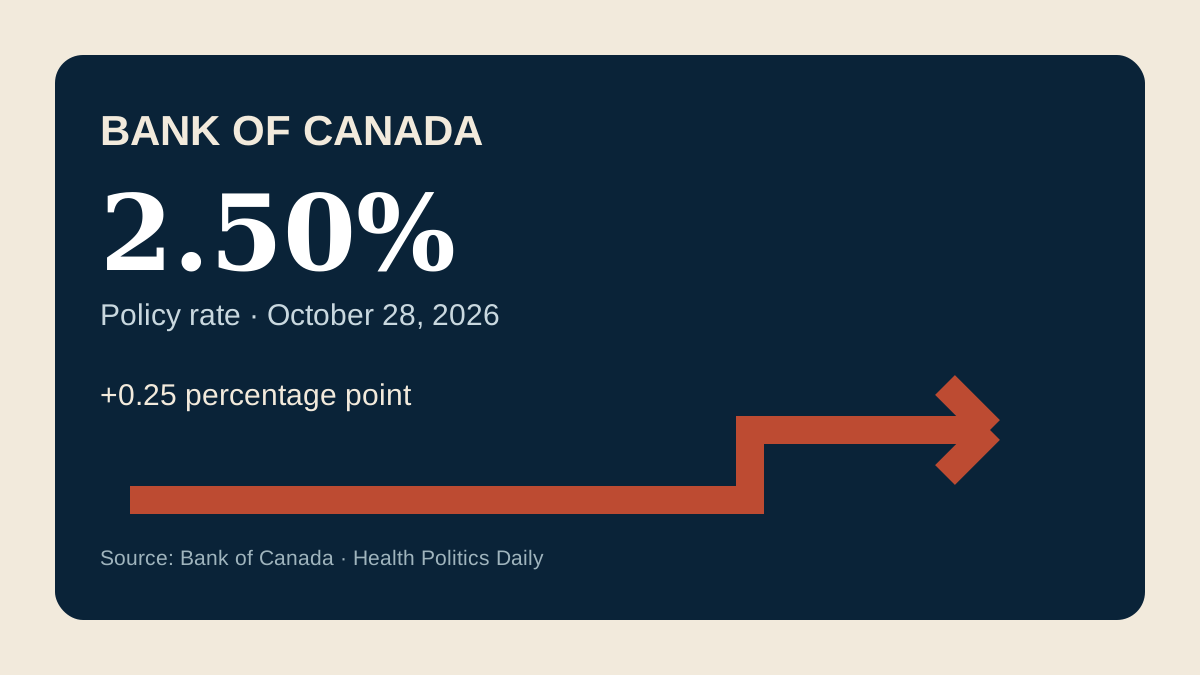
The Bank of Canada increased its target for the overnight rate by a quarter percentage point to 2.5% on Wednesday. The Bank Rate is now 2.75% and the deposit rate 2.45%. Governor Tiff Macklem said another increase could be needed, but decisions will be made one meeting at a time.
This is the first policy-rate increase since July 2023. It was widely expected by financial markets, though a Reuters survey was divided: 19 of 34 economists predicted an increase.
Why the bank tightened
Canadian inflation has been near 3% since April and the bank expects it to reach about 3.5% by year-end. Excluding gasoline, September inflation was 2.2%, and core measures remain near 2%. The concern is that persistently high oil prices, refinery margins and transport costs will be passed through into a wider range of prices.
Economic growth has also been stronger than expected. The bank estimates second-quarter GDP growth at 3.3% and about 2% in the third quarter, while unemployment has remained around 6.5%. It now projects 1% growth in 2026 and 2% in both 2027 and 2028.
The forecast changed materially
The October Monetary Policy Report projects inflation around 3% through much of 2027, one percentage point above the July forecast, before returning close to 2% in mid-2028. That is a forecast, not a measured outcome. Energy prices, the Middle East conflict, U.S. trade policy and business pricing behavior remain major uncertainties.
Practical implications
- Variable-rate borrowers: prime-linked loans and lines of credit may become more expensive, depending on lender decisions.
- Fixed-rate mortgages: pricing also reflects bond yields and funding costs, so it does not move mechanically with the overnight rate.
- Savers: some deposit rates may rise, but institutions choose how much and when to pass through a policy change.
- Businesses and households: higher borrowing costs can restrain spending even as fuel and transport costs remain elevated.
This is general economic reporting, not personal financial advice.
Fact, analysis, forecast and opinion
Verified fact: the overnight-rate target rose to 2.5%. Analysis: the bank is acting against the risk of energy inflation spreading, not because core inflation has already surged. Forecast: the bank projects inflation near 3% through much of 2027, but that path can change. Opinion: Health Politics Daily takes no position on the appropriate rate.
For comparison, see our coverage of New Zealand’s surprise decision to hold, Australia’s inflation increase and the global inflation outlook.
Bias Lens: inflation control or household burden?
Verified baseline: the policy rate is 2.5%, the increase was 25 basis points and the next scheduled decision is December 9.
Early coverage is more economic than partisan. The Bank of Canada emphasizes inflation persistence and resilience; centrist Reuters foregrounds the first increase in more than three years; business-oriented Wall Street Journal framed the decision within a global turn toward tighter policy. No comparably substantive, clearly left-leaning original report was available at publication, so this lens avoids invented symmetry and unsupported labels.
What remains uncertain
The bank may raise again, hold or later reverse course. The next decision depends on energy prices, cost pass-through, inflation expectations, trade policy and demand. Its own forecast says uncertainty remains elevated.
Principal sources
The article links to the Bank of Canada’s official press-conference video page; it was not embedded because persistent third-party embedding permission was not clear.
No comments yet.