Finance · Global economy · Inflation
Economists Raise 2027 Inflation Forecasts in 31 of 50 Economies
The revisions suggest price pressure is spreading beyond energy even as growth remains resilient. They are professional forecasts—not guarantees that every country or household will experience the same outcome.
By Health Politics Daily News Desk · October 27, 2026 at 9:55 a.m. ET
Verified baseline
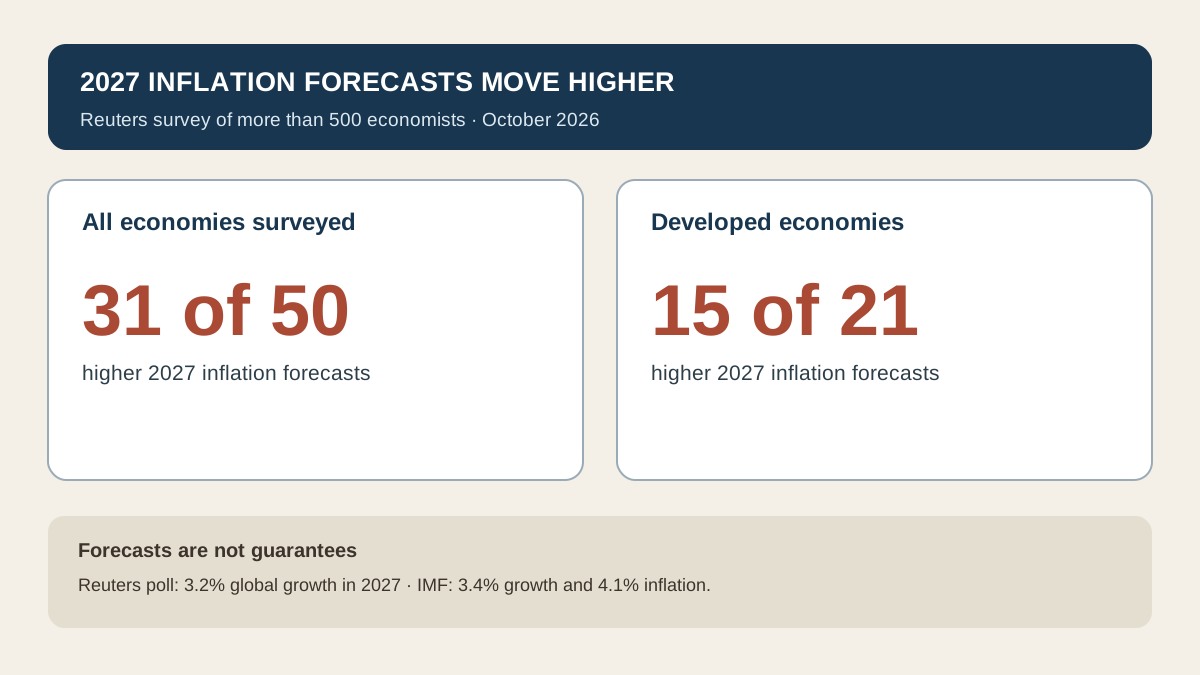
More than 500 economists surveyed by Reuters raised their 2027 inflation forecasts for 31 of 50 economies compared with the previous quarterly poll. Forecasts increased in 15 of the 21 developed economies covered.
Across the last three quarterly surveys, median 2027 forecasts rose by 0.7 percentage points for Britain, 0.5 points for the euro area and Brazil, 0.4 points for India and 0.2 points for the United States. These are revisions to expectations, not measured inflation rates.
Why forecasts moved higher
Oil has remained above $100 a barrel since October 7 and was more than 60% above its level when the U.S.-Israel conflict with Iran began, Reuters reported. The World Bank says its energy-price index rose 25.7% in September, including increases of 21.2% for crude oil and 15.3% for natural gas. Energy costs can feed into transportation, production, fertilizer and food prices.
Economists are increasingly concerned about those costs moving into broader core-price measures. That pass-through can make inflation more persistent and harder for central banks to reverse quickly.
Growth forecasts also improved
The survey raised global growth estimates to 3.0% for 2026 and 3.2% for 2027, from 2.9% and 3.1% in July. Strong artificial-intelligence investment and firmer activity in several regions are supporting demand even as household budgets face higher prices.
The International Monetary Fund projects 3.4% global growth and 4.1% headline inflation in 2027. Its baseline used information available through October 1 and may not incorporate every later market move.
What it could mean for households and borrowers
If inflation stays above central-bank targets, interest rates may remain higher for longer or rise again. That can keep mortgages, business loans and government borrowing expensive. Effects will differ: energy-importing households and countries generally face greater exposure, while exporters or economies benefiting from technology investment may be more resilient.
This is not personalized financial advice. Health Politics Daily has separately explained why mortgage-cost measures do not guarantee lower payments and how oil supply risks can reach household costs.
Fact, analysis, forecast and opinion
Verified fact: economists raised 2027 inflation forecasts for 31 of 50 surveyed economies. Analysis: the breadth of revisions indicates concern about price transmission beyond fuel. Forecast: Reuters' median projections put global growth at 3.2% in 2027, while the IMF projects 3.4%; neither is certain. Opinion: Health Politics Daily favors targeted, temporary support for vulnerable households and transparent central-bank communication.
Bias Lens: household squeeze, central-bank discipline or resilience?
Verified baseline: 2027 inflation forecasts rose in 31 of 50 economies in the Reuters survey, while global growth forecasts also improved.
Left-leaning coverage: The Guardian emphasizes effects on low-income families. Center coverage: Reuters centers forecast breadth, energy pass-through and AI-supported growth. Right-leaning coverage: Fox Business focuses on elevated U.S. inflation and constraints on Federal Reserve flexibility.
These frames emphasize different consequences of the same pressures; none shows that one policy response fits all 50 economies.
What remains uncertain
The duration of conflict, oil supply, tariffs, wages and AI-investment returns could all change the outlook. Falling energy prices could lower inflation faster; broader conflict or stronger cost pass-through could keep it higher.
Principal sources
No suitable official or publisher-authorized video with clear downstream embedding permission was available, so no video was embedded.