Finance · Australia · Inflation
Australia Inflation Rises to 4.3% as Housing and Transport Costs Climb
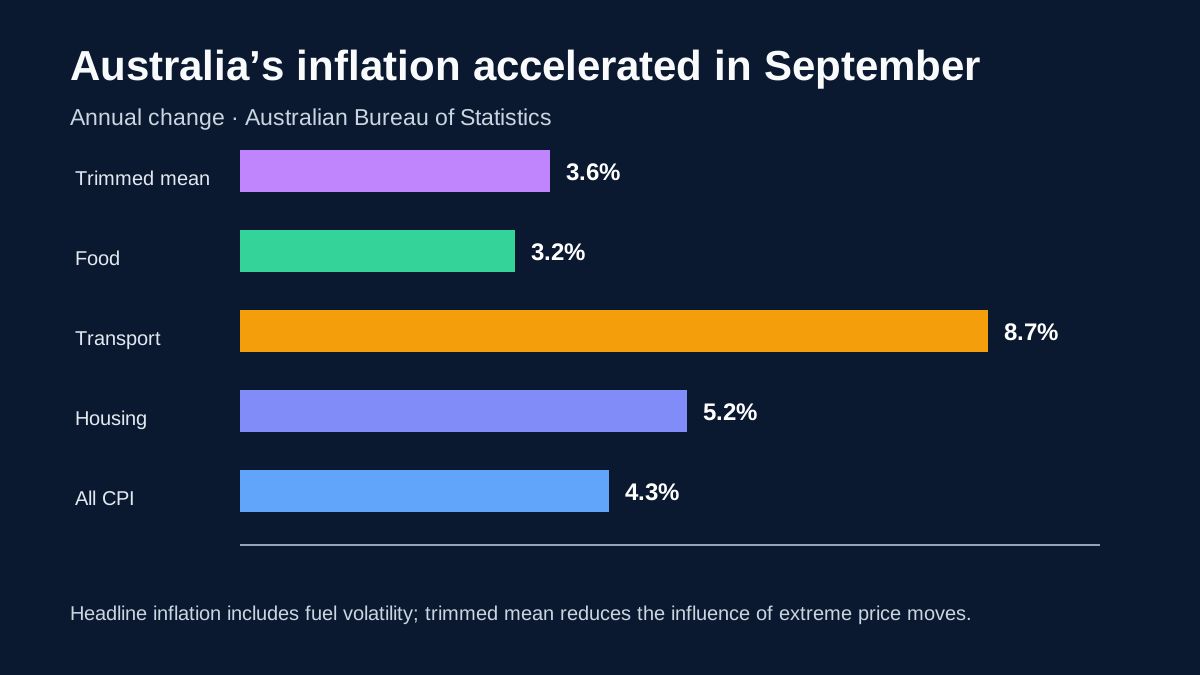
Consumer prices accelerated in September, with housing up 5.2% and transport up 8.7% over the year. Markets increased bets on another rate rise, but the Reserve Bank has not made its November 3 decision.
By Health Politics Daily News Desk · October 28, 2026 at 6:03 a.m. ET
Verified baseline
Australia’s Consumer Price Index rose 4.3% in the 12 months through September, up from 4.0% in August, the Australian Bureau of Statistics reported Wednesday. Prices rose 0.8% during September on the original monthly measure and 0.6% after seasonal adjustment.
The quarterly CPI increased 1.3%, compared with 0.6% in the June quarter. The trimmed mean—a measure that reduces the influence of unusually large price movements—rose 1.0% in the quarter and 3.6% over the year. Both headline and underlying inflation remain above the Reserve Bank of Australia’s 2%–3% target range.
Housing and transport drove the increase
Housing was the largest contributor to annual inflation, rising 5.2%. New-dwelling prices increased 4.7% as builders passed through higher material and labor costs. Transport prices rose 8.7%, with automotive fuel up 9.4% in September alone amid higher world oil prices.
Food and nonalcoholic beverages rose 3.2%, including a 3.9% increase for restaurant meals and takeaway food. Health prices rose 3.7%, education 4.7% and insurance and financial services 3.9%. These are national averages: an individual household’s experience depends on what it buys, where it lives and whether it rents, owns or has a mortgage.
What this means for interest rates
The Reserve Bank of Australia currently has a 4.60% cash-rate target and will announce its next decision on November 3. Reuters reported that market pricing moved to imply roughly an 85% chance of a quarter-point increase after the data, up from about 69% beforehand. That is a market probability, not a promise or an official forecast.
The Monetary Policy Board must balance inflation against employment and broader economic conditions. A higher rate can restrain demand but also raises borrowing costs for many households and businesses. The CPI release strengthens the case for tighter policy; it does not predetermine the vote.
Practical implications for households
- Borrowers: variable loan rates may rise if the RBA tightens, but individual lender timing and products vary.
- Renters and homebuyers: the CPI’s housing component includes new dwellings, rents and utilities; it is not a house-price index.
- Drivers and businesses: fuel was a major volatile contributor, so later oil-price changes could move headline inflation in either direction.
- Savers: deposit rates may change after a policy move, but banks do not pass through every cash-rate adjustment equally.
This is general economic reporting, not personal financial advice.
Fact, analysis, forecast and opinion
Verified fact: annual CPI rose to 4.3%, trimmed mean inflation to 3.6%, and the cash rate is 4.60%. Analysis: broad underlying inflation and large housing increases make the report more consequential than a fuel-only spike. Forecast: another rate increase is now widely expected, but the RBA decision and future inflation path remain uncertain. Opinion: Health Politics Daily takes no position on the appropriate cash rate and favors clear disclosure of the tradeoffs facing households.
Why this is distinct from global forecasts
Our recent report on economists raising 2027 inflation forecasts covered professional projections across 50 economies. This article concerns measured Australian prices already recorded through September. A forecast can change without prices changing; the ABS release is an official observation subject to later seasonal revisions.
For broader monetary-policy context, see our reporting on how rate decisions affect borrowing costs and China’s unchanged loan prime rates.
Bias Lens: cost-of-living pressure or case for tighter policy?
Verified baseline: annual CPI is 4.3%, trimmed mean inflation is 3.6%, and the RBA’s next decision is November 3. No rate decision has been announced.
Left-leaning — The Guardian Australia: emphasizes household pressure, wages and the risks another increase would pose to borrowers. Center — Reuters: foregrounds the market repricing, quarterly figures and central-bank decision. Right-leaning — The Daily Telegraph: stresses persistent inflation and the likelihood of tighter policy. The difference is emphasis—distributional cost versus inflation control—not disagreement about the ABS data.
What remains uncertain
The RBA may raise, hold or choose another policy path on November 3. Future inflation will depend on oil prices, housing and labor costs, demand, exchange rates and government policy. Monthly data can be volatile, and the ABS revised August trimmed mean inflation from 3.6% to 3.5% after seasonal-factor changes.
Principal sources
- Australian Bureau of Statistics CPI release
- ABS media release
- Reserve Bank inflation measures
- Reuters market and policy reporting
No suitable directly relevant official or publisher-authorized video with clear embedding permission was available, so none was embedded.
No comments yet.