Global finance · China · Borrowing costs
China Holds Loan Prime Rates at 3% and 3.5% as Pricing Reform Takes Shape
China’s October 20 loan benchmarks are unchanged. The central bank is considering a different policy-rate anchor, but that is not an automatic change to borrowers’ bills.
By Health Politics Daily News Desk · October 20, 2026 at 2:00 a.m. ET
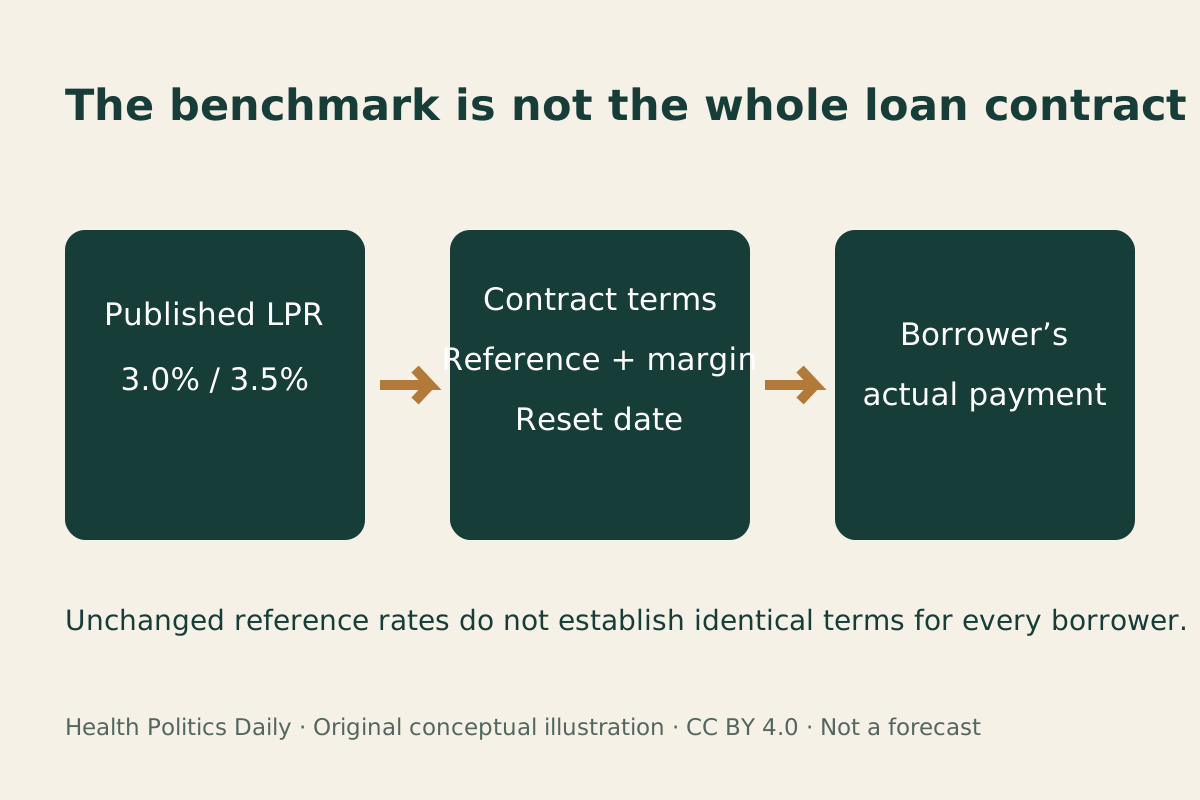
China’s one-year loan prime rate remains 3.0%, while the benchmark for terms longer than five years remains 3.5%, according to the October 20 announcement published by the People’s Bank of China. The National Interbank Funding Center issued the rates with the central bank’s authorization; they remain valid until the next release.
For households and businesses, the immediate finding is narrow: this benchmark announcement supplies no new rate cut. It does not mean every borrower pays either headline rate, every existing loan reprices today, or every other monetary-policy tool is unchanged.
A steady benchmark alongside proposed institutional changes
Reuters corroborated the rates and reported that they were unchanged for a seventeenth consecutive month. Its survey of 22 market participants on October 19 found all expected no change. That establishes the surveyed expectation before the announcement—not a reliable forecast of the next one.
The more substantial policy discussion came a day earlier. In an October 19 Financial Street Forum speech, Governor Pan Gongsheng said the central bank would study an appropriately timed shift in its main open-market operation from seven-day to overnight maturity, with the corresponding overnight operation rate becoming the principal policy rate.
He also described a move toward more varied loan-pricing benchmarks. Some financially capable companies could, by agreement with lenders, choose an interbank overnight repo rate or the LPR for floating-rate loans. The LPR could continue serving small businesses and individuals. Pan said policy guidance would be issued at an appropriate time.
Status distinction: Those are stated reform directions. The speech is not evidence that all loan contracts have switched benchmarks, and today’s LPR notice does not itself implement a universal conversion. The operative details and timetable matter as much as the proposed architecture.
Why borrowers should separate the benchmark from the contract
Analysis: A benchmark is a reference point in pricing. A borrower’s actual obligation depends on the relevant agreement: whether the rate is fixed or floating, what reference it uses, any contractual adjustment and when it resets. An unchanged reference does not establish that a bank’s offer, fees or credit decision must be identical to last month’s.
The distinction also applies to reform. Making another reference rate available is not the same as guaranteeing cheaper credit. A different mechanism can change how policy is transmitted without proving a particular household or firm will receive a lower payment.
Readers reviewing borrowing terms can usefully identify the named reference rate, reset date, margin and any written notice of a change. A news headline should not substitute for the agreement or a lender’s documented explanation. This is general reporting, not a recommendation to take, refinance or invest in a loan.
How this fits the growth debate
The release follows China’s latest GDP announcement, covered in our report on growth and weak domestic demand. That earlier coverage addresses economic activity; today’s announcement addresses loan-pricing references. Neither indicator alone measures whether a particular family’s income, housing costs or access to credit has improved.
For international readers, it is also important not to treat China’s rate framework as interchangeable with another central bank’s. Our coverage of the U.S. Federal Reserve outlook similarly distinguishes policy discussion from an enacted decision. Similar language about “rates” can describe different instruments and transmission channels.
What remains uncertain
The next LPR setting, the final scope and timing of pricing reforms, and their effect on access to credit remain unresolved by these documents. The governor’s stated aim of better transmission is a policy objective, not a measured result. Subsequent official guidance and actual lending outcomes will be needed to assess implementation.
Bias Lens: a rate hold is a fact; its meaning requires interpretation
Verified baseline: The official notice publishes 3.0% and 3.5%. The separate governor’s speech discusses future changes to the framework, not a completed repricing of every loan.
Center—Reuters: The report emphasizes the extended hold and reform context. Its interpretation about the urgency of further easing is analysis, separate from the published numbers.
Other international coverage—South Korea’s SBS: Its October 20 account foregrounds the sustained rate hold and economic context. Its English page discloses AI translation; the original Chinese central-bank documents, not that translation, are the primary evidence used here.
Official perspective: Pan’s speech stresses improving the monetary framework’s effectiveness. An institution’s explanation of its intended benefits is not independent proof that those benefits have arrived.
Left/right comparison limit: No directly relevant, verified left-leaning and right-leaning pair was identified for this technical announcement. A partisan three-way comparison would add unsupported symmetry. These distinctions concern the particular sources and their evidence, not stereotypes about national or political viewpoints.
Sources and media
The Chinese-language rate notice and governor’s speech were reviewed directly and summarized in English, with Reuters used for corroboration. The original illustration is a conceptual guide, not a rate forecast or depiction of any particular contract. No suitable directly relevant authorized video was verified, so none is embedded.