U.S. Foreign Policy · Israel · Military Aid
Trump Says U.S. Will End Annual Israel Military Aid in 2027
The president says Israel no longer needs roughly $3.8 billion a year in assistance and can continue buying American weapons. The statement signals a major shift, but no public implementation plan explains how it would interact with the current agreement or Congress's funding authority.
By Health Politics Daily News Desk · November 4, 2026 at 8:00 a.m. ET

Watch in this article
Pumpjack operating at the Kern River Oil Field
A short CC0 field video provides visual context for reporting on oil production and fuel supply.
Thomas Farley / Wikimedia Commons · CC0 1.0 · License and source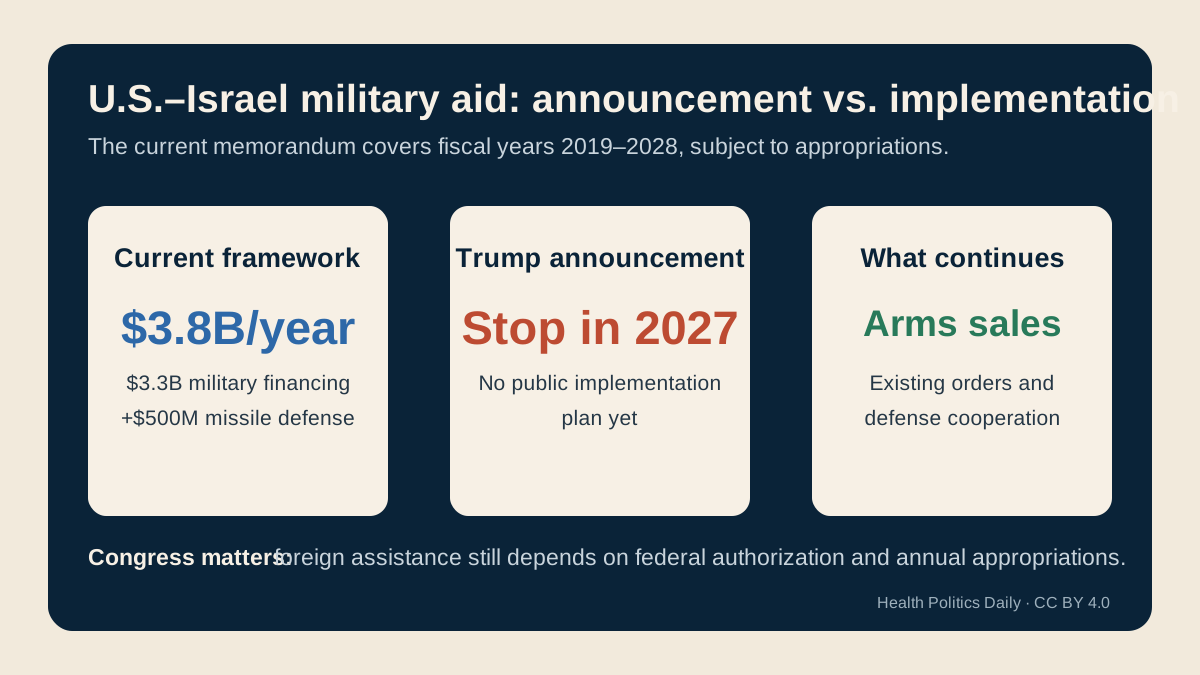
Verified baseline
President Donald Trump said in a Fox News interview that the United States would stop providing roughly $4 billion a year to Israel after 2026. He said Prime Minister Benjamin Netanyahu had raised the idea, Israel no longer needed the support and U.S. arms sales would continue.
The current program totals $3.8 billion annually: $3.3 billion in Foreign Military Financing and $500 million for cooperative missile-defense programs. A 2016 memorandum of understanding covers fiscal years 2019 through 2028.
An announcement is not yet a completed cutoff
The White House had not published an order, revised agreement or appropriations proposal detailing the change at publication. Trump also did not explain whether the cutoff would affect both financing and missile-defense cooperation, money already appropriated, or contracts already in production.
The memorandum is not a treaty and is not legally binding in the same way. But foreign assistance is ultimately implemented through laws and appropriations. Congress therefore has a central role in whether future funds are authorized, provided or restricted.
What would continue
Trump said Israel could continue buying U.S. weapons. Foreign Military Sales are separate transactions: the purchasing government pays for equipment, Congress generally receives notice of major sales and U.S. agencies manage contracting and delivery.
Existing orders would not disappear immediately. Weapons can take years to manufacture and deliver, and previously funded cooperative programs may continue under their own authorities and contracts. Joint exercises, intelligence cooperation and research are also broader than the annual aid package.
Why the change matters to both countries
For Israel, ending grants would shift more defense costs to its national budget during ongoing regional conflicts. Israeli officials would also have to decide how quickly domestic procurement or paid U.S. purchases could replace subsidized acquisitions.
For the United States, most Foreign Military Financing for Israel must be spent on U.S.-made equipment. A cutoff could therefore affect American defense contractors if Israel does not replace the grant-funded orders with purchases from its own budget. The scale and timing depend on contracts and future budgets, not the headline amount alone.
Practical implications
- Taxpayers: the announcement does not immediately produce $3.8 billion in spendable savings; Congress must set future appropriations and existing obligations may remain.
- Israelis: no current benefit or tax change follows automatically. Israel's government would determine how to finance replacement defense spending.
- Defense workers and suppliers: current production does not stop solely because of the statement; effects depend on funded contracts and future orders.
- Regional security: the change does not end U.S.–Israel cooperation, guarantee fewer weapons transfers or alter every existing commitment.
Fact, analysis, forecast and opinion
Verified fact: Trump announced an end to annual assistance after 2026 while supporting continued arms sales. Analysis: Congress and the existing fiscal 2028 framework make the operational timeline more complicated than the statement suggests. Forecast: lawmakers are likely to debate appropriations, transition arrangements and missile-defense cooperation, but the outcome is unresolved. Opinion: Health Politics Daily takes no position on the aid itself; any cutoff should be described through public legal, budget and contract documents.
Bias Lens: independence, retrenchment or election politics?
Verified baseline: the president announced a year-end cutoff; the current agreement provides $3.8 billion annually through fiscal 2028; Congress controls appropriations; arms sales would continue.
Left-leaning — The Guardian: emphasizes the Election Day timing and voters skeptical of support for Israel. Center — Associated Press: focuses on the strategic shift, congressional obstacles and effects on Israeli and U.S. defense industries. Right-leaning — Fox News: foregrounds Trump's argument that a prosperous Israel can buy weapons without grants and Netanyahu raised the idea.
These frames differ over motive and political meaning. None resolves the unanswered implementation questions, which require official documents and congressional action.
What remains uncertain
Netanyahu had not publicly confirmed the reported agreement at publication. It remains unclear which fiscal-year funds would be affected, whether Congress will agree, how missile-defense programs would be treated, whether Israel would replace grants with purchases and how the change would interact with existing obligations under the Camp David framework.
Principal sources
- Fox News — President Trump's interview and full reported remarks
- Associated Press — congressional, Israeli and defense-industry context
- Reuters — announcement and unresolved timeline
- U.S. State Department archive — $38 billion memorandum structure
- Congressional Research Service mirror — legal status and congressional role
A directly relevant Fox News publisher-authorized video report is linked rather than embedded so the publisher retains playback, advertising and accessibility controls.
No comments yet.