U.S. Politics · Trade Policy · Mexico
Trump Threatens to Double Mexico Tariffs Over Migrant Caravans; Scope Unclear
The president tied a major trade warning to migration enforcement. Mexico says the groups are shrinking and none has reached the U.S. border.
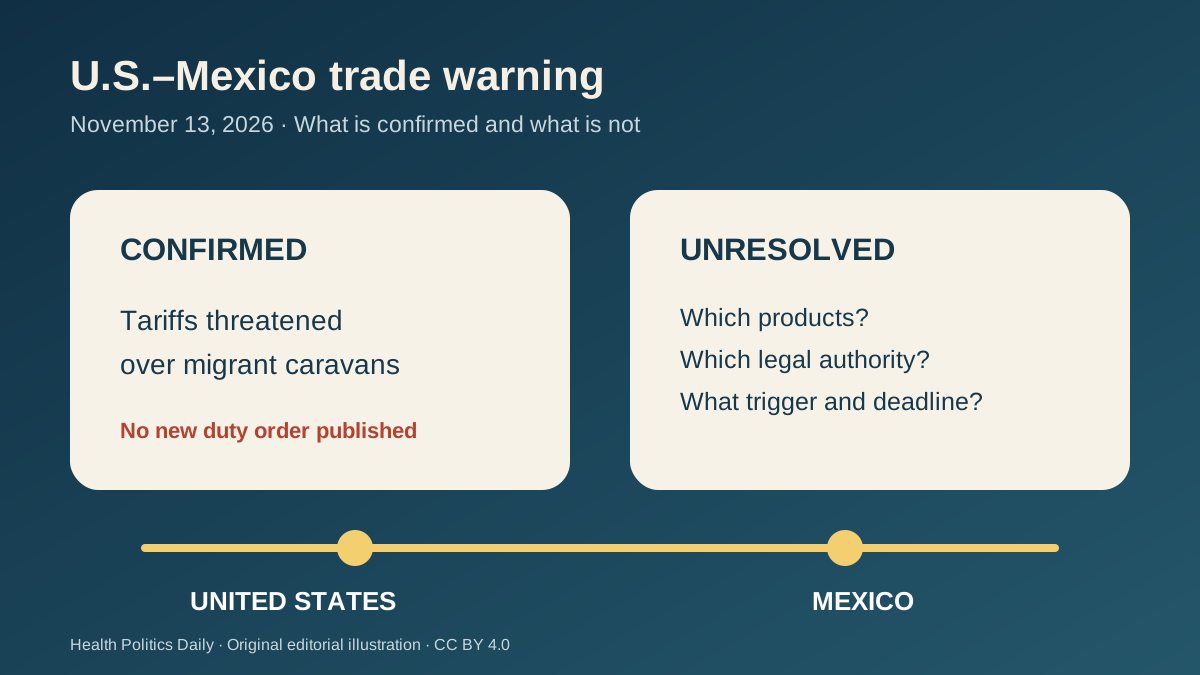
Verified baseline: a threat, not a new tariff order
President Donald Trump said Thursday that tariffs on Mexico would be “immediately doubled” unless Mexico stopped migrant groups traveling north. The White House repeated the statement in a release that also said the administration would not admit the migrants.
The statement did not identify which Mexican products or existing tariff programs would be affected, what rate would apply, what legal authority the administration would invoke, how Mexico’s compliance would be measured or when a change would take effect. No implementing proclamation, executive order, U.S. Trade Representative notice or Federal Register notice accompanied the threat as of publication.
That distinction matters. A presidential statement can affect negotiations and business expectations, but customs authorities generally need a legally operative directive and tariff-schedule instructions before importers owe a different duty.
Mexico disputes the scale and rejects force
Mexican President Claudia Sheinbaum said no migrant caravan had reached the U.S. border since Trump returned to office in January 2025, according to Associated Press reporting from her daily briefing. She said one group in Chiapas that began with about 600 people had largely dispersed, while officials were encouraging several hundred Honduran migrants in another group to return home.
Sheinbaum ruled out repression. She said Mexican authorities were accompanying migrants, explaining the difficulty of entering the United States and offering return options. Reuters separately estimated that about 1,500 people, mostly from Central America, had departed Tapachula earlier in the week; the figures may describe different points in the movement or different groups.
Those are not mutually exclusive facts: a large group can set out and then shrink substantially before reaching northern Mexico. The available reports do not establish that any caravan is near the U.S. border or that Mexico has refused to engage with its members.
Why “double the tariffs” has no single obvious meaning
Mexican goods face a patchwork rather than one universal U.S. tariff. Some products qualify for preferential treatment under the United States–Mexico–Canada Agreement, while others are covered by separate duties on steel, aluminum, vehicles, tomatoes or goods identified in a Section 301 investigation.
The U.S. Trade Representative said in July that the United States did not renew the USMCA in its current form, but that the agreement remains in force while the three countries continue negotiations. A later Section 301 notice imposed a 10% tariff on covered Mexican goods with specified exemptions. Other sectoral rates differ.
Without an implementing document, “double” could mean raising one program’s rate, multiple sectoral rates or a new levy applied more broadly. It could also remain negotiating leverage rather than become policy. Reporting a single new rate now would therefore be speculation.
The household and business stakes
Mexico is the United States’ largest goods supplier. Census Bureau data show the United States imported $481.6 billion in Mexican goods from January through September 2026, including a record $62.2 billion in September alone.
Higher duties are collected from U.S. importers. Whether and how much of the cost reaches households depends on contracts, exchange rates, supplier margins, substitution and the availability of domestic alternatives. Potentially exposed supply chains include vehicles and parts, electronics, machinery, food and construction materials, but exposure would depend entirely on the products named in any final action.
Companies should not assume a social-media statement has changed the tariff schedule. Importers can monitor U.S. Customs and Border Protection, USTR and the Federal Register, and review classifications and contract terms with qualified trade professionals if an operative notice appears. This report does not provide individualized legal or investment advice.
What the legal process may require
The Constitution gives Congress authority over tariffs, while federal statutes delegate narrower powers to the president or executive agencies under defined conditions. A Congressional Research Service overview identifies authorities including Section 232 of the Trade Expansion Act and Sections 122, 201 and 301 of the Trade Act.
The Supreme Court ruled earlier in 2026 that the International Emergency Economic Powers Act did not authorize tariffs, narrowing one route used by the administration. Other statutes remain available, but many require findings, an investigation, time limits, product definitions or publication. Which authority might support this threat is unknown because the president did not specify one.
Our earlier report on robotics and machinery import talks explains why negotiations and tariff implementation are different stages. Our analysis of ICE’s fiscal-2026 enforcement totals provides separate context on current U.S. immigration policy.
Fact, analysis, forecast and opinion
Verified fact: Trump threatened to double unspecified tariffs if Mexico did not stop migrant caravans; the White House publicized the threat, while Mexico said the groups were shrinking and had not reached the U.S. border. Analysis: the statement raises negotiating and supply-chain risk, but it is not specific enough to calculate a new duty or consumer-price effect. Forecast: the next meaningful evidence would be an implementing legal document, a negotiated stand-down or a measurable change in the migrant groups’ movement; none is guaranteed. Opinion: Health Politics Daily takes no position on the preferred tariff or immigration policy and applies the same evidence standard to claims from both governments.
Bias Lens: border enforcement, political escalation or trade risk?
Verified baseline: Trump threatened to double unspecified tariffs on Mexico unless it stopped migrant caravans. Mexico says no caravan has reached the U.S. border since January 2025 and that current groups are dispersing or being offered return options.
Left-leaning — The Guardian: places the threat in the post-election political confrontation and emphasizes migrants traveling with children. Center — The Associated Press: leads with Sheinbaum’s factual rebuttal, describes the groups’ current size and sets the dispute beside ongoing trade talks. Right-leaning — Fox News: foregrounds tariff leverage and Trump’s border-enforcement rationale.
The difference is chiefly which consequence receives priority: political escalation, Mexico’s operational response or deterrence at the border. None of those frames settles the undefined tariff scope, the size of the groups at every point in time or the legality of a future duty.
What remains uncertain
The administration has not defined which tariffs would be doubled, whether USMCA-qualifying goods would remain protected, what conduct Mexico must complete, what deadline applies or which statute would authorize the change. Mexico has not said whether the threat will alter its trade position or migrant-management policy.
The size and location of the migrant groups may change quickly. Any later tariff action should be assessed from its operative text, not inferred from the threat alone.
Principal sources
- White House — November 12 release reproducing the president’s tariff threat
- Associated Press — Sheinbaum briefing, group-size estimates and current tariff context
- Reuters — caravan reporting and statements from both governments
- U.S. Trade Representative — USMCA review status
- U.S. Census Bureau — 2026 trade in goods with Mexico
- Congressional Research Service — tariff authorities and legal process
No suitable directly relevant official or publisher-authorized video with clear, persistent embedding permission was available, so no video was embedded.
No comments yet.