U.S. Policy · Immigration Enforcement · Public Finance
ICE Reports Record 483,200 Deportations in Fiscal 2026; Data Gaps Remain
The agency also reported 474,850 administrative arrests, but its release did not show who had criminal convictions or fully explain what counted as a deportation.
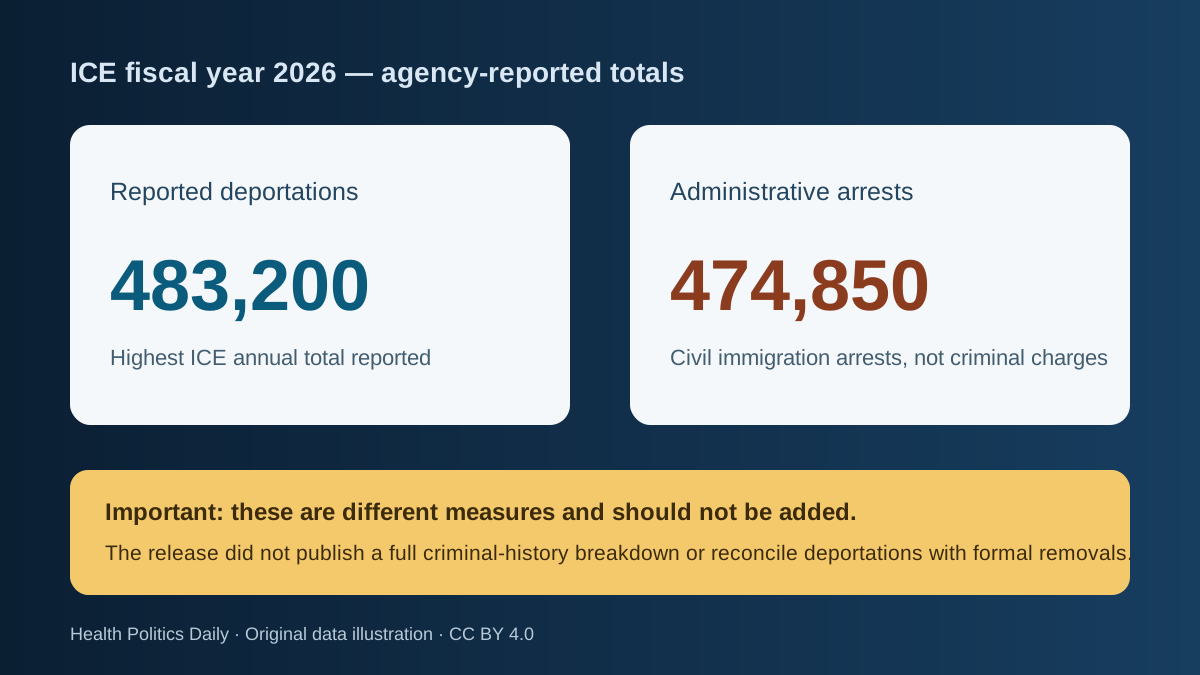
Verified baseline: records in ICE’s published series
U.S. Immigration and Customs Enforcement says it deported 483,200 people in the fiscal year that ended September 30, the highest annual total in the agency’s 23-year history. The total was 9% above fiscal 2025 and 78% above fiscal 2024, according to the Department of Homeland Security’s ICE release and reporting by The Associated Press.
DHS also reported more than 491,000 total arrests, including 474,850 administrative arrests. An administrative arrest is a civil immigration-enforcement action; it is not, by itself, a criminal charge or proof of a criminal conviction. ICE says September alone included more than 48,000 arrests.
The figures are agency-reported. The public release did not provide the criminal-history breakdown used in earlier annual reports, a nationality table, length-of-residence data or a reconciliation between its broad “deportation” total and formal removals. Those omissions limit comparisons and do not establish the circumstances of any individual case.
Why the counting distinction matters
“Deportation” is often used as an umbrella term, but immigration data distinguish formal removals from voluntary departures and returns. Formal removal generally carries legal consequences for reentry; a return or voluntary departure can follow a different process. Transactional Records Access Clearinghouse, analyzing case-level federal records current through August 24, found that formal removals made up 63% of the broader deportation count in July and August, with voluntary departures and returns accounting for the rest.
That does not make the ICE total false. It means the headline number measures a broader set of outcomes than formal removal orders alone. TRAC’s dataset also covers DHS components beyond ICE and stops before the fiscal year ended, so its projection is not a like-for-like substitute for ICE’s annual figure.
The record also falls short of the administration’s stated goal of one million deportations a year. The AP reported that the agency’s expanded funding, staffing, detention space and flights contributed to the increase, while operational and legal constraints remained.
What changed for families and communities
For people in immigration proceedings, the national total does not predict whether a specific case will end in detention, release, voluntary departure, relief or removal. Case outcomes depend on status, court orders, available relief, country conditions and access to counsel. This article is public-policy reporting, not personalized legal advice.
For families, a civil administrative arrest can still trigger detention, missed work, interrupted caregiving and urgent court deadlines. People seeking help can use the Justice Department’s list of pro bono legal-service providers or a licensed immigration attorney; no aggregate statistic can replace case-specific advice.
Capacity has expanded alongside enforcement. An October Government Accountability Office report says ICE’s average daily detained population rose 71%, from 39,314 on January 20, 2025, to 67,180 on July 30, 2026, while authorized detention facilities roughly doubled from 134 to 272. GAO warned that rapid expansion without better planning could waste taxpayer money.
Our earlier report on Stephen Miller’s appointment as White House chief of staff explains the policy leadership behind the enforcement agenda. Our coverage of the shorter refugee-status response window shows how procedural deadlines can affect people separately from arrest totals.
Practical implications
- For Congress and taxpayers: the records strengthen the case for a comparable annual dataset showing costs, detention days, case outcomes and the legal category of each departure.
- For local governments: a higher interior-arrest pace can increase demand for legal aid, school and family support, and coordination around detention transfers.
- For employers and households: an arrest total does not prove that any named person or workplace violated law; individual claims should be checked against court and agency records.
- For affected people: notices and deadlines matter. Qualified legal counsel can evaluate an individual case; this report cannot.
Fact, analysis, forecast and opinion
Verified fact: ICE reported 483,200 deportations, more than 491,000 arrests and 474,850 administrative arrests in fiscal 2026. Analysis: the totals confirm a major expansion of enforcement, but the missing breakdowns make it impossible to evaluate from the release alone how many people had criminal convictions or how many departures were formal removals. Forecast: congressional oversight is likely to seek more detailed cost and outcome data, but the scope and timing of any inquiry are uncertain. Opinion: Health Politics Daily takes no position on the enforcement program; consistent public data would let supporters and critics test their claims against the same evidence.
Bias Lens: record enforcement, political backlash or data transparency?
Verified baseline: ICE says fiscal 2026 produced agency records for deportations and administrative arrests. The release did not provide a complete criminal-history breakdown or reconcile its broad deportation figure with formal removals.
Left-leaning — The Washington Post: foregrounds the enforcement surge and the political and community backlash surrounding the campaign. Center — The Associated Press: leads with the agency records, compares administrations and emphasizes both the one-million target and missing detail. Right-leaning — New York Post: foregrounds the administration’s enforcement achievement and public-safety rationale while also noting that DHS did not detail the deportees’ circumstances.
The same verified totals support different news judgments about what deserves top billing: scale, consequences, transparency or fulfillment of a campaign promise. Those emphases are not evidence that every case involved a serious crime, nor that enforcement is unlawful as a whole.
What remains uncertain
DHS has not published enough detail to determine from this release how many deported people had convictions, pending charges, final removal orders or no criminal record. It also has not shown nationality, time in the United States, arrest location, detention duration or per-case cost.
The figures do not say how many people received relief, were later released or were counted in more than one enforcement stage. Until ICE releases a methods note and a comparable case-level table, the record claim is best read as a record in the agency’s published series—not a complete measure of all U.S. deportations across history.
Principal sources
- Department of Homeland Security — ICE fiscal 2026 record announcement
- Associated Press — record totals, historical comparisons and missing breakdowns
- CBS News — administrative-arrest definition and counting caveats
- TRAC — case-level removals, voluntary departures and returns
- U.S. Government Accountability Office — detention expansion and taxpayer-risk findings
No suitable directly relevant official or publisher-authorized video with clear, persistent embedding permission was available, so no video was embedded.
No comments yet.