International Politics · Israel · Elections
Israel’s Final Election Count Leaves Netanyahu Bloc Eight Seats Short of Majority
Likud remains the largest party, but no bloc reached the 61 seats needed to govern. The count is complete; the identity of Israel’s next government is not.
By Health Politics Daily News Desk · October 30, 2026 at 2:03 a.m. ET
Verified baseline
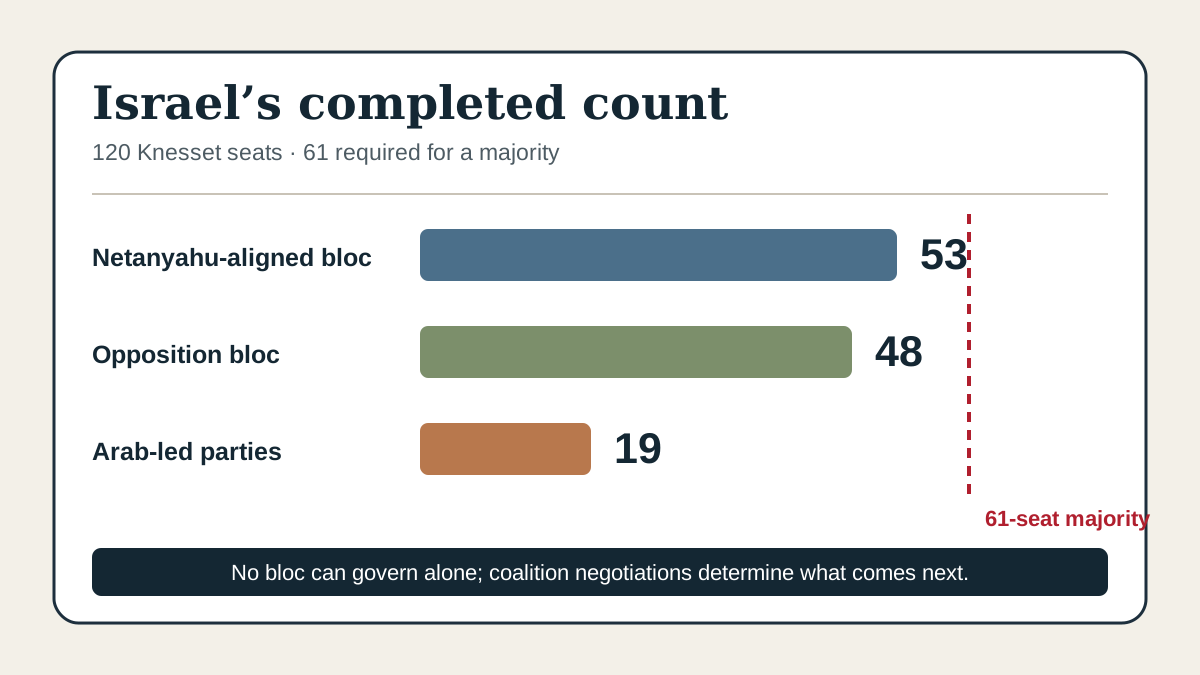
Israel’s Central Elections Committee completed its count with Prime Minister Benjamin Netanyahu’s governing bloc on 53 seats in the 120-member Knesset, eight short of a majority. The opposition bloc led by Gadi Eisenkot won 48 seats, while the Joint List and Ra’am—the two Arab-led groupings—won 19 seats combined.
Likud is the largest individual party with 27 seats. Yashar won 21, B’Yachad 12, the Joint List 11, and the Democrats and Ra’am eight each. Yisrael Beytenu, United Torah Judaism and Otzma Yehudit each won seven; Shas and Religious Zionism each won six.
The committee reported 77.9% turnout and more than 5.7 million votes cast. The results are due to be formally submitted to President Isaac Herzog on November 4 after integrity checks and any minor corrections. The Knesset is scheduled to be sworn in on November 10.
What changed since the exit polls
Election-night surveys correctly pointed to a hung parliament, but they varied on the strength of the competing blocs. The completed count now fixes the seat allocation and confirms that the outgoing governing coalition lost its majority. It does not determine who will be prime minister.
Under Israel’s parliamentary system, the president consults elected parties and assigns a lawmaker the task of forming a government. The leader of the largest party is not automatically selected, and a government must ultimately command sufficient parliamentary support.
The coalition arithmetic
Netanyahu’s aligned parties need at least eight additional seats. Eisenkot’s bloc needs at least 13. The 19 seats held by Arab-led parties could therefore be decisive through formal coalition participation, outside support or abstention, but leaders have set competing conditions and no governing agreement has been announced.
Other routes include a broad unity government, defections or agreements across the current blocs. Another election is possible if no one forms a government, but it is an outcome—not a scheduled next step.
Unsubstantiated claims do not change the count
Likud alleged that the election was “stolen” and suggested foreign interference without presenting public evidence that would alter the result. Election officials said allegations of systematic violations were baseless. A request for the Shin Bet security service to examine possible foreign interference does not establish that interference occurred, implicate Arab voters or cancel certified ballots.
Investigating a credible allegation and accepting the lawful count are compatible. Claims should be judged against evidence released by the election committee, courts or investigators, not repeated as established fact because a party made them.
Practical implications
- Government: Netanyahu remains prime minister while coalition formation proceeds; the election did not immediately install a replacement.
- Legislation: the completed count determines the next Knesset’s composition, but a new governing program depends on coalition agreements.
- Security and diplomacy: the caretaker government continues operating, though major discretionary decisions may face political scrutiny while its future support is unresolved.
- Public information: seat totals are confirmed by the election committee; coalition scenarios remain analysis until parties sign agreements.
Fact, analysis, forecast and opinion
Verified fact: the completed count produced a 53–48–19 division, with no bloc reaching 61. Analysis: Arab-led parties hold leverage because either large bloc needs support beyond its current allies. Forecast: negotiations may produce a unity arrangement, cross-bloc support, a minority government or another election, but none is assured. Opinion: Health Politics Daily takes no position on the parties; unsupported fraud allegations should not be treated as evidence.
Our election-night report explains why the exit polls could not name a winner. Our voting-day guide covers the issues and electoral system, while our report on President Trump’s endorsement of Netanyahu documents the U.S. political context.
Bias Lens: victory, rejection or deadlock?
Verified baseline: Likud won the most seats, Netanyahu’s bloc lost its majority, no opposing bloc reached 61, and coalition talks—not the headline framing—will determine the government.
Left-leaning framing: Le Monde emphasizes the record strength and potential leverage of Arab-led parties, alongside Netanyahu’s attacks on them. Center wire framing: the Associated Press foregrounds the lack of a majority, the unsupported fraud allegations and the coalition uncertainty. Right-leaning framing: Israel Hayom focuses on Likud’s first-place finish, the party-by-party count and the routes to a unity government. These are differences in emphasis; the seat totals themselves are not ideologically disputed.
What remains uncertain
It is not known whom Herzog will first ask to form a government, which parties will recommend each candidate, whether Arab-led parties will join or support a coalition, or whether election-integrity inquiries will produce substantiated findings. Coalition promises may also change during negotiations.
Principal sources
- Israel Central Elections Committee — national results
- Associated Press — final count and integrity-claim context
- CBS News — coalition process and completed count
- Reuters — coalition analysis
No suitable directly relevant official or publisher-authorized video with clear persistent embedding permission was available, so none was embedded.
No comments yet.