International Politics · Israel · Elections
Israel Exit Polls Show Deadlock With No Bloc Reaching 61 Seats
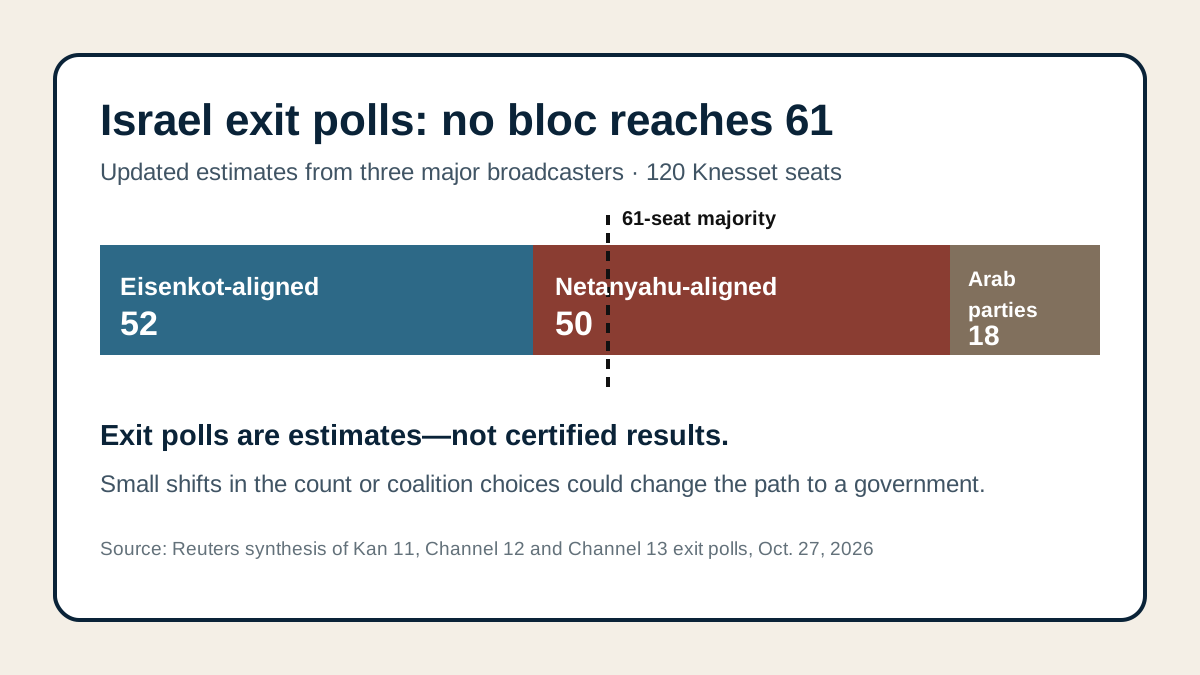
Updated estimates from three major broadcasters put the opposition bloc aligned with Gadi Eisenkot on 52 seats and Benjamin Netanyahu’s bloc on 50. The official count—not the exit polls—will determine the next Knesset.
By Health Politics Daily News Desk · October 27, 2026 at 6:03 p.m. ET
Verified baseline
Updated exit polls from Israel’s three major television networks projected 52 seats for parties aligned with former military chief Gadi Eisenkot, 50 for parties aligned with Prime Minister Benjamin Netanyahu and 18 for Arab parties not committed to either bloc, according to Reuters. A government needs the support of at least 61 members in the 120-seat Knesset.
These figures are survey estimates of voters leaving polling places. They are neither ballot totals nor a declaration of a winner. The Associated Press reported that preliminary results were expected within hours and final results could take days.
What the exit polls show—and do not show
The common message from the three large broadcasters is deadlock: neither main bloc is close enough to govern alone. A separate Channel 14 poll, from a network supportive of Netanyahu, put his bloc at 60 seats—still one short of a majority. That difference illustrates why no single exit poll should be treated as a result.
Even a one- or two-seat shift can matter. Parties must clear a 3.25% vote threshold to enter parliament; a party moving above or below it can redistribute seats across the chamber. Coalition commitments can also change after ballots are counted.
What happens after the count
The Central Elections Committee publishes the official count. After results are finalized, Israel’s president consults party leaders and asks the lawmaker judged most likely to assemble a coalition to try to form a government. The process can take up to six weeks, and the first candidate may fail.
If no candidate can secure 61 supporters, negotiations may produce a broader or minority arrangement, or Israel could eventually face another election. None of those outcomes follows automatically from the exit polls.
Why the result matters beyond coalition arithmetic
The next government will inherit decisions on security, Gaza, the West Bank, regional diplomacy, the state budget and the relationship between courts and elected officials. But caretaker arrangements and existing law remain in force while coalition negotiations proceed. An exit poll does not itself change policy, appoint a prime minister or approve a budget.
For residents, businesses and international partners, the practical signal is uncertainty rather than an immediate transfer of power. Markets and governments may react to likely coalitions, but those reactions are forecasts based on provisional information, not confirmation of a new administration.
Fact, analysis, forecast and opinion
Verified fact: three major network exit polls leave both leading blocs below 61 seats. Analysis: the estimates point to difficult coalition talks and make the choices of smaller parties consequential. Forecast: seat totals and viable alliances may change as ballots are counted; no outcome is yet reliable enough to call. Opinion: Health Politics Daily’s view is that publishers and political leaders should label exit-poll numbers clearly and avoid presenting coalition scenarios as settled results.
Bias Lens: referendum on Netanyahu or coalition arithmetic?
Verified baseline: the principal exit polls show no bloc with the 61 seats needed to govern, and certified results are not yet available.
Left-leaning coverage: The Guardian frames the vote around Netanyahu’s record, democratic direction and the consequences for Palestinians. Center coverage: Reuters and AP foreground the seat arithmetic, uncertainty and formal coalition process. Right-leaning coverage: Fox News emphasizes Netanyahu’s political future, security record and legacy.
The outlets select different stakes, but their emphasis does not change the baseline: exit polls are provisional and a majority requires 61 seats. Labels describe broad editorial orientation, not every reporter or article.
What remains uncertain
The final seat distribution, turnout by constituency, performance of parties near the threshold and willingness of Arab or other smaller parties to support a government remain unresolved. The president’s choice of candidate and the duration or outcome of coalition talks cannot be known from tonight’s surveys.
Principal sources
- Israel Central Elections Committee — official results portal
- Reuters — updated broadcaster exit-poll synthesis
- Associated Press — election-night report and result timing
- Associated Press — coalition process explainer
No suitable directly relevant official or publisher-authorized video with clear downstream embedding permission was available, so no video was embedded.