International Security · Ukraine · U.S. Foreign Policy
U.S. Approves Proposed $2.1 Billion Sale of 500 Patriot Missiles to Ukraine
Canada, Germany, Norway and EU-backed Ukrainian funds would finance the PAC-3 interceptors. Approval is a major step, but the missiles have not been delivered or manufactured.
By Health Politics Daily News Desk · October 31, 2026 at 12:04 a.m. ET
Verified baseline
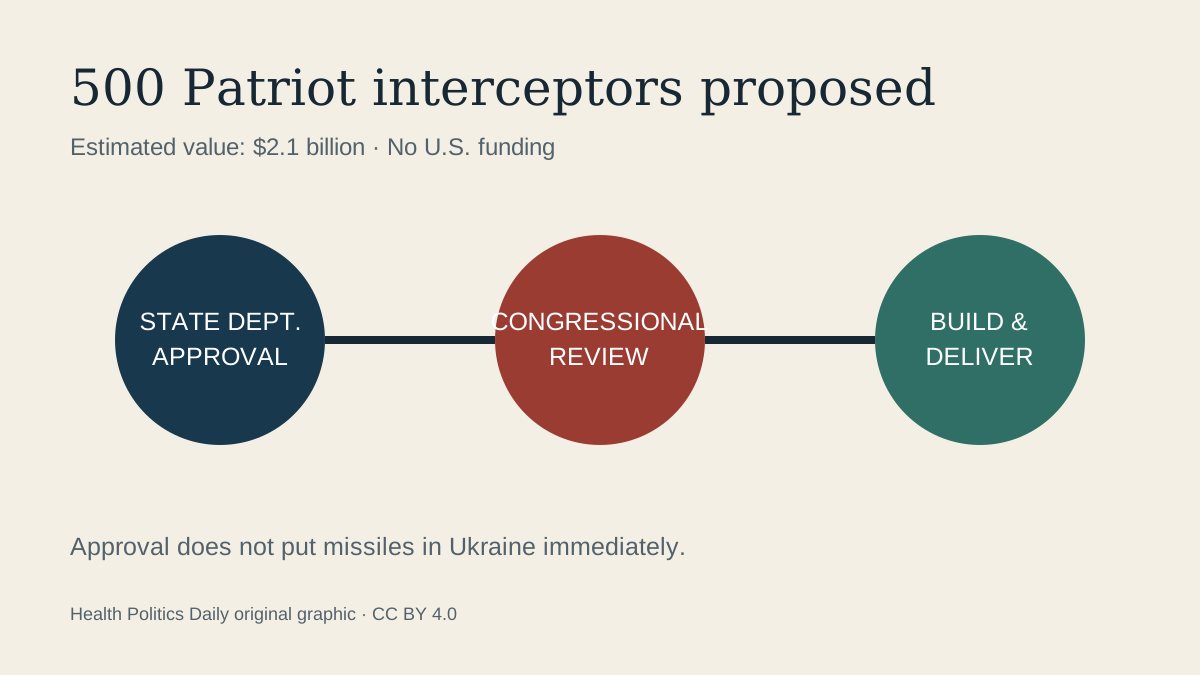
The U.S. State Department approved a proposed foreign military sale to Ukraine of 500 Patriot Advanced Capability-3 Missile Segment Enhancement interceptors and related support, with an estimated value of $2.1 billion. Lockheed Martin would be the principal contractor.
Canada, Germany and Norway would contribute through the U.S. JUMPSTART program, while Ukrainian national funds supported by the European Union’s Ukraine Support Loan would provide additional financing. The State Department and Associated Press said no U.S. government funds would finance the purchase.
Approval is not delivery
The proposal remains subject to congressional review and contract negotiations. The announced value is an estimate, and the final quantity, cost and schedule can change. Reuters reported the interceptors have not yet been manufactured and are not expected to arrive until the early 2030s under the current production path.
Ukraine is seeking faster access, potentially through transfers from existing U.S. stocks that would later be replenished. No such accelerated arrangement was confirmed in the approval.
Why Ukraine says the missiles are urgent
Patriot PAC-3 interceptors are designed to counter ballistic and other advanced aerial threats. Ukraine has repeatedly asked for more interceptors as Russian strikes hit cities and energy infrastructure. Recent attacks killed civilians in Dnipro, Kyiv and other locations.
Ukrainian President Volodymyr Zelenskyy had accused the Pentagon of delaying approvals for missiles bought by allies. U.S. and NATO officials disputed that broader account and said deliveries under other programs were continuing. Those claims concern separate existing transfers, not the newly proposed 500-missile package.
Production and inventory constraints
PAC-3 demand is high among the United States and allied operators. Lockheed Martin has said it plans to expand production toward 2,000 interceptors annually, but that target is years away. Faster delivery to Ukraine could require changing allocations among customers or drawing from inventories.
Verified fact: State approved a possible sale of 500 interceptors for an estimated $2.1 billion. Analysis: the package signals long-term allied support but does not solve Ukraine’s near-term shortage. Forecast: delivery could accelerate only if governments rearrange inventories or production priorities; no schedule is guaranteed. Opinion: Health Politics Daily takes no position on military strategy and distinguishes defensive purpose from claims about timing or battlefield effect.
Practical implications
- For civilians in Ukraine: the announcement does not immediately increase protection during current attacks.
- For allied taxpayers: the package relies on Canadian, German, Norwegian and EU-backed Ukrainian funding rather than U.S. appropriations.
- For industry: the order adds pressure to expand interceptor production while meeting other U.S. and allied commitments.
Related site reporting includes the Oleshky humanitarian operation and earlier U.S. weapons-policy developments.
Bias Lens: approval breakthrough or delayed capability?
Verified baseline: the United States approved a possible allied-funded sale of 500 interceptors. Congress, contracting, manufacturing and delivery remain.
Left-leaning — Financial Times: emphasizes strained U.S.–Ukraine relations and inventory pressure. Center — Associated Press: leads with the approval after Kyiv’s claimed holdup and clearly identifies allied funding. U.S. government framing — State Department statement quoted by AP: emphasizes partner security and European stability. No timely mainstream right-leaning report added independent evidence, so this lens does not force symmetry.
What remains uncertain
The congressional-review outcome, final contract, delivery schedule, possible stock transfers and actual battlefield availability are unresolved. Public documents also do not specify how funding is divided among contributors.
Principal sources
- Associated Press — approval, funding and U.S. statement
- Reuters — manufacturing and delivery context
- Defense Security Cooperation Agency — official major-arms-sales notices
No suitable directly relevant authorized video with clear persistent embedding permission was available.
No comments yet.