International · Ukraine War · Humanitarian Affairs
Oleshky Aid and Evacuations Begin Under Rare Local Ukraine Ceasefire
Food and medicine reached the Russian-held town as residents boarded buses for Ukraine or Russia in the first joint relief operation of this scale during nearly five years of war.
By Health Politics Daily News Desk · October 30, 2026 at 5:57 p.m. ET
Verified baseline
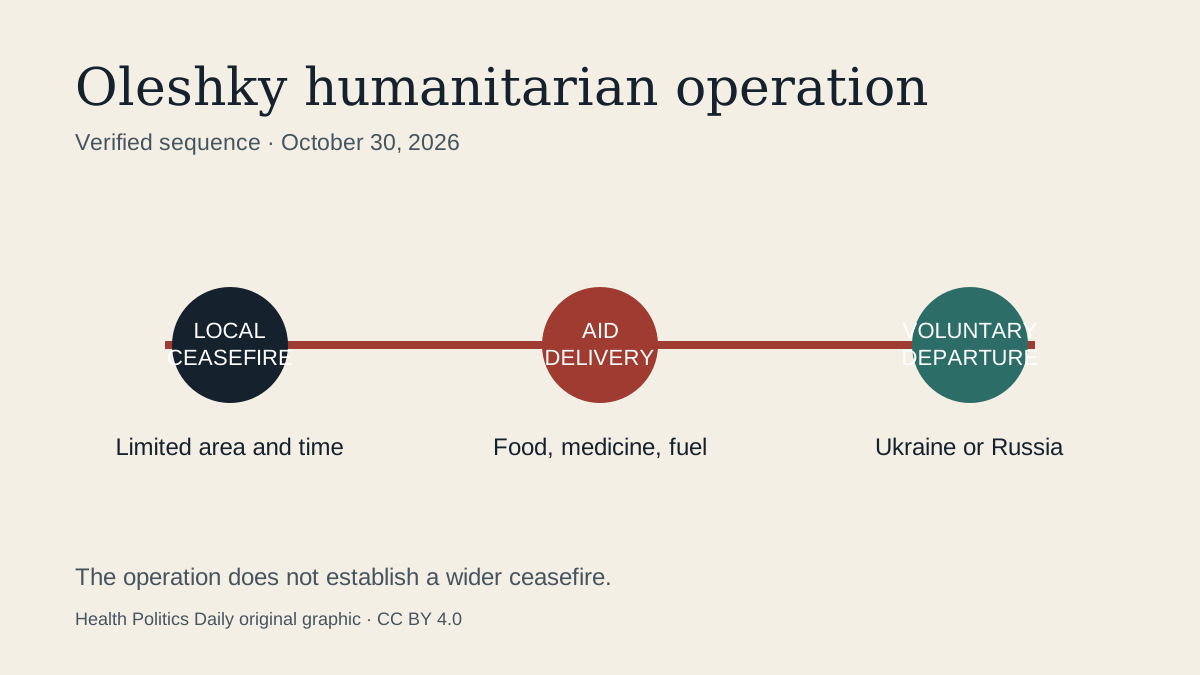
Ukrainian and Russian officials said a humanitarian convoy reached Russian-occupied Oleshky in southern Ukraine on October 30 under a localized ceasefire. Food, hygiene supplies, medicine and fuel were delivered, while residents who wished to leave began boarding buses for destinations in Ukraine or Russia.
Ukraine’s human-rights commissioner Dmytro Lubinets and Russian commissioner Yana Lantratova coordinated the operation and appeared together publicly. Ukraine’s armed forces had announced a halt to fire in a defined area to permit the mission. The White House said first lady Melania Trump mediated the arrangement, with Pope Leo also involved.
How the evacuation works
Reuters reported that 25 buses and nine ambulances transported people first toward Crimea. Residents traveling to Ukrainian-controlled territory face a circuitous route through southern Russia and Belarus before entering Ukraine; others may continue to Russia. Officials said departure was voluntary and aid would remain available to people who stayed.
Ukraine’s prime minister withdrew an earlier numerical estimate and said no reliable total was available while the operation continued. That correction matters: published figures for planned departures should not be treated as a completed count.
Why Oleshky needs aid
Russian forces seized Oleshky near the start of the full-scale invasion in 2022. The town was heavily damaged and flooded after the Kakhovka dam’s destruction in 2023. Residents have described severe shortages and dangerous travel on mined roads to obtain food and water.
The mission required demining and a temporary pause in fighting. Russian officials said two people involved in preparatory demining were killed. Health Politics Daily could not independently verify that account.
What the cooperation means—and does not mean
The joint appearance and synchronized aid operation show that narrowly defined humanitarian coordination is possible despite continuing war. But attacks continued elsewhere in Ukraine, and the Kremlin described the cooperation as an isolated case. The local arrangement therefore does not establish a national ceasefire, peace agreement or lasting evacuation corridor.
Analysis: success could create a practical model for other civilian corridors, but only if both sides maintain security guarantees and permit independent monitoring. Forecast: officials may seek similar operations, although there is no verified commitment to extend this one. Opinion: Health Politics Daily takes no position on the belligerents’ political claims; civilian choice, safety and accurate accounting should guide evaluation of the mission.
Practical implications
- For residents: people may choose their destination, but routes are long and operational conditions can change quickly.
- For families: official Ukrainian channels and the ombudsman are safer sources than unverified social-media passenger lists.
- For aid groups: the operation may test whether limited deconfliction can support repeated deliveries, medical transfers and assistance for people who remain.
Related site reporting includes the release of an American held in Russia and the EU court’s ruling on Russia sanctions listings.
Bias Lens: humanitarian breakthrough or isolated exception?
Verified baseline: aid entered Oleshky, voluntary evacuations began, and Ukrainian and Russian officials coordinated under a limited ceasefire. The number evacuated was not final, and fighting continued elsewhere.
Left-leaning — The Guardian: places the operation within a broader Ukraine briefing that stresses continued Russian attacks. Center — Reuters: emphasizes the rare joint logistics, residents’ choices and limits of the ceasefire. Right-leaning/official U.S. framing — White House: centers Melania Trump’s mediation and describes the agreement as a secured humanitarian ceasefire. These differences concern emphasis and credit; none changes the narrow geographic scope.
What remains uncertain
The final number and destinations of evacuees, the condition of people who remain, the ceasefire’s durability and prospects for further deliveries are unknown. Independent observers have not yet published a complete accounting.
Principal sources
- Cabinet of Ministers of Ukraine — correction on evacuation numbers
- Ukrainian Parliament Commissioner for Human Rights — mission update
- Armed Forces of Ukraine — localized ceasefire announcement
- White House — mediation terms
- Reuters — on-the-ground logistics and corroboration
Officials published short clips from the operation, but no complete item-specific video with clear persistent embedding permission was available, so none was embedded.
No comments yet.