Finance · United Kingdom · Budget
UK Budget Gives 20 Million Households £100 Energy Payment, Raises Bank Tax
The £2.6 billion payment and extended electricity VAT relief aim to cushion high bills; a temporary bank surcharge helps fund the package.
By Health Politics Daily News Desk · October 28, 2026 at 4:00 p.m. ET

Watch in this article
Pumpjack operating at the Kern River Oil Field
A short CC0 field video provides visual context for reporting on oil production and fuel supply.
Thomas Farley / Wikimedia Commons · CC0 1.0 · License and source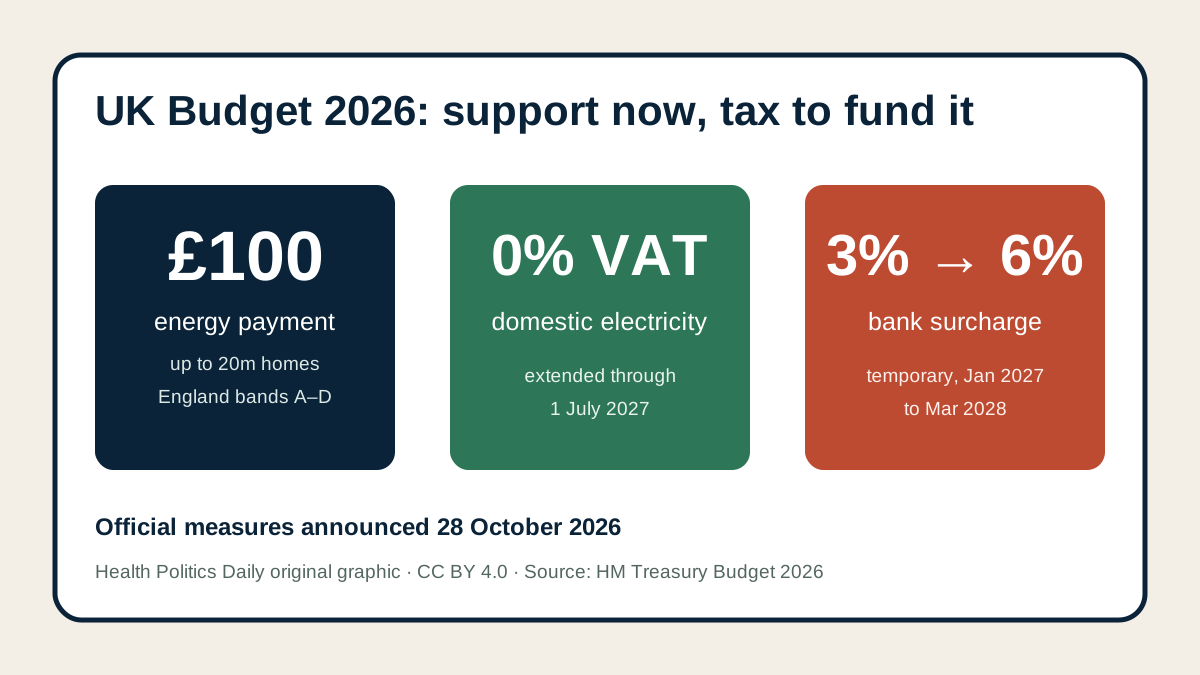
Verified baseline
Chancellor John Healey's Budget statement announced a £100 Household Energy Payment for up to 20 million households in England's council-tax bands A to D. The full Budget document prices the program at £2.625 billion and says payments will begin in January 2027.
The same document extends the temporary zero rate of VAT on qualifying domestic electricity through July 1, 2027. To help pay for support, the Bank Corporation Tax Surcharge will rise from 3% to 6% from January 1, 2027 through March 31, 2028.
What households should know
The £100 payment applies directly in England. Households must live in and be liable for council tax on a main home in bands A to D; second homes and empty properties are excluded. People who pay council tax by direct debit should receive the money automatically. Other eligible households will be invited by their local council to apply, according to official guidance.
Scotland, Wales and Northern Ireland will receive additional funding under the Barnett formula, but their governments will decide how to use it. A Treasury announcement is therefore not, by itself, proof that every household across the four nations will receive an identical payment on the same timetable.
Energy bills: relief, not a price guarantee
The Treasury estimates that extending the electricity VAT cut will reduce the April 2027 annual Ofgem price cap by about £50. It also wants Ofgem to remove the fixed gas standing charge and recover those costs through unit prices instead. That change could help lower-use households, but it does not eliminate system costs and may affect customers differently according to consumption.
The payment and tax relief do not guarantee that any household's total bill will fall. Wholesale prices, usage, supplier tariffs and future price-cap decisions still matter.
Who pays and what else changes
The temporary bank surcharge increase is forecast to raise about £1.5 billion. It applies to taxable banking profits above the relevant allowance, on top of corporation tax; it is not a 6% levy on customer deposits. The Budget also keeps the annual cash ISA allowance at £20,000, raises machine-games duty on higher-stake machines from 20% to 25%, and shifts VAT-collection responsibility for qualifying sales by UK businesses to online marketplaces from October 2027.
For workers and motorists, the government announced a 3.9% minimum-wage increase and extended the fuel-duty freeze and temporary 5-pence cut through July. These policies have different eligibility rules and start dates, so their effects cannot be reduced to a single household figure.
Fact, analysis, forecast and opinion
Verified fact: the Budget authorizes the £100 England payment, extends electricity VAT relief and temporarily raises the bank surcharge. Analysis: the package trades targeted near-term relief for higher sector-specific taxes while preserving limited fiscal headroom. Forecast: Treasury and budget-watchdog estimates depend on energy prices, tax receipts and economic growth and may be revised. Opinion: supporters and opponents disagree over whether the package is large or durable enough; Health Politics Daily takes no position.
For fiscal context, see our reports on UK borrowing and debt before the Budget and the announced funding changes for English mayors. Our UK–Canada defence-financing explainer covers a separate initiative and should not be counted as Budget household support.
Bias Lens: relief package or limited room to act?
Verified baseline: the official Budget provides a £100 payment to up to 20 million English households, extends electricity VAT relief and raises the bank surcharge temporarily from 3% to 6%.
Left-leaning The Guardian led with the household support while stressing weaker living-standards forecasts. Center-oriented Reuters emphasized the balance among subsidies, fuel-duty relief and borrowing constraints. Right-leaning The Sun framed the package as politically risky and constrained by a “fiscal prison.” Those emphases differ; the Treasury document and parliamentary record remain the baseline for what was enacted or proposed.
What remains uncertain
Full eligibility details for exempt households are still due, Ofgem must design the standing-charge change, and devolved governments have not all set out matching programs. Parliament must approve tax legislation, while forecasts for growth, borrowing and energy costs can change.
Principal sources
- HM Treasury: Budget 2026
- UK Parliament: Financial Statement and Budget Report
- HM Treasury: household energy guidance
- Reuters
- ITV News / Press Association
No video was embedded. The UK Parliament's official live and archived video service is the authorized source for parliamentary proceedings.
No comments yet.