European security · Public safety
Lithuania Lifts Air Alert as Officials Investigate Possible Drone Debris
October 18 warnings sent residents to safety and disrupted aviation. The alerts have ended, but the object’s identity and responsibility remain unresolved in the evidence reviewed.
By Health Politics Daily News Desk · October 18, 2026 at 4:06 a.m. ET
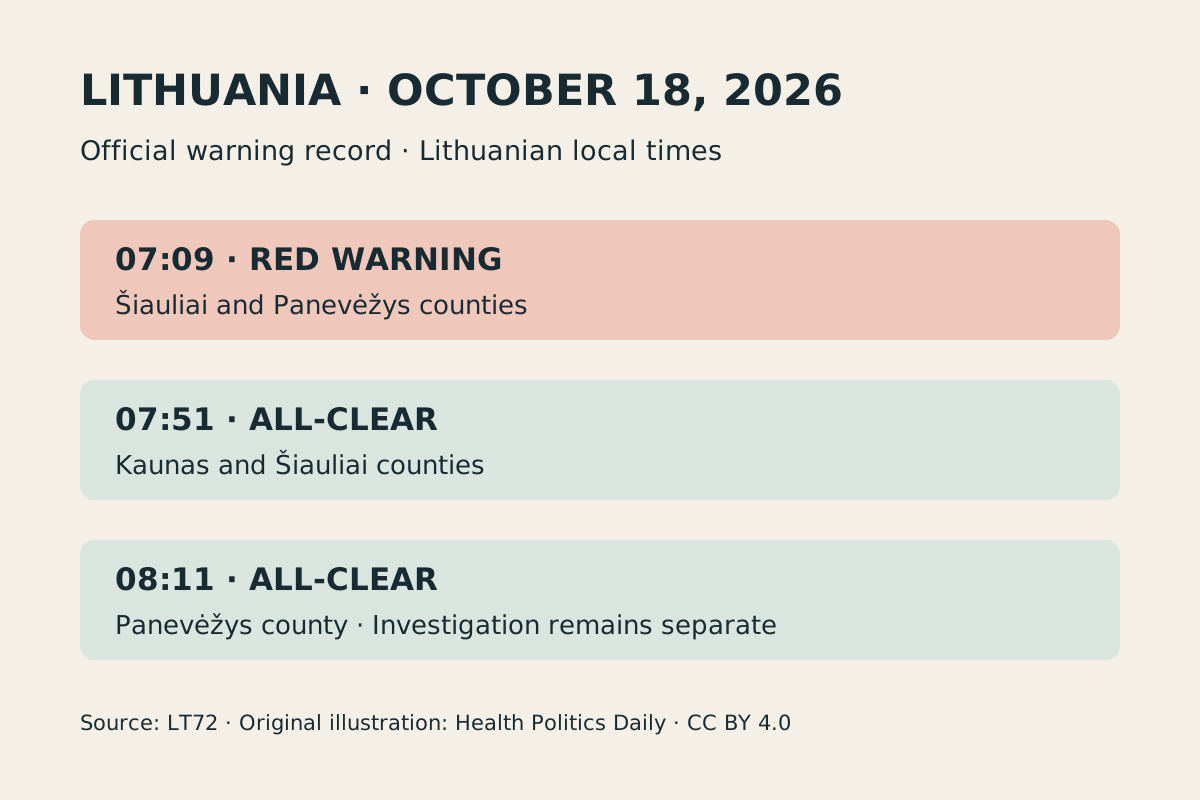
Lithuania lifted air warnings on Sunday morning, October 18, after a possible drone triggered shelter instructions in parts of the country. Official notices establish that the red alerts are over; they do not establish who operated the object or why it entered Lithuanian airspace.
The distinction matters for residents deciding whether an old warning still applies, and for anyone interpreting the incident as a confirmed military attack. A protective response and a final identification are different things.
What the official warning record shows
Lithuania’s LT72 emergency-preparedness portal records yellow warnings in Kaunas county at 7:00 a.m. and in Šiauliai and Panevėžys counties at 7:05 a.m. The latter two areas received a red warning at 7:09 a.m., referring to a potentially detected drone and directing people to a safe place. All times in this timeline are Lithuanian local time on October 18.
The portal records the all-clear for Kaunas and Šiauliai at 7:51 a.m., followed by Panevėžys at 8:11 a.m. The final cancellation notice says normal activities may resume. This article is reporting that completed warning episode, not issuing a new shelter instruction.
What investigators are examining
Reuters, citing the crisis-management centre, reported that NATO air-policing fighters were summoned and Kaunas airport closed during the episode. It also reported an investigation of possible drone debris near Juodžionys after the object disappeared from radar. The centre said the object probably entered from Poland; a probable route is not proof of an operator’s nationality.
In an interview reported by public broadcaster LRT, Defence Minister Robertas Kaunas said radar had tracked an object but fog and cloud prevented pilots from visually identifying it. He said a decision to destroy it was not taken because that visual identification had not been achieved. Those are the minister’s explanations of the response, not an independently completed finding about the object.
A separate police notice for Pasvalys district at 9:35 a.m. told people not to approach or touch suspicious objects and to call 112. The end of an airborne warning therefore should not be confused with permission to handle possible debris.
Why the alert matters beyond its duration
Analysis: Even a short air warning can interrupt work, travel and family routines. The verified timeline is useful because screenshots of the red message can keep circulating after authorities issue the all-clear. Sharing the date, affected area and subsequent cancellation gives readers more actionable information than an isolated image of an emergency notification.
The episode also illustrates an identification problem: authorities can take protective measures while uncertainty remains. Treating every precaution as evidence of a known attacker would go beyond the available record. Equally, cancelling a warning does not answer the investigation’s questions about what flew, what happened to it or whether anything hazardous remains on the ground.
Practical information and remaining uncertainty
Official guidance: LT72’s air-warning instructions say to follow the directions in the actual notification and subsequent official messages. Residents and visitors should check current notices rather than rely on this article for live alert status. Travellers should check their airline and airport for their own flight; a reported closure does not establish the status of every later departure.
Unresolved: The reviewed evidence does not establish the object’s manufacturer, operator, mission or confirmed cause of its loss from radar. It does not justify assigning responsibility to Russia, Ukraine, Poland or another country. No forecast of further incursions or escalation is offered here.
Bias Lens: precaution is not attribution
Verified baseline: Official Lithuanian notices document the warnings and cancellations. Investigation of the object remains a separate evidentiary task.
Reuters’ center-oriented report emphasizes the operational disruption. LRT’s minister interview foregrounds identification limits and the decision not to fire. LT72 provides the primary public-safety record rather than political commentary.
Distinct, verified left-leaning and right-leaning accounts of this specific morning’s incident were not identified in the coverage reviewed. We do not import partisan arguments from different incidents or label an official alert as a political viewpoint. The meaningful framing question here is whether a report distinguishes a possible drone from a confirmed origin and operator.
Sources and media
Primary sources are the dated LT72 alert, cancellation and police notices linked above. Reuters corroborates the incident; LRT carries the defence minister’s on-record account. The original illustration below the publication details is explanatory, not a map, radar image or picture of the object. No suitable directly relevant authorized video was verified, so none is embedded.
Related Coverage
For separate airspace and regional-security context, not evidence identifying this object: