AVIATION — BORDER SECURITY — DRONE OPERATIONS
FAA Announces U.S.–Mexico Border Drone Restriction; Operators Must Check Flight Notices
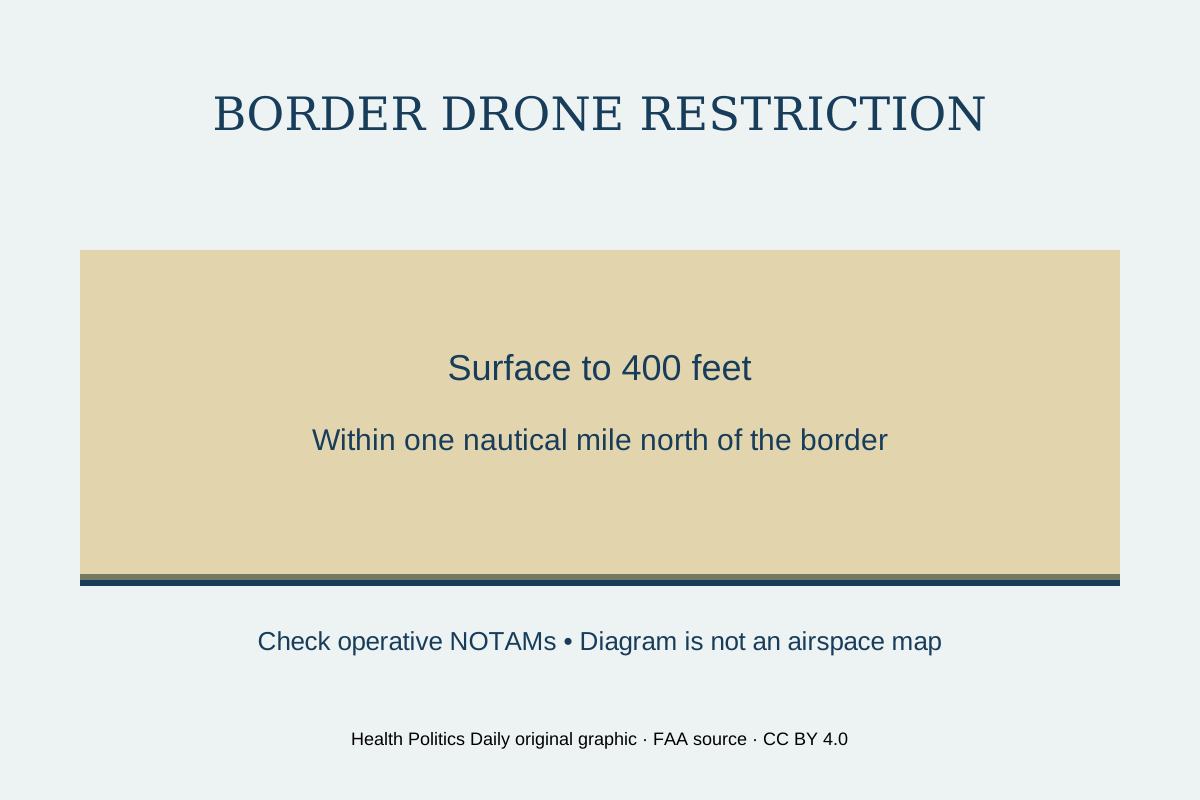
The announced restriction covers unauthorized drone flights within one nautical mile north of the border, from the surface to 400 feet. Two FAA publications give different start dates, making the operative flight notices essential.
By Health Politics Daily News Desk · October 17, 2026 at 2:02 a.m. ET
What the FAA announced
Verified fact: an October 16 FAA release announces a temporary restriction on unauthorized drone activity in a corridor extending one nautical mile north of the U.S.–Mexico border, from ground level to 400 feet. Transportation, defense and homeland security officials describe the measure as protecting border operations and personnel.
Reuters corroborated the announcement. The agencies’ statements about anticipated security benefits are their rationale, not independent evidence that the restriction has already reduced drone incursions.
The official publications differ on timing
The press release says the restriction is effective October 16. Its linked Domestic Notice instead carries an October 19, 2026–October 19, 2027 heading and references NOTAMs ZLA 6/9954, ZAB 6/9978 and ZHU 6/9956.
The notice expressly directs operators to the published NOTAMs for complete dates, times, boundaries, exceptions and requirements. This report cannot resolve the discrepancy between those two publications. Pilots should verify the operative notices for their exact flight rather than treat either a headline or the notice’s illustrative map as operational clearance.
What legitimate operators need to check
The Domestic Notice says access requests go to Customs and Border Protection at least 48 hours before the proposed operation. It lists operator identification, FAA certifications, contact information, flight details and aircraft information among the requested items. Emergency responders may qualify for expedited coordination.
Analysis: border-area surveying, inspection, photography and other lawful drone work may therefore require additional planning. A commercial purpose does not itself supply permission to enter restricted airspace. Operators should review the FAA’s TFR guidance and current notices before committing to a flight or promising a delivery date to a client.
The announced measure concerns drones in a defined corridor. It should not be described as a blanket closure of passenger aviation along the border.
Why coordination matters
Earlier counter-drone operations prompted scrutiny after airspace disruptions near El Paso. AP’s April report explains the FAA’s subsequent safety review and interagency coordination efforts.
Analysis: the central policy tradeoff is how to distinguish authorized activity from threats while protecting other airspace users. Publishing a restriction establishes a rule; it does not answer every question about identification accuracy or operational performance.
Drone technologies also appear in our coverage of Ukraine’s satellite-service restrictions. Closer to home, the Norte Fire response illustrates why emergency operations require reliable airspace coordination, although it is a separate incident and location.
What remains uncertain
The reviewed press release and Domestic Notice do not reconcile their start dates. The effect on authorized civilian work and the measurable security benefits remain to be established. Forecast: implementation will depend on clear notices, timely permissions and consistent interagency coordination. No prediction about incident reductions or automatic airport closures is justified by the announcement alone.
Bias Lens: security rationale and operational accountability
Verified baseline: the FAA announced a drone restriction and directs pilots to operative notices.
Center: Reuters explains the announcement and enforcement context. Left-leaning contextual coverage: The Guardian’s earlier reporting stresses coordination failures. Right-leaning contextual opinion: Chuck DeVore’s Fox News column favors stronger action.
The latter sources address earlier events and are not reports on this new restriction. Their different priorities do not resolve its dates or establish its effectiveness. Opinion and attributed political criticism are distinct from the FAA’s operational instructions.
Sources and video
Principal sources are the linked FAA release, Domestic Notice, TFR guidance and Reuters reporting. Reuters’ October 5 publisher-hosted video provides earlier counter-drone testing context; it does not depict implementation of the new restriction. No media is downloaded or rehosted.