International politics · China · North Korea
Kim Jong Un Enters China via New Yalu River Bridge
South Korea says the North Korean leader crossed into Dandong through a border bridge that opened this month. The trip is verified; its agenda, duration and economic results are not.
By Health Politics Daily News Desk · October 24, 2026 at 4:03 a.m. ET
Verified baseline
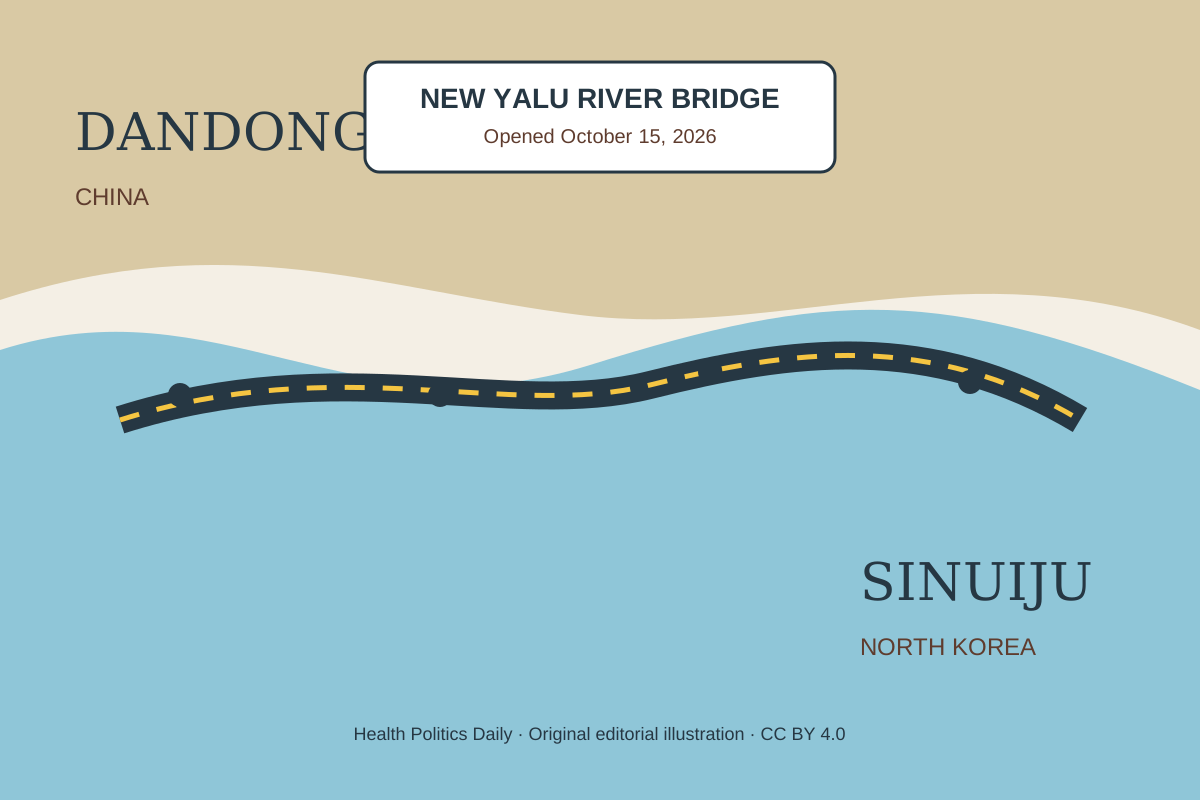
South Korea’s Unification Ministry said Saturday that North Korean leader Kim Jong Un was visiting the Chinese border city of Dandong. A South Korean government source told Yonhap News Agency that Kim entered through the New Yalu River Bridge earlier in the day.
Reuters and the Associated Press separately reported the South Korean confirmation. Chinese and North Korean state media had not published a detailed itinerary when this article was completed.
Why the bridge matters
The crossing is itself part of the story. The 3-kilometer New Yalu River Bridge opened to traffic on October 15 after years of delay. It provides a modern road route between Sinuiju and Dandong capable of carrying containers, heavy equipment and other freight around the clock.
China remains North Korea’s principal trading partner and diplomatic backer. The bridge could expand legal commerce, but U.N. sanctions still restrict many transactions tied to Pyongyang’s nuclear and missile programs. A ceremonial crossing does not show how much cargo will move, what goods will be exchanged or how sanctions will be enforced.
Diplomatic context
Kim’s previous publicly known trip to China was in September 2025. Chinese President Xi Jinping visited Pyongyang in June 2026, when the two governments pledged closer cooperation in trade, agriculture, construction and technology. North Korea has also deepened military and economic ties with Russia, giving Kim more room to balance two larger neighbors.
The visit comes as South Korea seeks military talks with North Korea to reduce border risks and as U.S. officials assess whether renewed diplomacy with Pyongyang is possible. For background, see our reporting on North Korea’s October 12 missile launches and our earlier review of its hypersonic-missile claim.
Practical implications
For governments and companies, the immediate question is whether the bridge produces a measurable rise in border trade. Shipping and customs data—not ceremony alone—will be the clearest evidence. Any restricted goods, financial services or military-use technology would raise sanctions-compliance questions.
For people in North Korea, more trade could improve access to food, fuel and industrial inputs, but there is no public agreement guaranteeing that benefits will reach households. Travelers should rely on current government advisories; the visit does not mean the North Korean border is broadly open.
Fact, analysis, forecast and opinion
Verified fact: South Korea says Kim entered Dandong via the newly opened bridge. Analysis: using the crossing gives political weight to infrastructure intended to deepen China–North Korea commerce. Forecast: a senior meeting and announcements on trade are plausible, but neither was confirmed at publication. Opinion: Health Politics Daily takes no position on engagement policy; claims that the trip proves a new alliance or imminent nuclear talks exceed the available evidence.
Bias Lens: strategic realignment or a border visit?
Verified baseline: South Korea confirmed the visit and the bridge crossing; the agenda and any meeting with Xi Jinping were not publicly confirmed.
Center coverage — Reuters and AP: both lead with South Korea’s confirmation and frame the crossing as evidence of renewed Beijing–Pyongyang ties. Primary regional reporting — Yonhap: stays closest to the government source and gives fewer conclusions about motive. A reliable left-center-right split had not developed around this breaking event, so this lens does not force ideological symmetry.
What remains uncertain
Neither the full delegation nor the schedule was public. It was not known whether Kim would meet Xi, how long he would remain in China, whether the trip extends beyond Dandong, or whether the two sides would announce agreements. Because the initial confirmation relied on South Korean officials, details should be updated if Beijing or Pyongyang publishes a formal account.
Principal sources
- Yonhap — South Korean government source and Unification Ministry confirmation
- Reuters — visit and regional context
- Associated Press — independent corroboration and diplomatic context
No suitable directly relevant official or publisher-authorized video with clear embedding permission was available, so none was embedded.