NORTH KOREA — MISSILE SECURITY — EAST ASIA
North Korea Fires Multiple Ballistic Missiles After South Korean Hypersonic Test
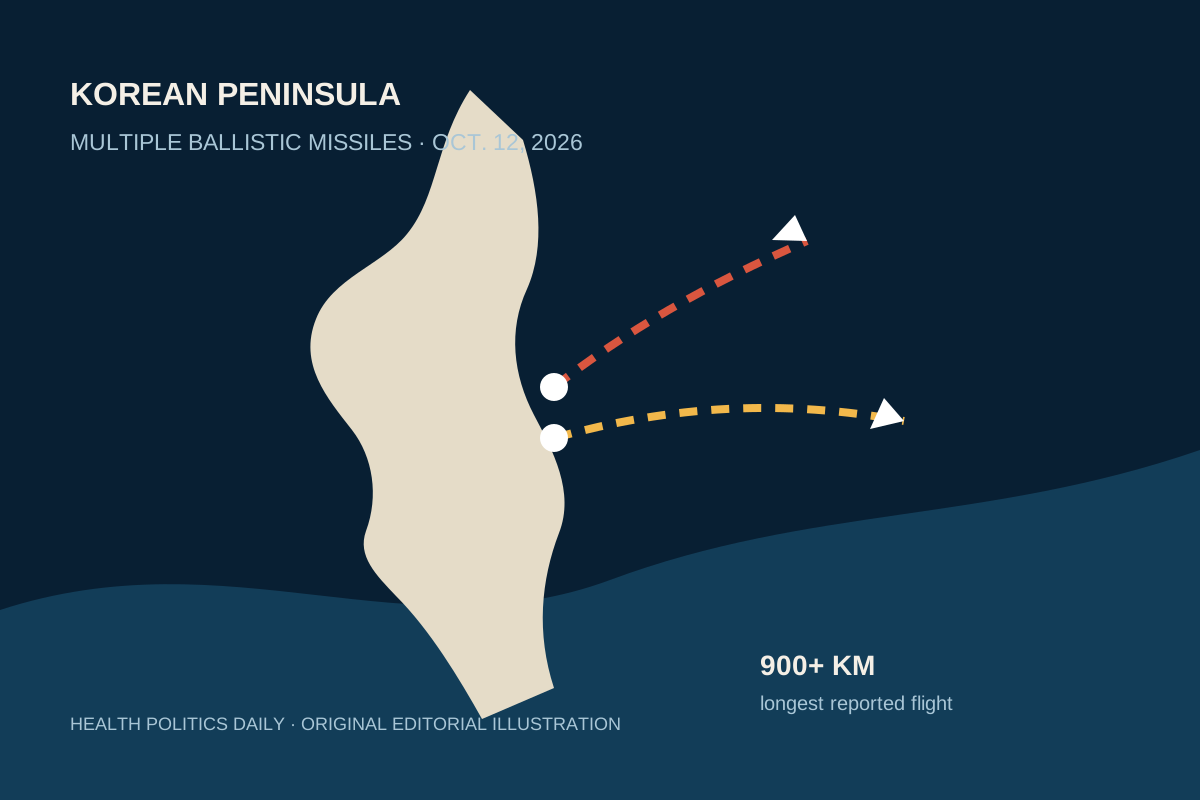
North Korea launched multiple ballistic missiles of apparently different types from near Pyongyang, with one flying more than 900 kilometers. The weapons fell outside Japan’s exclusive economic zone, and officials reported no damage.
By Health Politics Daily News Desk · Published Monday, October 12, 2026 at 2:01 a.m. America/New_York · Approximately 8 minutes
Verified Baseline
Seoul and Tokyo detected multiple launches
South Korea’s Joint Chiefs of Staff said North Korea fired multiple ballistic missiles at about 9:20 a.m. local time Monday from the Pyongyang area. The military said the launches appeared to involve different missile types and that one weapon traveled more than 900 kilometers before falling into the sea east of the Korean Peninsula.
Japan’s Defense Ministry separately reported suspected ballistic-missile launches and said the projectiles had fallen. Japanese officials told Associated Press that they detected at least two missiles launched 17 minutes apart; both landed outside Japan’s exclusive economic zone and caused no reported damage. Reuters independently reported the South Korean assessment.
Verified fact: multiple ballistic missiles were detected and no impact inside Japan’s exclusive economic zone was reported. Not yet verified: the missiles’ exact models, payloads, maximum speeds, maneuvering performance or intended targets.
What Happened
The launch followed a rare public South Korean weapons test
Days earlier, South Korea flight-tested its first domestically developed hypersonic weapon while President Lee Jae Myung watched. Seoul said that weapon separated from its booster, maneuvered and struck a target. Hypersonic systems are designed to travel at least five times the speed of sound and can complicate interception when they maneuver unpredictably.
The timing makes the South Korean test important context, but timing alone does not prove North Korea launched in direct retaliation. Pyongyang had already conducted several missile demonstrations in recent weeks, including an October 3 test it described as a new intermediate-range system. North Korea had not published a detailed account of Monday’s launches when this article was completed.
This report is a distinct update to our October 4 analysis of North Korea’s earlier hypersonic claim. Monday’s event involved multiple projectiles and a new South Korean and Japanese detection record.
Why It Matters
Different missile types complicate warning and defense
A mixed launch can require defenders to track projectiles with different ranges, trajectories and maneuvering patterns at the same time. The reported 900-kilometer flight is long enough to raise concern across South Korea and Japan, but distance alone does not establish whether the weapon was intermediate-range or carried a particular payload.
United Nations Security Council resolutions prohibit North Korea’s ballistic-missile activity. South Korea convened an emergency National Security Office meeting and called the launches violations of those resolutions. Japan, the United States and South Korea routinely share warning data, but Monday’s technical analysis was still underway.
The launch also arrives during a diplomatic freeze. President Donald Trump has expressed interest in renewed talks with Kim Jong Un, while Pyongyang has demanded an end to what it calls hostile U.S. policy and rejects negotiations premised on denuclearization. A weapons test does not itself prove that diplomacy has ended, but it increases the military and political cost of restarting it.
Practical Implications
What changes now—and what does not
- Residents and travelers: no government reported damage or an immediate public-safety emergency. Official alerts remain the reliable source during future tests.
- Shipping and aviation: authorities may issue navigation warnings while debris areas and flight paths are assessed; no broad closure was announced initially.
- Regional militaries: South Korea, Japan and the United States will compare radar and satellite data to classify the missiles.
- Diplomacy: the launch adds pressure but does not create new sanctions automatically.
- Risk assessment: a 900-kilometer flight does not show that a nuclear warhead was carried or that an attack was imminent.
What Remains Uncertain
Officials have not identified every missile
South Korea did not initially specify the total number of projectiles or publish complete altitude, speed and trajectory data. Japan said one missile may have followed an irregular path, but that preliminary observation is not confirmation that it was a hypersonic glide vehicle.
Analysis: the use of apparently different missile types may be intended to test layered defenses or demonstrate coordinated launches. Forecast: technical classification and any North Korean state-media claim are likely to shape the next allied response. Opinion: Health Politics Daily takes no position on military procurement; public discussion should distinguish measured flight data from claims about capability or intent.
Bias Lens: how coverage frames the launch
South Korea detected multiple ballistic missiles from near Pyongyang, one flying more than 900 kilometers. Japan detected at least two and reported no damage after they fell outside its exclusive economic zone. Exact missile models and intent remain under analysis.
Center coverage: Associated Press emphasizes the continuing test streak, frozen diplomacy and the possibility that one weapon maneuvered; Reuters foregrounds the sequence after South Korea’s hypersonic test and Seoul’s emergency meeting. Right-leaning context: Fox News covered the October 3 launch with greater emphasis on potential range to Guam, Alaska and U.S. deterrence. It predates Monday’s launch, so it is context rather than equivalent breaking coverage.
No timely, directly comparable mainstream left-leaning report on Monday’s launch was available at publication. The article does not force symmetry: differences are mainly in emphasis on technical uncertainty, diplomatic sequence and U.S. strategic exposure.
Principal Sources
Official notice and independent reporting
- Japan Ministry of Defense — October 12 missile notice
- Associated Press — launch profile and Japanese assessment
- Reuters — South Korean military statement and security meeting
- Associated Press — South Korea’s hypersonic test
No suitable official or publisher-authorized video of Monday’s launches was available with clear embedding permission. No video was embedded.
Related Coverage