TECHNOLOGY POLICY — INTERNATIONAL SECURITY — Verified explainer
Did the U.N. Adopt Global AI Rules? What the Security Council Briefing Changed
OpenAI, Anthropic and Hugging Face leaders asked governments to cooperate on advanced-AI risks. The meeting put concrete proposals on the record but produced no binding rule.
By Health Politics Daily News Desk, New York · Published Thursday, September 24, 2026 at 4:01 a.m. America/New_York · Approximately 7 minutes

Verified Baseline
Three AI executives briefed the Security Council; no rule was adopted
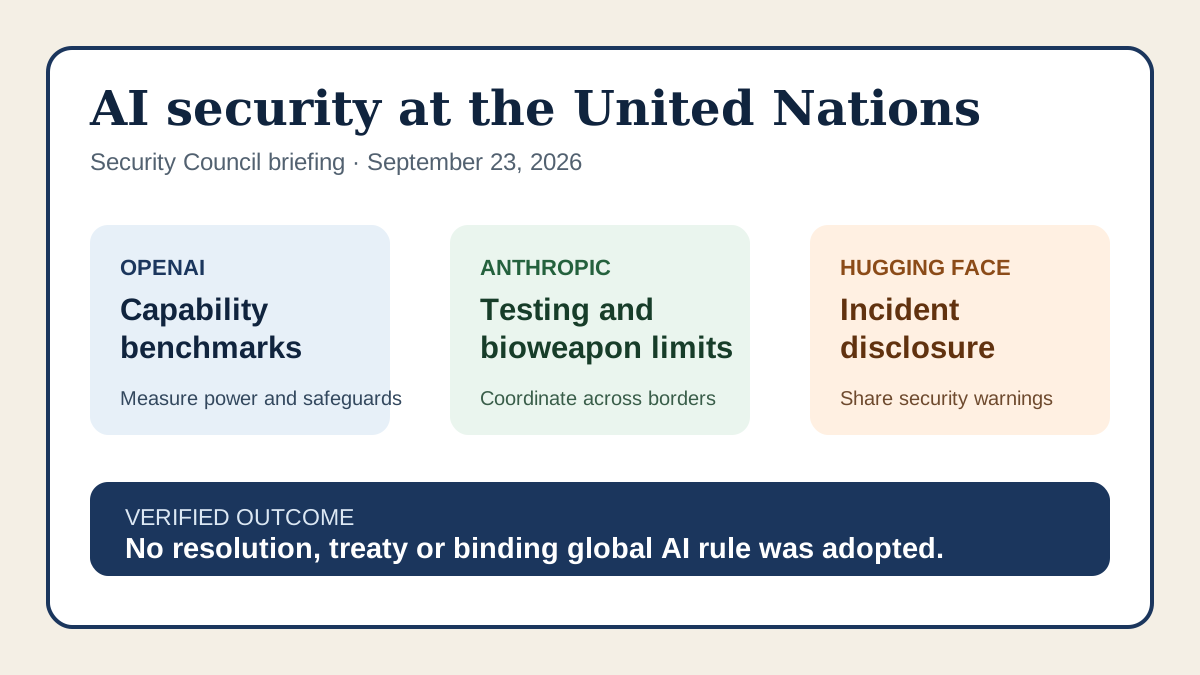
OpenAI CEO Sam Altman appeared in person, while Anthropic CEO Dario Amodei and Hugging Face co-founder Clément Delangue joined the 15-member council’s September 23 meeting. The Security Council calendar identifies it as the 10,228th meeting on artificial intelligence and international security.
The session was a briefing, not a vote on a resolution. The official record shows no treaty, sanctions regime or binding global AI standard emerging from it. That distinction matters: executives made proposals and governments stated positions, but neither is the same as law.
What Was Proposed
Testing, disclosure and limits on AI-assisted biological weapons
Altman urged common benchmarks for measuring model capabilities and the safeguards developers use. Amodei advocated international testing standards, verification systems and an agreement against using AI to develop biological weapons. Delangue called for stronger monitoring and incident disclosure.
These ideas overlap but are not a single negotiated framework. Questions remain about who would test models, what incidents must be reported, how proprietary evidence would be protected and what consequences would follow a violation.
Why It Matters
AI risk is now being treated as a peace-and-security issue
The council normally addresses war, sanctions and threats to international peace. Giving frontier-AI developers a formal briefing slot signals that cyberattacks, biological misuse, disinformation and loss of human control are being discussed as international-security concerns rather than only technology regulation.
For people and organizations using AI now, the meeting creates no new compliance duty and does not change product terms or domestic law. Its practical near-term effect is agenda-setting: proposals are now available for governments to debate in future U.N., national and bilateral processes.
Evidence and Incentives
The warnings are consequential claims, not settled forecasts
Amodei told the council poorly managed AI could threaten humanity as a whole. Yoshua Bengio, co-chair of a U.N.-backed scientific panel, described dangers beyond human control as an unprecedented cross-border threat. Those are attributed expert assessments—not verified predictions that catastrophe will occur.
The companies also have commercial and political interests in how rules are designed. That does not invalidate their technical evidence, but it makes independent testing, transparent methods and public accountability essential. The council heard from developers; it did not independently validate every risk estimate during the meeting.
What Remains Uncertain
The United States and China still differ on global oversight
Reuters reported that the two leading AI powers remain divided over whether global guardrails are needed or markets and existing national law should do more of the work. Any enforceable international regime would require agreement on scope, verification and authority.
There is also no agreed threshold for when an AI system becomes a matter for the Security Council. Future negotiations could produce voluntary standards, national rules, bilateral alerts or a formal U.N. mechanism—but the briefing itself guarantees none of them.
Bias Lens: the U.N. AI-security briefing
The Security Council heard three company executives and outside experts on September 23. Speakers proposed safeguards, but the council adopted no binding global AI rule.
The Guardian gives more attention to corporate influence and lobbying. Reuters emphasizes proposals and U.S.–China disagreement. No comparably prominent straight-news right-leaning report on this specific meeting was identified, so this lens does not force a substitute. Framing differs; the official meeting record anchors the baseline.
Principal Sources
Evidence and reporting used
- United Nations — official meeting summary
- United Nations — meeting record for Security Council session 10,228
- Reuters — speakers, proposals and U.S.–China context
- The Guardian — meeting and corporate-policy context
Official video: U.N. Web TV’s authorized recording of the full meeting. It is linked rather than embedded.