Korean Peninsula · Security · International politics
North Korean Artillery Seen Near DMZ as Border Dispute Reaches UN
A visibly positioned weapon adds to a confrontation over a September landmine blast, repeated border crossings and competing warnings. Its purpose and duration are not established.
By Health Politics Daily News Desk · October 26, 2026 at 2:02 a.m. ET

Watch in this article
Pumpjack operating at the Kern River Oil Field
A short CC0 field video provides visual context for reporting on oil production and fuel supply.
Thomas Farley / Wikimedia Commons · CC0 1.0 · License and source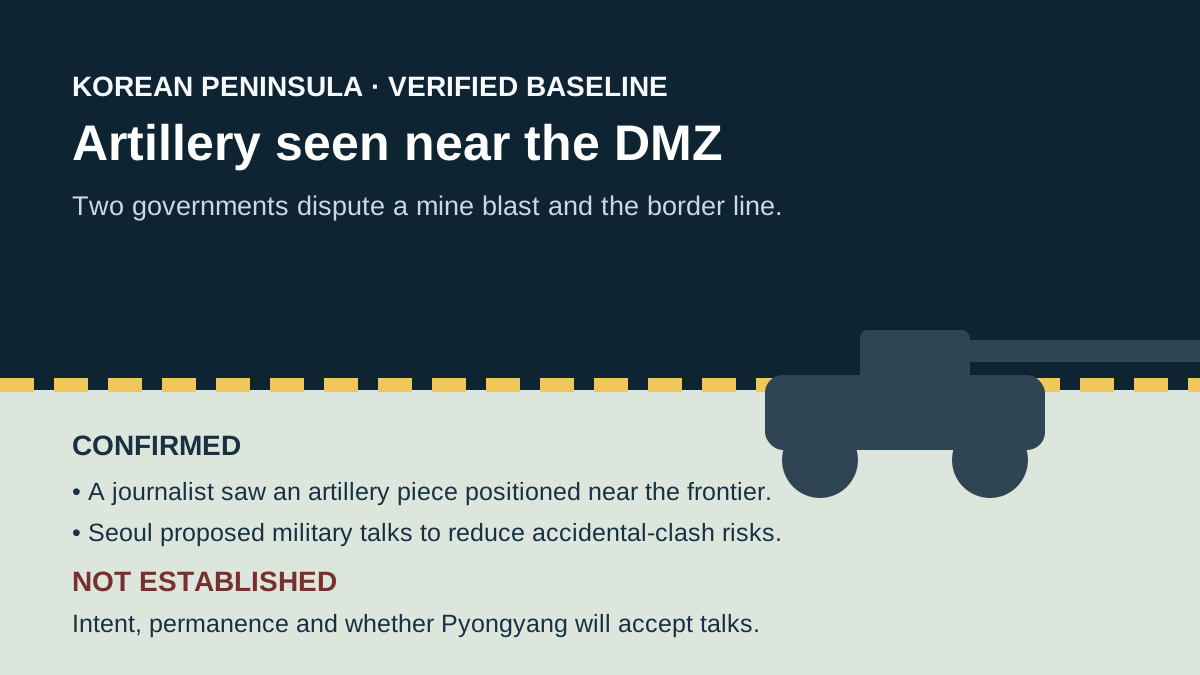
Verified baseline
A Reuters journalist at a South Korean observatory saw a North Korean artillery piece positioned in clear view near the heavily fortified border on Monday. South Korea’s Yonhap news agency identified it as a 122 mm self-propelled howitzer and described the placement as an unusual public display. Photographs also showed armored vehicles facing south and troops working on fencing inside the Demilitarized Zone.
The sighting does not establish that the weapon is newly deployed, permanently stationed or prepared to fire. North Korea has not publicly explained the placement. Military hardware in a tense area can carry a signaling purpose without proving that an attack is imminent.
Why tensions are rising
The display comes amid a dispute over September 21 mine explosions that injured three South Korean soldiers. Seoul says a joint investigation and forensic evidence linked the blast to North Korean mines south of the Military Demarcation Line. Pyongyang denies responsibility and, in a letter reported by its state news agency, accused Seoul of fabricating the incident.
South Korea told the UN Security Council that the mine incident violated the 1953 armistice. North Korea submitted its own letter rejecting that claim and warning that alleged violations of its sovereignty could trigger self-defence measures. The United Nations Command’s armistice guidance says placing mines south of the line is an automatic violation, while defensive work north of it is not.
The practical risk is miscalculation
South Korea says North Korean personnel have crossed the line roughly 50 times this year while expanding fences, roads, barriers and minefields. South Korean forces have answered some crossings with warning broadcasts and shots. Pyongyang says its workers remain on its side and has threatened a strong response if warning fire causes damage or injuries.
Some old boundary markers have disappeared, and the two militaries do not agree on every local interpretation of the line. That combination—armed work parties, warning fire, mines and heavier weapons nearby—raises the chance that a limited incident could be mistaken for a deliberate attack.
On October 23, South Korea proposed military talks to confirm the ground boundary, restore military communication channels and discuss steps to prevent accidental clashes. It also said it was open to three-way talks with the United Nations Command. North Korea had not accepted the proposal at publication time.
What this means for people
The development does not create a general evacuation order or establish that conflict is imminent. Local authorities remain the appropriate source for access restrictions, shelter instructions and unexploded-ordnance warnings. People should not approach border barriers or objects that could be mines.
For governments, the immediate question is whether reliable military-to-military contact can be restored before another crossing or warning-shot episode. For markets and travelers, the verified development is a visible artillery deployment during a diplomatic and military dispute, not evidence that firing has begun.
Fact, analysis, forecast and opinion
Verified fact: an artillery piece was seen near the border, both Koreas have sent competing accounts of the mine dispute to the UN, and Seoul has proposed talks. Analysis: the weapon’s visibility may be intended as a deterrent signal, but available evidence does not prove its purpose. Forecast: more patrol encounters or propaganda broadcasts could increase pressure for talks; whether Pyongyang responds is unknown. Opinion: Health Politics Daily favors accurate public information and protection of civilians, and takes no position on either government’s political system or territorial claims.
Bias Lens: how coverage frames the border confrontation
Verified baseline: a weapon was visibly positioned near the DMZ; Seoul and Pyongyang dispute responsibility for the mine blast; South Korea proposed talks; North Korea’s intent and willingness to negotiate remain unverified.
Center-oriented wire coverage: Reuters combines the firsthand sighting with both governments’ UN letters and expert caution about signaling. Left-leaning coverage: The Guardian emphasizes deteriorating ties and a possible return of propaganda broadcasts, while noting Seoul’s earlier de-escalation steps. Right-leaning coverage: the New York Post foregrounds North Korea’s threat to deploy more weapons and uses more confrontational language. These are differences in emphasis, not evidence that any account alone establishes the weapon’s purpose.
What remains uncertain
It is not known how long the artillery piece has been at the site, whether it is operational, whether other weapons were moved, or whether the display changes either military’s rules of engagement. The origin and movement of the mines, the exact local boundary and North Korea’s response to the talks proposal remain contested.
Principal sources
- United Nations Command — DMZ armistice enforcement fact sheet
- Reuters — firsthand sighting and competing UN letters
- Associated Press — South Korea’s military-talks proposal
- Yonhap — North Korea’s reported UN letter
No suitable directly relevant official or publisher-authorized video with clear downstream embedding permission was available, so no video was embedded.