Global events · Spain · Public safety
Spain’s Adam Floods Force Rooftop Rescues as Restrictions Ease
Flooding disrupted homes and transport in Valencia and Alicante on October 19. Later reports say the remaining confinement orders ended—not that recovery is complete.
By Health Politics Daily News Desk · October 19, 2026 at 6:02 p.m. ET
Helicopters rescued residents from rooftops in eastern Spain on October 19 after torrential rainfall associated with Adam flooded communities in Valencia and Alicante. Later local reports said authorities had lifted the remaining stay-at-home restrictions, marking a change from the morning emergency—not a declaration that every road, home or service was safe. The lifting is also corroborated in El País’s late-evening update, reviewed before this edition’s first publication.
From rescue operations to easing restrictions
Reuters’ October 19 dispatch describes helicopter rescues and residents stranded by floodwater. That report captured an earlier phase when restrictions still affected tens of thousands of people.
EFE’s regional account describes an initial confinement affecting 145 municipalities, subsequently reduced to eight. They were Bellreguard, Oliva, Daimús, Piles and Miramar in Valencia, and Xàbia, Pego and Els Poblets in Alicante.
Later reports from Cadena SER and The Objective say regional emergency chief Juan Carlos Valderrama announced the end of confinement in those final eight towns after an emergency coordination meeting. They also report demobilization of the Military Emergency Unit as conditions improved.
Reporting limit: The regional government’s press pages could not be retrieved for this edition. The lifting announcement is therefore attributed to the linked reporting, not presented as a government document independently inspected by this newsroom.
What AEMET warned—and why forecast dates matter
AEMET’s special notice 37/2026, issued October 18 at 13:39, described a detached upper-level low—known in Spain as a DANA—interacting with moist easterly and northeasterly air. It warned of intense, persistent rainfall, local flooding and sudden rises in streams and normally dry channels, particularly where soils were already saturated.
The notice identified October 18–19 as the most adverse period and anticipated rainfall shifting toward northern Valencian and Catalan coastal areas. It also stressed uncertainty about the low’s position and the precise rainfall distribution. Those statements are a dated forecast, not measurements or a live warning for every place named.
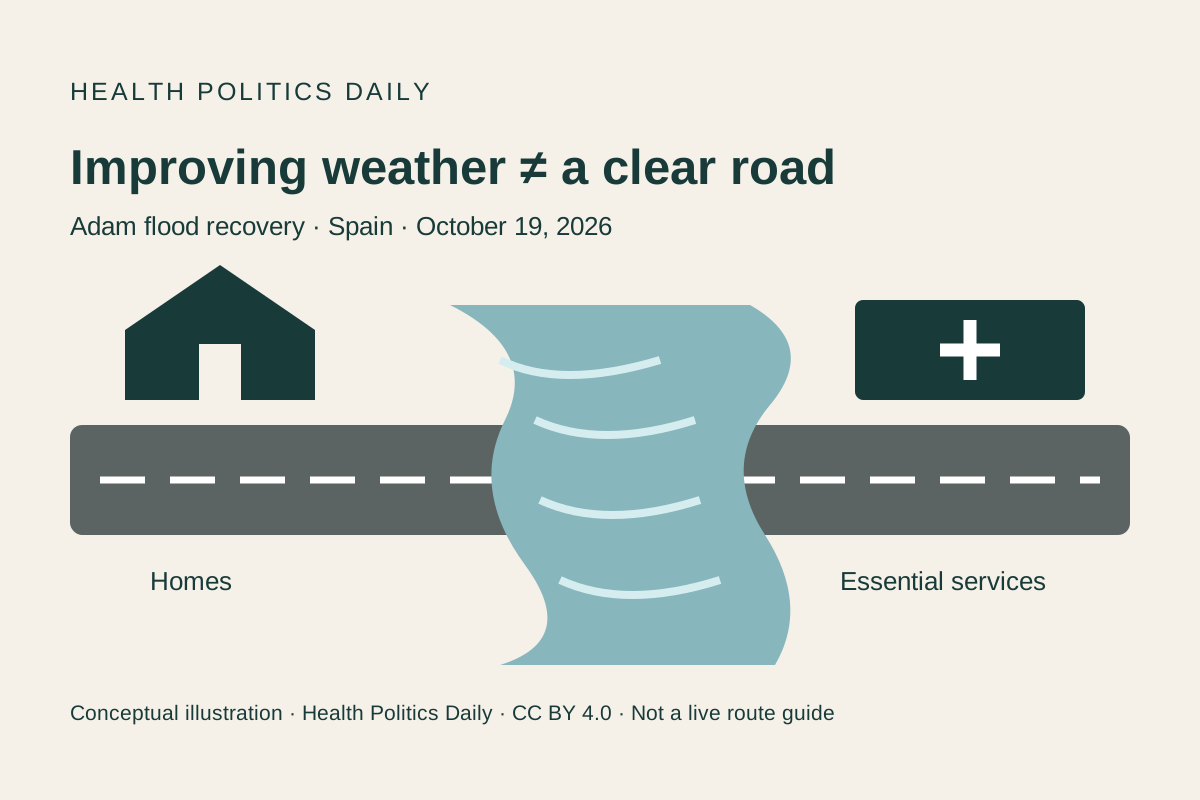
Analysis: Forecast improvement and recovery are different milestones. Less rain does not remove water, debris or damage already interrupting access. A regional relaxation of movement rules also does not certify a particular bridge or street as usable.
The human cost and the limits of a running tally
RTVE’s October 19 bulletin reports four confirmed deaths associated with the storm and another death whose relationship to the rains remained under investigation. This edition attributes that count to the broadcaster and does not combine totals from different reporting times or geographic areas.
El País’s reporting from Oliva describes isolated homes and families trying to establish that relatives were safe. That illustrates why communication and access remain consequential even after the heaviest rain passes. Individual accounts are not a measure of conditions throughout the region.
What residents and visitors can usefully check
Spain’s Civil Protection flood guidance warns against crossing flooded stretches on foot or by vehicle: water can carry both people and vehicles away. Follow current local instructions and barriers rather than infer safety from a route’s appearance or a social-media video.
Before essential travel, check the latest official AEMET warnings, local emergency notices and transport-operator updates. Confirm an appointment or service directly before setting out. This article is a dated report, not a live road-status list or an instruction to return to a flooded property.
The separate October 4 Catalonia flood report concerns an earlier event. Our Northeast U.S. flood explainer offers another example of distinguishing forecasts from observed disruption; its alerts do not apply to Spain.
Bias Lens: rescues, household disruption and recovery
Verified baseline: Flood rescues occurred on October 19. Later reporting says the remaining confinement orders were lifted. AEMET’s October 18 notice is a forecast document, not a current local all-clear.
Left-leaning—El País: The linked Oliva dispatch foregrounds household isolation, family contact and the difficulty of reaching affected homes.
Center—Reuters: Its dispatch leads with rooftop rescues and the scale of emergency restrictions at that stage of the day.
Right-leaning—The Objective: Its publicly retrievable report, published at 21:13 Spanish local time, foregrounds lifting restrictions and the transition in the emergency response. The full page could not be opened, so this observation is limited to the retrievable text.
These differences reflect reporting focus and timing; they do not establish a partisan dispute about rescue needs. The accounts are not simultaneous snapshots. No framing proves that all danger has ended or assigns responsibility for every loss.
What remains uncertain
The final casualty total, full damage assessment, restoration timetable and precise remaining local hazards are not established here. This report does not attribute a specific death to flooding while its cause remains under investigation, estimate losses or assign blame. The dated forecast should be replaced by current official information when making immediate safety decisions.
Sources and video
Primary context comes from AEMET and Civil Protection; Reuters, EFE and local reporting establish the event sequence with the access limits noted above. Watch the directly relevant report on RTVE’s official video page. It is linked, not embedded, downloaded or rehosted. The original conceptual illustration is licensed CC BY 4.0.