CATALONIA — FLOOD EMERGENCY
Catalonia Floods Kill Two: What Travelers and Residents Should Know
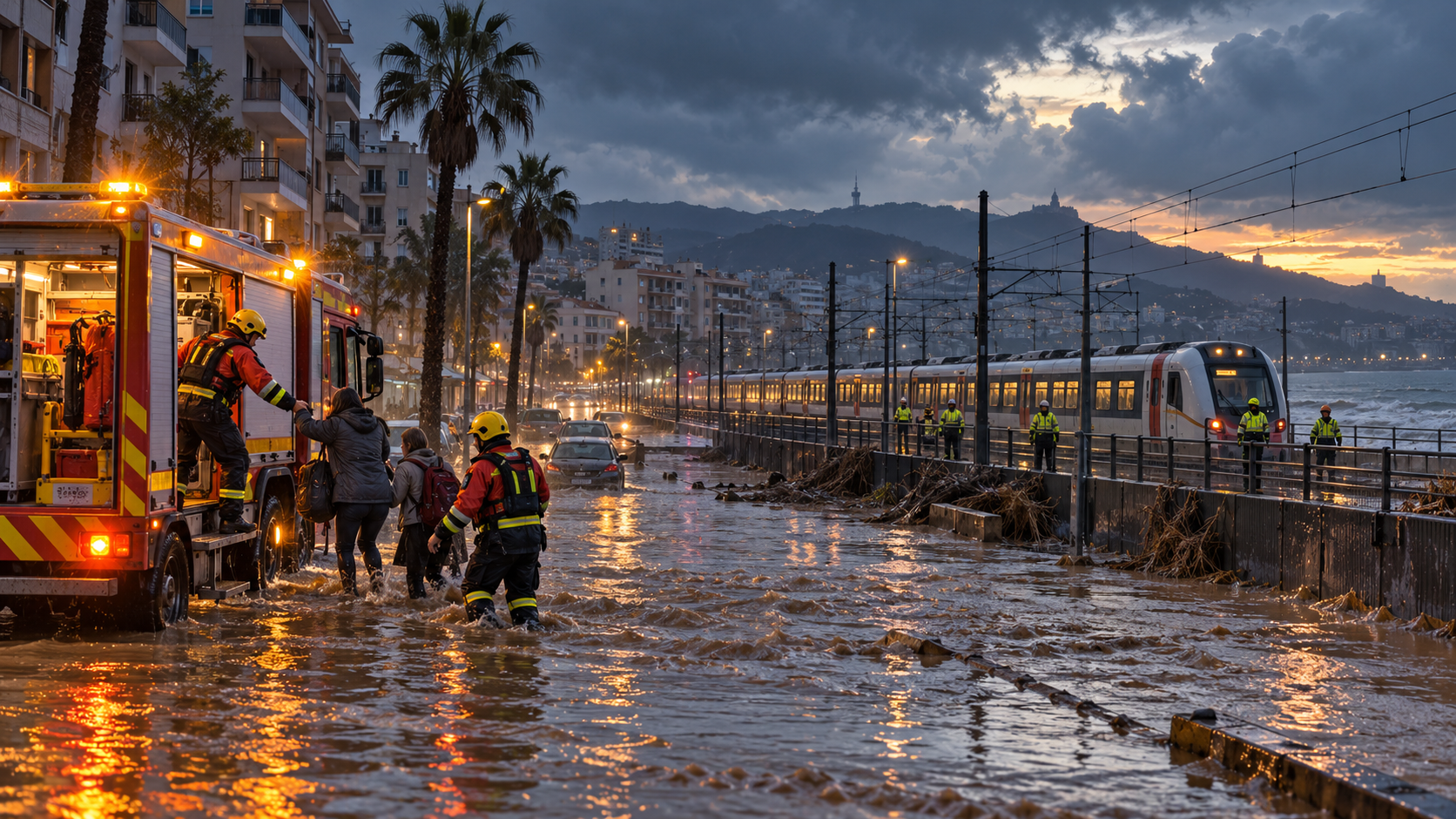
Catalonia ended broad mobility restrictions Sunday evening after severe flooding killed two people and prompted hundreds of rescues. The weather has improved, but the regional INUNCAT flood plan remains in its emergency phase and some transport disruption continues.
By Health Politics Daily News Desk · Published Sunday, October 4, 2026 at 4:00 p.m. America/New_York · Approximately 7 minutes
Verified Baseline
Two deaths are confirmed as restrictions ease
Catalonia’s government says two people died during the flooding, one in Montornès del Vallès and one in Tordera. By 3 p.m. local time, the 112 emergency service had received 7,608 calls connected to 5,546 incidents. Firefighters reported 2,469 operations by 8 p.m., including 228 rescues, while the regional emergency medical service recorded 87 affected people and 11 hospitalizations, none described as serious.
Authorities lifted broad mobility restrictions at 9 p.m. local time and closed the river-flow warnings because officials no longer saw an immediate overflow risk. Those changes do not mean the emergency is over: Catalonia kept the INUNCAT flood plan in its emergency phase, and forecasts still allowed for isolated showers and a low probability of torrential rain.
Why It Matters
Conditions can improve before roads and transport fully recover
Flood risk has two timelines. Rainfall and river levels can fall first, while damaged roads, debris, waterlogged buildings and disrupted rail service take longer to clear. The regional government said transport was being restored gradually and that some disruptions remained.
Spain’s AEMET weather agency maintained a red alert for Girona into early Monday, according to El País, while the heaviest totals were reported closer to the Barcelona coast. That geographic difference matters: a regional headline does not describe conditions on every route or in every municipality.
Practical Implications
What residents and travelers should check
- Use official route information: confirm Rodalies rail service, road closures and airport status before leaving. A general lifting of restrictions does not guarantee a particular route is open.
- Avoid floodwater: do not drive or walk through water covering a road, underpass, stream crossing or ford. Depth and current are difficult to judge, and pavement may be damaged.
- Follow local alerts: Meteocat and Catalonia Civil Protection provide the current warning map and emergency notices. Conditions can differ sharply over short distances.
- Call 112 for an emergency: use the regional emergency number for immediate danger; do not enter a flooded area to retrieve a vehicle or belongings.
What Remains Uncertain
A missing-person search and overnight weather risk
Earlier official updates said teams were searching for a missing person in Pineda de Mar. The later Catalonia government bulletin confirmed the two deaths but did not announce a resolution of that search, so this article does not count the missing person as a fatality.
Verified fact: two people died, hundreds were rescued and the broad mobility restriction ended. Analysis: the main near-term risk is shifting from widespread movement limits to localized hazards and infrastructure recovery. Forecast: further disruption is possible if overnight rain intensifies, but no reliable source can predict impacts on a specific street or journey.
Bias Lens: disaster toll, public warning or service disruption?
Catalonia confirmed two deaths, thousands of emergency calls and hundreds of rescues. Broad mobility restrictions ended Sunday evening, while the INUNCAT emergency remained active and some transport disruption continued.
The Guardian, generally described as left-leaning, foregrounded the human toll and warnings of rainfall above 200 millimeters. Center-oriented Reuters emphasized the confirmed deaths, missing-person search and travel disruption. No major right-leaning outlet had comparable original reporting with updated official totals at publication time; forcing a third label with commentary would create false symmetry. These framing choices affect emphasis, not the official baseline.
Principal Sources
Emergency updates, weather data and corroborating reporting
- Government of Catalonia — restrictions lifted, emergency status and final Sunday response totals
- Catalonia Civil Protection — INUNCAT alerts and safety guidance
- Meteocat — official Catalonia weather observations and warnings
- Reuters — deaths, missing-person search and transport disruption
- El País — rainfall totals, storm context and Girona warning
No directly relevant official or publisher-authorized video with clear embedding permission was available at publication time, so no video was embedded.