MIDDLE EAST — ENERGY SECURITY — YEMEN
Houthi Attack Damages Saudi Aramco Headquarters as Oil-Site Threats Expand
A strike damaged several upper floors of the state oil company's headquarters in Dhahran without reported casualties. The attack did not produce a reported oil-supply outage, but the Houthis say Saudi oil facilities and airports remain targets.
By Health Politics Daily News Desk · Published Wednesday, October 14, 2026 at 6:00 p.m. America/New_York · Approximately 8 minutes
Verified Baseline
Saudi officials confirm damage and no casualties
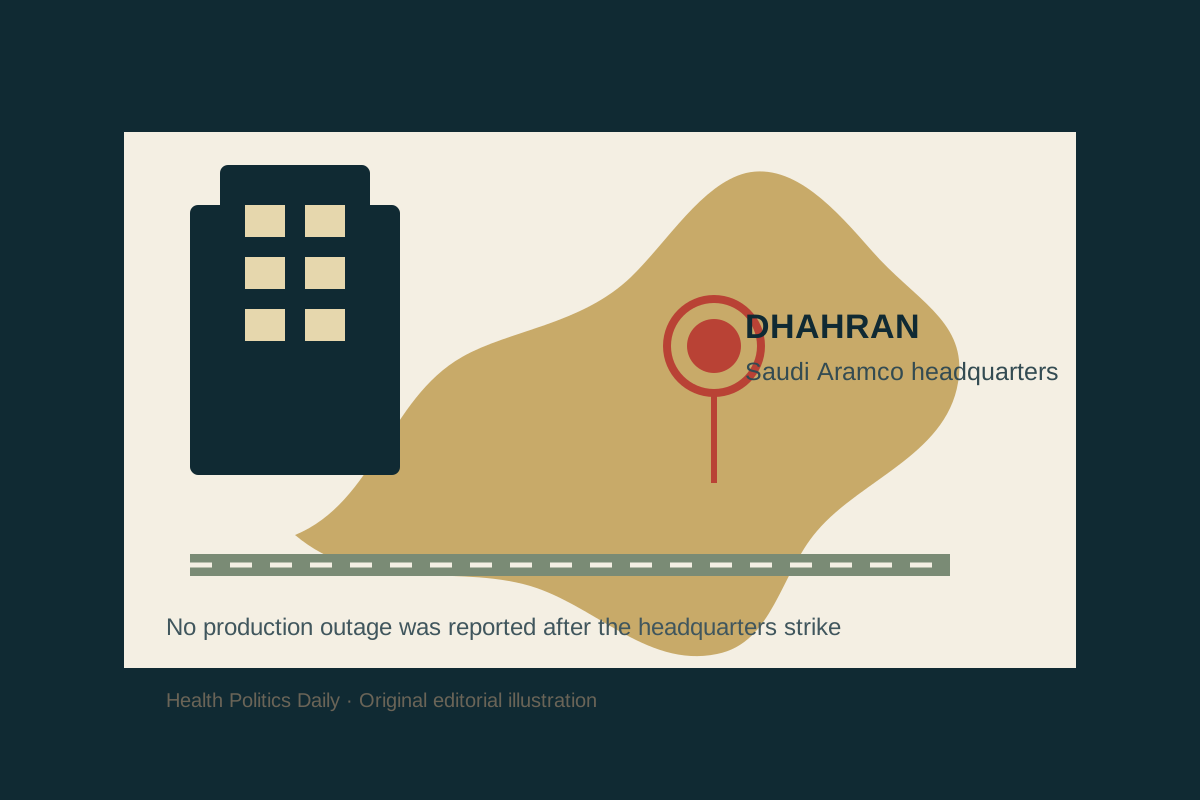
Saudi Arabia's Energy Ministry said an attack on Saudi Aramco's administrative building in Dhahran caused a limited fire and no deaths or injuries. Reuters reported, citing a company source, that a ballistic missile hit the office tower and damaged its top three floors. Associated Press also reported that executive offices were damaged.
The Houthis claimed the operation and said it used ballistic and cruise missiles and drones against Aramco and other Saudi targets. That claim establishes what the group says it launched, not an independently verified count or proof that every claimed target was hit.
Verified fact: the headquarters sustained damage and no casualties were reported there. Not verified: the full weapons sequence, whether every projectile reached its intended target, or the total cost of repairs.
Why It Matters
The complex helps coordinate a global oil network
Aramco's Dhahran campus includes a major operations center overseeing oil fields, pipelines, refineries and export terminals. An attack on that complex therefore has symbolic and operational significance even when production continues.
No Saudi authority or Aramco statement reviewed for this report announced a reduction in crude production, refinery output or exports caused by the headquarters strike. Employees were told to work from home, Reuters reported, but that is not the same as a shutdown of oil operations.
Analysis: the strike shows that a high-profile corporate command site can be reached during the widening Saudi-Houthi exchange. Its immediate market significance depends less on visible office damage than on whether future attacks interrupt production, processing, shipping or worker safety.
Escalation
The Houthis say airports and oil facilities will remain targets
The Houthi military said operations deep inside Saudi Arabia would continue and warned workers, civilians and shipping companies to leave areas around prospective targets. Saudi-led forces said they intercepted a ballistic missile aimed at Riyadh on Wednesday as explosions were heard over the capital.
The threat follows repeated attacks on King Khalid International Airport. Reuters and The Guardian reported that a Saturday strike killed 13 people and injured more than 300. Saudi forces have also struck oil depots and other sites in Houthi-held Yemen, making the current episode a reciprocal military escalation rather than an isolated incident.
Warnings by a belligerent are reported here as claims and threats, not endorsements of lawful targeting. Airports and other civilian sites retain protection under international humanitarian law, and the status of a particular target depends on facts that may be disputed.
Practical Implications
Travel disruption is clearer than any oil-supply effect
Travelers should rely on their airline and official airport notices because schedules can change rapidly; the site's earlier Riyadh flight-disruption guide explains the practical steps. Energy customers and investors should distinguish a damaged headquarters from a confirmed production loss. This report provides general context, not personalized travel or investment advice.
Forecast: continued threats raise the probability of further air-defense activations and precautionary workplace or flight changes. They do not establish that a successful attack on production infrastructure or a sustained oil-price move will occur.
Opinion: Health Politics Daily takes no position on the parties' political aims. Public reporting should identify claims by source, avoid treating threats as outcomes and give priority to civilian safety and verified operational effects.
What Remains Uncertain
Operational effects and the next phase are not yet known
Aramco has not published a detailed damage assessment or said when headquarters staff will return. Officials have not fully explained how the projectile reached Dhahran, whether the fire followed a direct impact or debris, or whether any operations-center systems were temporarily impaired. No timetable or target list for further Houthi attacks can be independently confirmed.
Bias Lens: retaliation, civilian risk and energy exposure
Saudi officials confirm damage and a limited fire at Aramco headquarters with no reported casualties. No oil-production outage has been announced. The Houthis claimed the attack and threatened additional Saudi oil and airport targets.
Left-leaning coverage: The Guardian frames the episode as reciprocal escalation, leading with Saudi strikes on Yemeni fuel sites and the Houthi warning around Aramco facilities. Center coverage: Reuters separates the Saudi ministry's limited-fire statement from source reporting on the building damage; AP emphasizes the unprecedented reach into Aramco's executive offices and the broader defense challenge. Right-leaning coverage: Fox News places the strike within its rolling Iran-war and oil-price coverage and foregrounds the Houthis' Iranian alignment.
The outlets agree on the core event. Their differences concern emphasis—reciprocal strikes, evidentiary caution, Saudi defenses or Iran's role—not whether the headquarters was damaged.
Principal Sources
Official statements and corroborating reports
- Reuters — Saudi Energy Ministry statement, damage and company operations
- Associated Press — attack, damage and regional context
- Reuters — continuing threats and Riyadh interception
- The Guardian — reciprocal strikes and Houthi warnings
No directly relevant official or publisher-authorized video with clearly documented third-party embedding permission was available, so no video was embedded.
Related Coverage