GERMANY — EUROPEAN POLITICS — DEMOCRATIC INSTITUTIONS
AfD Politician Takes Saxony-Anhalt Parliament Presidency, Testing Germany’s Firewall
Tobias Rausch won the state legislature’s top procedural office in a secret ballot, becoming the first far-right politician to lead a German state parliament since 1945 and intensifying debate over mainstream parties’ isolation of the AfD.
By Health Politics Daily News Desk · Published Wednesday, October 7, 2026 at 2:04 p.m. America/New_York · Approximately 8 minutes

Watch in this article
Pumpjack operating at the Kern River Oil Field
A short CC0 field video provides visual context for reporting on oil production and fuel supply.
Thomas Farley / Wikimedia Commons · CC0 1.0 · License and source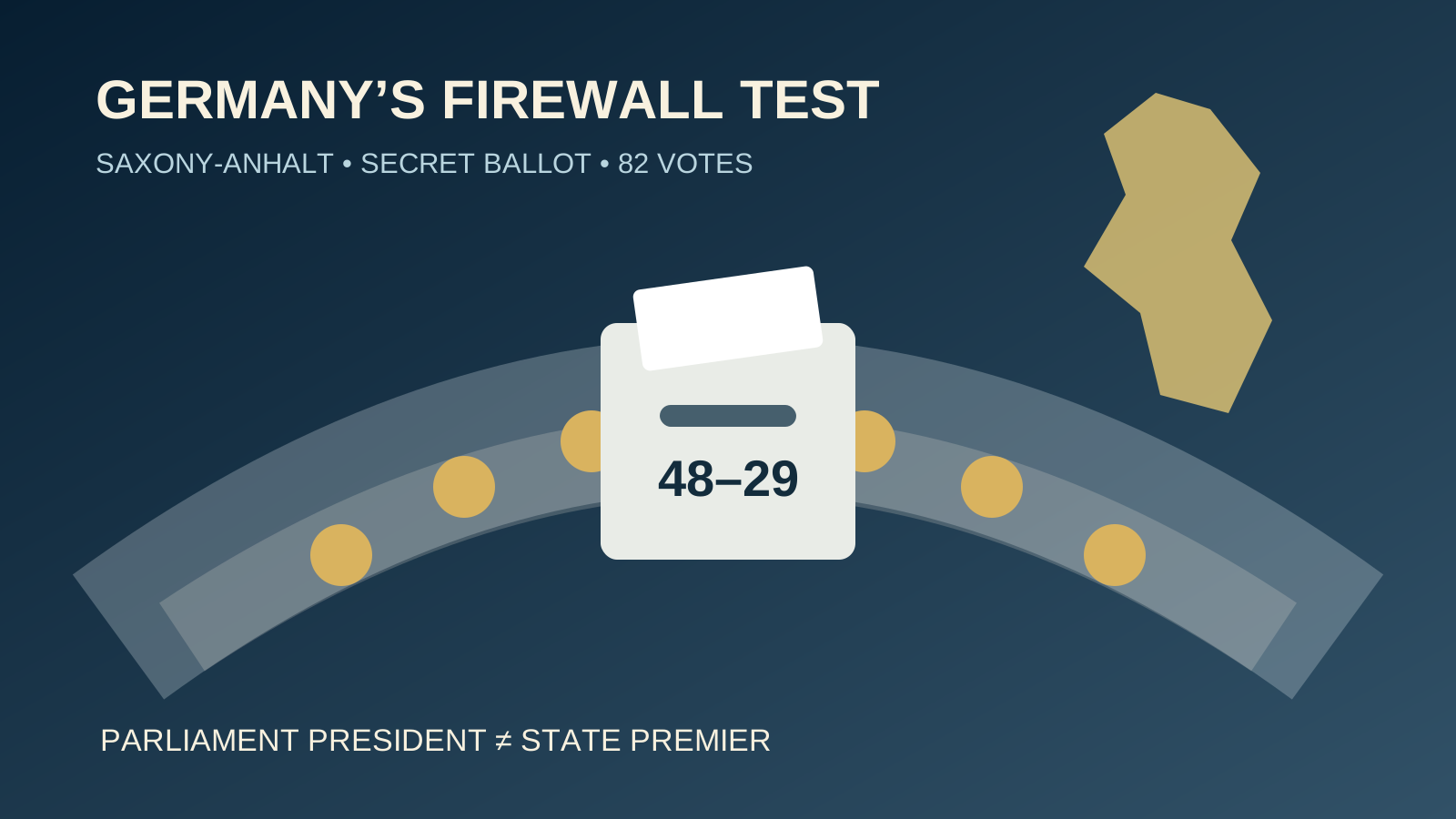
Verified Baseline
Rausch won 48 votes in an 82-member secret ballot
The Saxony-Anhalt parliament’s official record says 82 of its 83 members participated in Tuesday’s opening session. AfD lawmaker Tobias Rausch received 48 votes for parliament president, while 29 members voted no and five abstained. The chamber then elected AfD lawmaker Hans-Thomas Tillschneider and CDU lawmaker Carsten Borchert as vice presidents.
The AfD holds 39 seats. The five-member BSW said it would support Rausch, leaving at least four affirmative votes from unidentified lawmakers outside those groups. Because the ballot was secret, public evidence does not establish who cast those votes. Claims that particular CDU members supported Rausch remain inference, not verified fact.
Why It Matters
The result weakens—but does not formally end—the political firewall
Germany’s established parties have generally maintained a “Brandmauer,” or firewall, against cooperation with the AfD. Rausch’s election shows that AfD candidates can obtain enough support beyond their caucus to win an institutional office, even though the party lacks an outright majority.
Chancellor Friedrich Merz warned Wednesday about extremism entering parliaments. The vote also places pressure on his center-right CDU because the unexplained votes came from outside the publicly declared AfD–BSW total. That arithmetic cannot identify individual voters or prove an organized party agreement.
What the Office Does
Parliament president is influential, but not the state’s head of government
The parliament president chairs sessions, applies procedural rules, represents the legislature and helps oversee its administration. The role can shape how debate is conducted and how the institution presents itself, but it does not give Rausch the executive powers of Saxony-Anhalt’s minister-president.
The state parliament must choose a minister-president separately. AfD state leader Ulrich Siegmund hopes to win that office, but the party’s 39 seats are short of a majority in the 83-seat chamber. Rausch’s victory does not predetermine that later vote.
Practical Implications
What changes now—and what stays the same
- Rausch now presides over the chamber and performs its representative and administrative duties.
- The secret ballot does not create a governing coalition or a formal CDU–AfD agreement.
- German military aid, immigration law and foreign policy remain primarily federal matters; this state vote does not change them.
- Residents should look to published agendas, rulings from the chair and recorded legislative votes—not speculation about anonymous ballots—to assess institutional effects.
What Remains Uncertain
The extra votes and the path to a state government
Verified fact: Rausch received 48 votes, more than the combined AfD and BSW seat totals. Analysis: the outcome demonstrates some willingness beyond the AfD caucus to support its candidate in a secret ballot. Forecast: it may make cooperation on individual measures easier, but it does not guarantee an AfD-led government. Opinion: this report takes no position on any German party and does not infer a voter’s identity from secret-ballot arithmetic.
Bias Lens: how the vote is framed
Rausch won 48–29 with five abstentions. AfD and BSW together account for 44 seats, so at least four affirmative votes came from elsewhere; the secret ballot does not reveal from where.
Left-leaning coverage: The Guardian emphasized the postwar precedent and concerns about normalizing the far right. Center coverage: Reuters focused on Merz’s warning, the secret-ballot arithmetic and pressure on the CDU. Right-leaning coverage: Welt foregrounded the dispute over whether CDU lawmakers crossed the firewall while reporting the same unknown-vote problem.
The main difference is emphasis: historical normalization, national political fallout or responsibility within the center-right. None can establish the identity of secret-ballot voters.
Principal Sources
Official records and corroborating reporting
- Saxony-Anhalt parliament — official constituting-session and vote record
- Saxony-Anhalt parliament — Tobias Rausch biography
- Reuters — national political response
- Reuters — government-formation context
- Associated Press — election result and seat totals
No suitable directly relevant official or publisher-authorized video with clearly confirmed embedding permission was available, so no video was embedded.