Global Health · Gaza · International Humanitarian Law
Israeli Strike on Gaza’s Nasser Hospital Kills Six and Disrupts Key Services
The strike damaged a major surgical building serving southern Gaza. Israel says it targeted Hamas operatives; hospital officials and Hamas dispute central parts of that account.
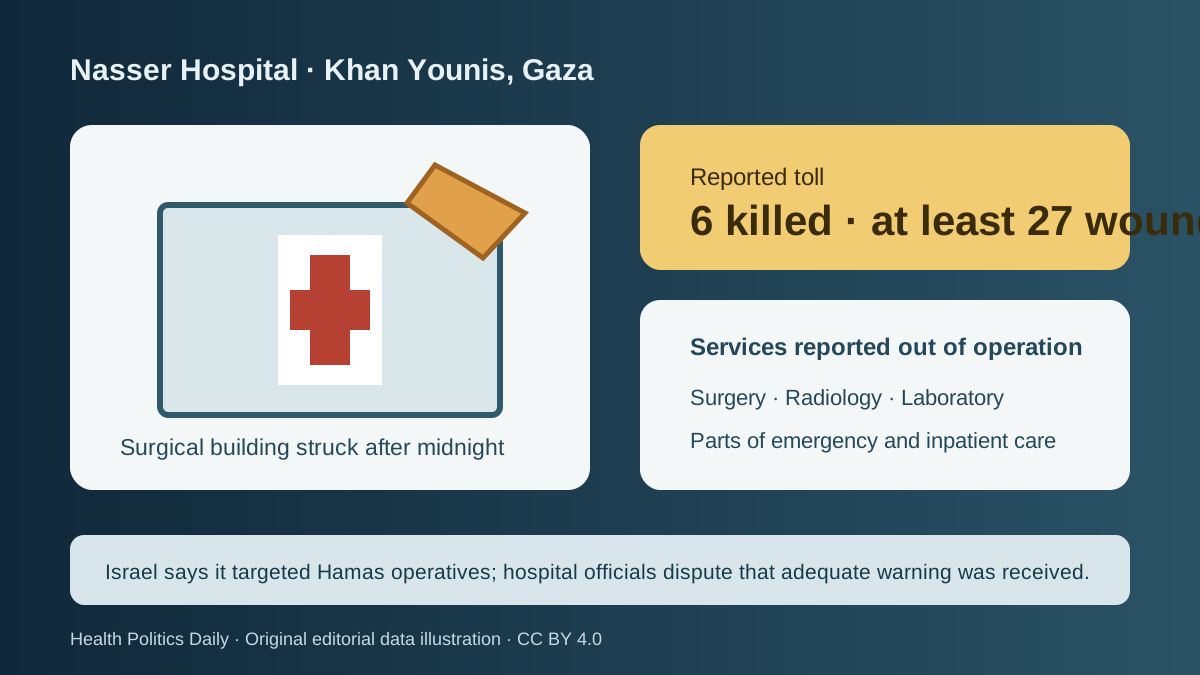
Verified baseline: six killed and a surgical building damaged
An Israeli airstrike hit the surgical building of Nasser Hospital in Khan Younis shortly after midnight Thursday, killing six people and injuring at least 27, according to the United Nations’ November 12 briefing. The dead included general surgeon Dr. Rizk Abu Shaira, a 13-year-old boy and patients, according to The Associated Press.
Initial injury counts differed. The United Nations reported 27, AP reported at least 28, and Médecins Sans Frontières later said 52 people were injured. Those figures may reflect different reporting times or definitions; Health Politics Daily could not independently reconcile them.
Images and witness accounts reviewed by AP and Reuters showed extensive damage to wards, operating rooms and hospital equipment. Nasser officials said surgery, radiology and laboratory services, along with parts of emergency and inpatient care, were out of operation. MSF describes Nasser as the main referral hospital for southern Gaza, serving an estimated 1.3 million people.
Israel’s claim and the unresolved evidence
The Israel Defense Forces and Shin Bet said the strike targeted Muhammad Abu Ismail, whom they identified as commander of Hamas’s Khan Younis Brigade, along with other operatives. They alleged that Hamas used part of the hospital as a headquarters, stored weapons there and planned attacks from the complex. The military said it used precision munitions and aerial surveillance and had repeatedly warned that military activity at the hospital must stop.
The strike’s outcome and Abu Ismail’s status were still under review, according to accounts of the military statement. Public statements reviewed for this article did not include evidence sufficient to independently verify the claimed command center, weapons storage or the presence of each named target at the moment of the strike.
Hamas denied using the hospital as a military base. Hospital officials told AP that they received no warning before the strike; Israel said it had issued repeated warnings, including recently. Both claims remain disputed. A recording later released by the military may show a warning conversation, but the public record does not yet establish what facility, time window or remedial action the notice covered.
Why the service loss matters
The immediate impact extends beyond the casualty count. A damaged operating department can delay trauma surgery, cancer care, diagnostic imaging, laboratory work and treatment for patients already hospitalized. Nasser staff said nearby facilities do not have equivalent capacity for specialized operations.
WHO has described Gaza’s health capacity as severely limited despite the October 2025 ceasefire, with hospitals operating beyond capacity and essential services compromised by shortages, access restrictions and attacks. The agency’s current emergency overview calls for health facilities to be protected and for safe access to care.
The disruption also affects aid planning. Emergency teams may need to move patients between buildings or facilities, replace damaged supplies and equipment, and decide which operations can continue safely. Those choices are clinical and logistical judgments for health professionals on the ground, not conclusions that can be made from casualty totals alone.
Our earlier report on cuts to Gaza food assistance explains the wider strain on humanitarian services. Our coverage of Hebron closures and family displacement provides separate context on civilian movement and security measures in the occupied Palestinian territories.
What international humanitarian law requires
Civilian hospitals have specific protection under international humanitarian law. The International Committee of the Red Cross explains that a hospital may lose that protection only if it is used, outside its humanitarian function, for acts harmful to an enemy.
Loss of specific protection is not an automatic license to attack. The attacking party must take feasible steps to verify the military objective, give an effective warning where required, allow reasonable time for compliance when circumstances permit, and still follow distinction, proportionality and precaution rules. Military use of a hospital can itself violate the law.
Those are the legal standards. Whether this strike complied with them requires a fact-specific investigation into the intelligence, target, warnings, weapons used, expected civilian harm and feasible alternatives. Neither the Israeli allegation of military use nor the scale of hospital damage, standing alone, resolves that legal question.
Practical implications
- For patients and families: service availability may change quickly. WHO and established humanitarian organizations are more reliable than social-media posts for current referral or evacuation information.
- For aid agencies: damage assessments must distinguish structural safety, medical-equipment loss, staffing and supply needs before services can fully resume.
- For investigators: preserving weapon fragments, surveillance material, warning records, patient logs and hospital access records will be important to test competing claims.
- For governments: public statements should separate confirmed casualties and service effects from unverified claims about combatant presence or legal responsibility.
Fact, analysis, forecast and opinion
Verified fact: Israel struck Nasser Hospital’s surgical building; six people were reported killed, at least 27 were reported injured and several medical services were disrupted. Analysis: the loss of specialist capacity may affect far more people than the initial casualty count, while the competing military-use and warning claims remain unresolved. Forecast: United Nations agencies and humanitarian groups are likely to seek restoration of services and an investigation, but the scope and independence of any review are uncertain. Opinion: Health Politics Daily takes no position on the parties’ legal responsibility; the evidence should be preserved and assessed under the same humanitarian-law standards applied to every armed conflict.
Bias Lens: hospital protection, military target or both?
Verified baseline: an Israeli strike hit Nasser Hospital’s surgical building, killed six people and disrupted medical services. Israel says Hamas operatives were using the hospital complex; Hamas and hospital officials dispute key parts of that account.
Left-leaning — The Guardian: foregrounds the dead surgeon, patients and damage to one of Gaza’s remaining hospitals, while noting Israel’s unsupported-at-publication military-use claim. Center — The Associated Press: leads with the casualty and service impact, then sets Israel’s allegations beside hospital testimony and the legal protection of medical facilities. Right-leaning — The Times of Israel: foregrounds the stated target, Hamas’s alleged use of the hospital and the military’s claimed precautions, while also reporting the deaths and medical damage.
The framing difference is mainly which verified or attributed fact receives priority: the human cost, the contested evidence, or Israel’s target rationale. None of those emphases by itself proves that the hospital was lawfully targetable, that all Israeli claims are false, or that the civilian harm was proportionate.
What remains uncertain
The final injury count, the full extent of structural and equipment damage, the timeline for restoring services and the status of the alleged Hamas commander remain unclear. The available public record also does not establish who occupied the targeted rooms, what intelligence Israel relied on, whether a legally sufficient warning reached the hospital or what alternative means were considered.
Casualty and operational figures may change as hospitals, aid groups and authorities update their records. This report will treat later findings as new evidence rather than retroactively presenting disputed claims as settled fact.
Principal sources
- United Nations — November 12 briefing on casualties, damage and humanitarian-law obligations
- World Health Organization — Gaza health-system status and protection appeal
- Médecins Sans Frontières — service disruption, hospital role and later injury count
- Associated Press — on-scene reporting and statements from the hospital and Israeli military
- International Committee of the Red Cross — legal protections for hospitals
No suitable directly relevant official or publisher-authorized video with clear, persistent embedding permission was available, so no video was embedded.
No comments yet.