U.S. NATIONAL SECURITY — CARIBBEAN
U.S. Caribbean Boat Strike Kills Four; Evidence and Legal Basis Remain Disputed
The U.S. military says it killed four people aboard a speedboat on a Caribbean route used by drug traffickers. The strike is verified, but officials did not publicly identify those killed or release evidence that the vessel carried drugs, leaving basic factual and legal questions unanswered.
By Health Politics Daily News Desk · Published Monday, October 5, 2026 at 4:05 a.m. America/New_York · Approximately 8 minutes

Watch in this article
Pumpjack operating at the Kern River Oil Field
A short CC0 field video provides visual context for reporting on oil production and fuel supply.
Thomas Farley / Wikimedia Commons · CC0 1.0 · License and source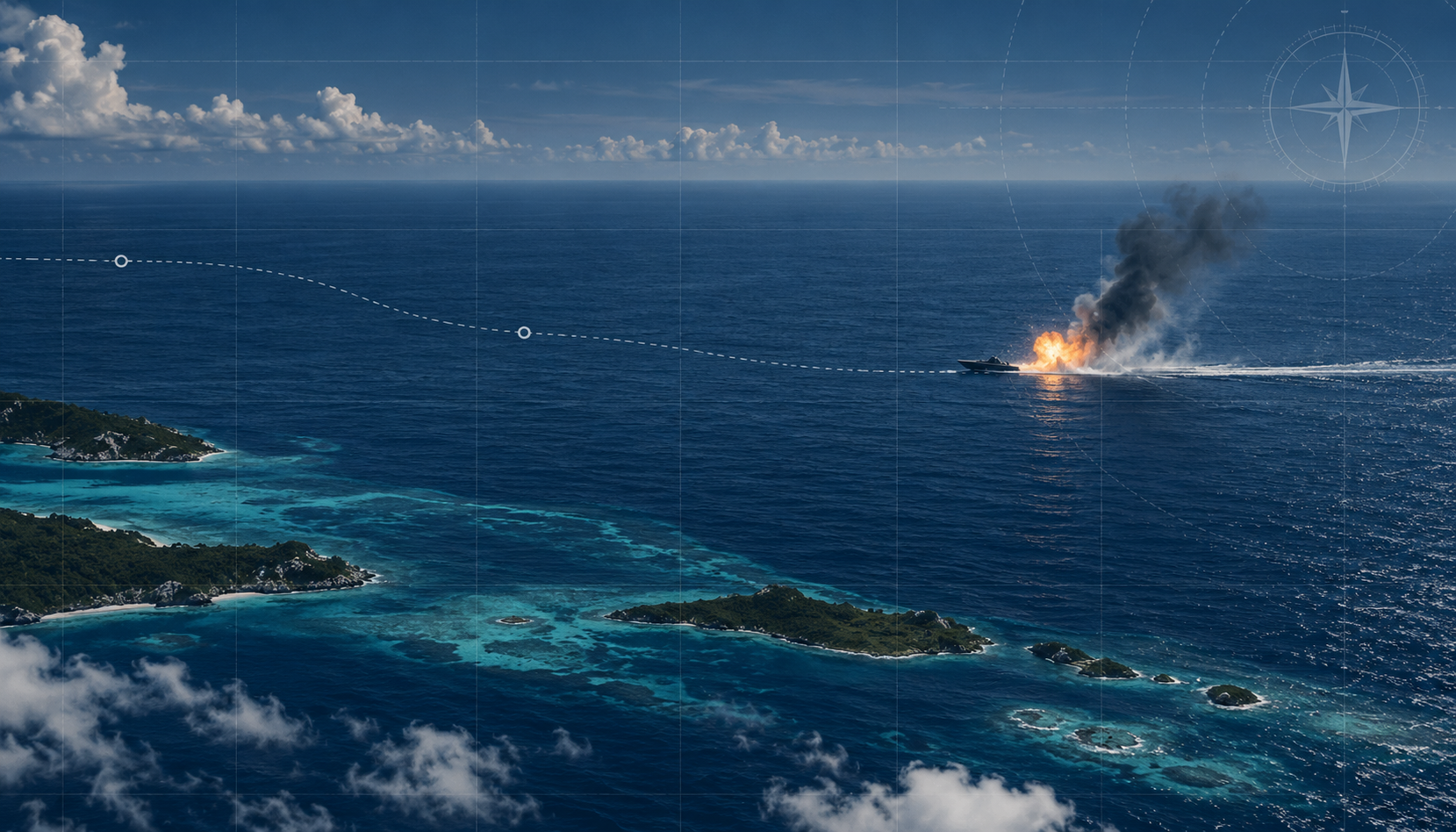
Verified Baseline
What the military said happened
U.S. Southern Command said American forces struck a “go-fast” vessel in the Caribbean Sea on Sunday and killed four people. The command said the boat was traveling along established narcotics routes and described those aboard as “narco-terrorists.” The Associated Press and Reuters reported the announcement.
A military video showed an explosion destroying a moving speedboat. A video can establish that a strike occurred; it does not, by itself, establish who was on the vessel, what it carried or whether lethal force was legally authorized.
The military did not publicly identify the four people, specify a nationality, disclose the boat’s precise location or publish evidence of narcotics aboard. Those are not minor omissions: they are central to assessing both the government’s factual claim and the lawfulness of the operation.
Campaign Scale
At least 235 people have been killed in 70 strikes
AP’s count puts the campaign’s death toll at at least 235 people across 70 strikes since September 2025. The administration says the operations are part of an armed conflict with drug cartels and are necessary to reduce the flow of narcotics and overdose deaths in the United States.
The government has also argued that the campaign has disrupted maritime trafficking. A September Defense Department progress report cited large reductions in illicit maritime activity in parts of the Caribbean and eastern Pacific. Those figures are the administration’s assessment; they do not independently prove the contents of this particular boat or identify the people killed Sunday.
Why It Matters
A counterdrug mission is being treated as armed conflict
Maritime drug interdiction has traditionally involved surveillance, stopping vessels, arresting suspects and seizing cargo. Lethal force is governed by a different and far narrower set of rules. Whether the United States is legally in an armed conflict with designated cartels—and whether the people on any given boat are lawful military targets—is therefore the central dispute.
Congress has not enacted a specific authorization for this campaign. A Senate joint resolution introduced in December 2025 sought to remove U.S. forces from hostilities against vessels in the Caribbean and eastern Pacific that lawmakers said were not authorized by Congress; the measure was referred to the Foreign Relations Committee and did not become law. The Constitution Annotated explains Congress’s role in authorizing limited uses of force as well as formal war.
Legal Dispute
International experts question the government’s theory
A group of U.N. special-procedure experts previously told the United States that the campaign raised concerns about serious violations of the right to life. Their official communication summary asked the government to clarify the scope and legal basis of military force against cartels and a September 2025 vessel strike.
The administration’s detailed legal opinion has not been made public. A federal court recently ordered additional review of the government’s reasons for withholding it in a transparency case brought by civil-rights groups. That litigation concerns disclosure; it has not produced a final judicial ruling that the strike campaign is lawful or unlawful.
Practical Implications
Transparency affects oversight, alliances and accountability
For the public and Congress, the immediate question is evidentiary: what intelligence linked this vessel and these four people to a group legally targetable by military force? For regional governments, the campaign raises questions about sovereignty, intelligence sharing and whether cooperation could expose partners to legal risk.
For U.S. service members, rules of engagement and the chain of legal authorization matter. For families of those killed, identification and access to a credible review determine whether any factual claim can be challenged. None of those questions can be resolved from the strike video alone.
Fact, Analysis And Forecast
What is known—and what remains uncertain
Verified fact: the U.S. military struck a moving boat and says four people died. Unverified government claim: the people were drug traffickers and the vessel was conducting narcotics activity. Analysis: the lack of public evidence prevents independent assessment of necessity, identification and proportionality. Forecast: Sunday’s strike is likely to intensify demands for the legal memorandum and operational evidence, but publication of either is not assured.
No credible public information available at publication time established the identities of those killed, the boat’s cargo, the exact strike coordinates or an imminent threat to U.S. personnel. Absence of public evidence is not proof that classified evidence does not exist; it means outside verification is currently impossible.
Bias Lens: how the framing differs
U.S. forces destroyed a speedboat in the Caribbean and reported four deaths. Officials did not publicly identify those killed or release evidence that the vessel carried narcotics.
Left-leaning: The Guardian foregrounds a U.N. expert’s legal condemnation and the cumulative human toll. Center: The Associated Press leads with the military announcement, then emphasizes the missing evidence, death count and administration’s armed-conflict rationale. Right-leaning: Fox News gives more prominence to SOUTHCOM’s description of the targets and the known trafficking-route context.
These labels describe the selected outlets’ customary editorial orientation, not the accuracy of every sentence. The useful difference is emphasis: alleged criminal identity and deterrence on the right, legal accountability and casualties on the left, and a verification gap in the center. All three ultimately depend on the same official claim, which has not been accompanied by public evidence specific to this boat.
Principal Sources
Military claims, official law and independent reporting
- Associated Press — latest strike and campaign count
- Reuters — military announcement and legal criticism
- Defense Department — Operation Southern Spear progress claims
- U.N. special procedures — official legal-concerns summary
- Congress.gov Constitution Annotated — authorizations for force
The military’s strike video was described by reporting but not embedded because its evidentiary value is limited and no stable, publisher-authorized embed added context beyond the linked source reports.