U.S. POLITICS — AUTOS — Proposed legislation · Automated Assistance Disclosed · Editor Review Recommended
Is the U.S. Banning Chinese Cars? What the Senate Bill Would Change
A bipartisan group wants quick Senate approval for permanent restrictions on vehicles and connected technology tied to China and other adversary countries. The proposal has momentum, but it is not yet law.
By Health Politics Daily News Desk, United States · Published Wednesday, September 23, 2026 at 6:01 p.m. America/New_York · Approximately 6 minutes

Watch in this article
Pumpjack operating at the Kern River Oil Field
A short CC0 field video provides visual context for reporting on oil production and fuel supply.
Thomas Farley / Wikimedia Commons · CC0 1.0 · License and source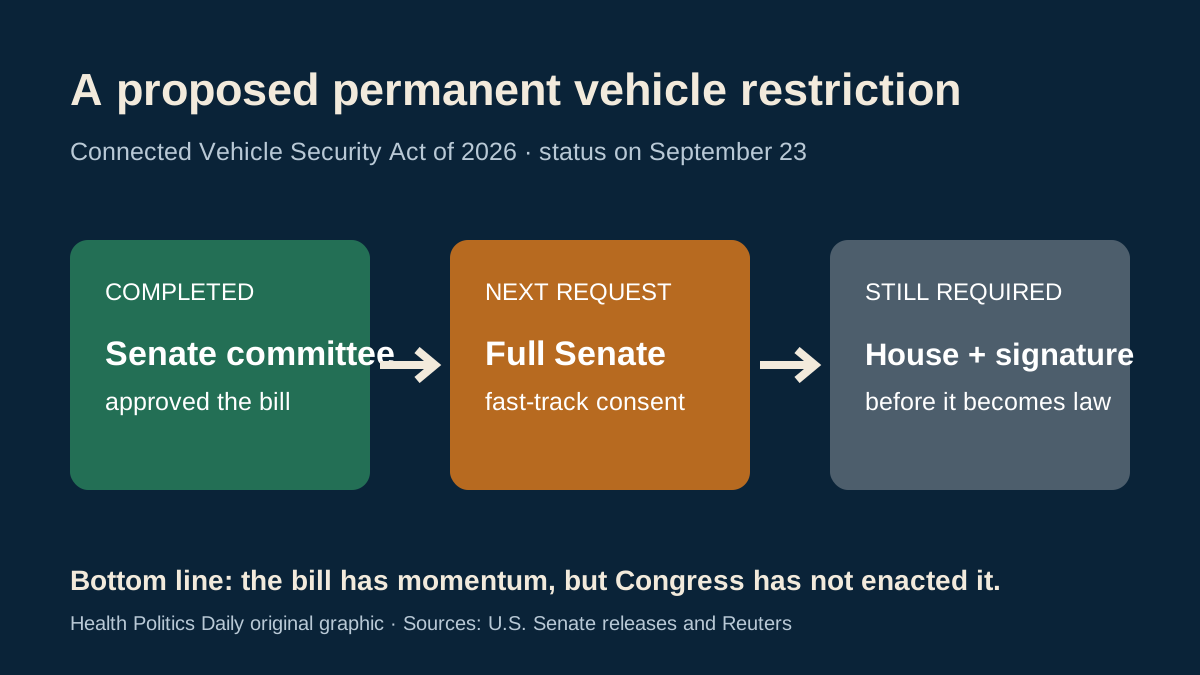
Verified Baseline
Senators are seeking approval—not announcing a new law
Republican Senator Bernie Moreno of Ohio and Democratic Senator Elissa Slotkin of Michigan are seeking fast-track Senate action on the Connected Vehicle Security Act while Chinese President Xi Jinping visits the United States. Reuters reported the renewed push on September 23.
The Senate Commerce Committee approved the measure unanimously in July, according to Slotkin’s official release. Committee approval does not enact a statute. The full Senate and House must pass compatible text before a president can sign it.
What It Would Cover
The proposal reaches vehicles, ownership, software and components
The sponsors say the bill would prohibit the import, sale and operation of vehicles manufactured in China or another country of concern and restrict connected-vehicle technologies developed there. The committee version also uses ownership thresholds that could reach a company even when its brand is not Chinese.
That distinction matters. Earlier Commerce Department rules primarily target connected hardware and software linked to China or Russia. The legislation would put broader restrictions into statute, making them harder for a future administration to reverse.
Who Could Be Affected
The consequences extend beyond Chinese-nameplate cars
Reuters reported in July that a threshold covering automakers with more than 15% Chinese ownership could affect Mercedes-Benz, whose investors include Geely and BAIC. The bill includes a later compliance date and a waiver process, so an affected manufacturer would not necessarily disappear from U.S. showrooms immediately.
Automakers could respond by changing ownership, supply chains, software, battery sourcing or production locations. Those responses—and how Commerce interprets exceptions—would determine the real impact on model availability and prices.
Why Supporters Want It
National security and industrial policy are intertwined
Supporters argue connected cars collect location, camera and operational data that could be accessed by a foreign adversary. They also argue heavily subsidized Chinese manufacturers could undercut U.S. production. The sponsors’ April release presents both national-security and manufacturing rationales.
Those are policy arguments, not proof that every Chinese-made component is conducting surveillance. Risk depends on data access, software control, ownership and the safeguards applied to a particular system.
Practical Implications
Nothing changes for drivers solely because senators requested a vote
Consumers do not need to stop driving or sell a vehicle because of this week’s Senate maneuver. If the proposal becomes law, implementation dates, waivers and agency guidance would determine which vehicles or components are affected and when.
Prospective buyers can monitor manufacturer notices and federal rules, but the current development is legislative procedure—not a recall or immediate nationwide prohibition.
What Remains Uncertain
Unanimous consent can be blocked by one senator
The fast-track effort can fail if any senator objects. Even Senate passage would leave House action, reconciliation of any differences and presidential approval. The administration’s position also matters because President Trump has previously expressed openness to Chinese companies building vehicles in the United States.
Bias Lens: restricting Chinese-connected vehicles
The bill cleared the Senate Commerce Committee but has not passed Congress. Its text reaches vehicles, connected technologies and specified foreign ownership relationships.
Coverage differs most in emphasis: domestic jobs, legislative mechanics or surveillance risk. None of those frames changes the bill’s current status as a proposal.
Principal Sources
Documents and reporting used
- Senator Moreno — bill summary and linked text
- Senator Slotkin — committee action
- Reuters — ownership threshold and industry effects
- Reuters — current political context
No suitable directly relevant authorized video with clear embedding permission was available.