INDIA — ELECTION ADMINISTRATION
India Election Roll Protests Grow: What Voters Should Know
Thousands rallied in Delhi and Mumbai for a third day, demanding Chief Election Commissioner Gyanesh Kumar resign and that a nationwide voter-roll revision be reversed. The protests and detentions are verified; allegations that the process is designed to benefit the governing BJP remain disputed.
By Health Politics Daily News Desk · Published Sunday, October 4, 2026 at 2:02 p.m. America/New_York · Approximately 7 minutes
Verified Baseline
Protests expanded, and police detained demonstrators
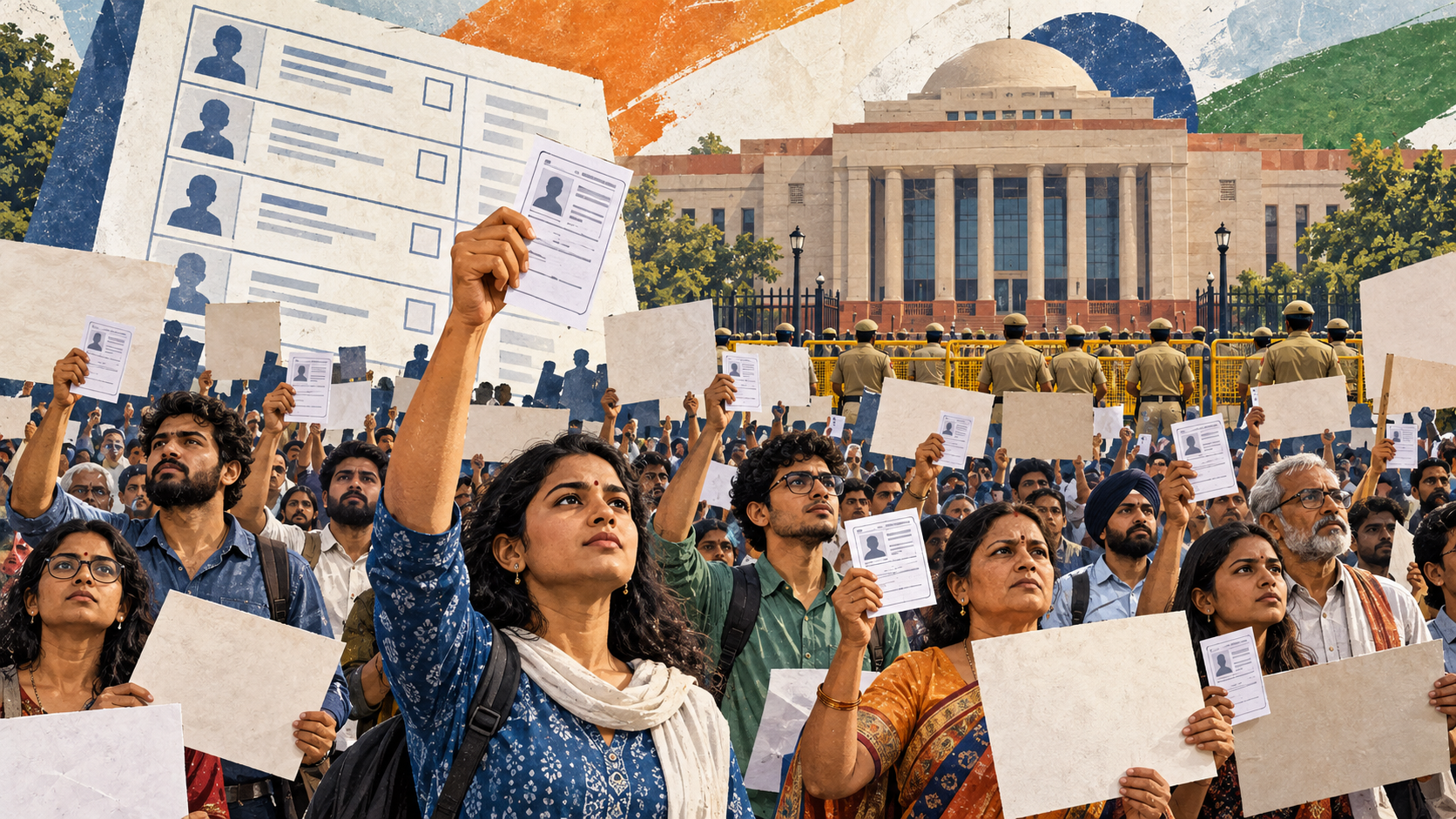
Reuters witnesses reported thousands of youth and opposition supporters demonstrating Sunday in Delhi and Mumbai. Opposition leaders Raj Thackeray and Uddhav Thackeray led the Mumbai march, while police detained some people in Delhi after protesters gathered despite restrictions on mass assemblies.
The demonstrations demand the resignation of Chief Election Commissioner Gyanesh Kumar and cancellation of the Special Intensive Revision, or SIR, of electoral rolls. The Election Commission and Prime Minister Narendra Modi’s Bharatiya Janata Party deny that the revision is partisan and say the process is meant to remove invalid entries and correct records.
What the Revision Does
Officials are checking eligibility and resolving discrepancies
The SIR requires election officials to review existing registrations, identify unmapped or inconsistent entries and decide claims and objections. Critics say documentation requirements, data errors and a compressed timetable can exclude eligible voters, especially people with fewer records or unstable housing.
On September 26, the Election Commission announced that booth-level officers would visit people flagged for missing links or logical discrepancies, that help desks should be established for homeless and low-income residents, and that most people should not have to attend an in-person hearing. It also extended Delhi’s claims-and-objections period through October 30.
Claims and Evidence
Large disenfranchisement figures are politically contested
Protest leaders say millions of eligible voters have been removed and that the changes advantage the BJP. Those are consequential allegations, but a protest claim is not proof of partisan intent. The Election Commission says its actions are lawful and that corrections, claims and objections remain available; the BJP rejects the accusation that it is manipulating the rolls.
There is nevertheless a concrete policy question beyond motive: whether safeguards can identify and restore eligible voters before an election. Official revisions, court proceedings, published roll data and individual case records—not slogans from either side—will provide the strongest evidence.
Practical Implications
What voters can do now
- Check registration: voters can use the Election Commission’s official electoral-search and voter-services tools or contact their local election office.
- Save records: keep screenshots, application numbers and copies of documents submitted through an official channel.
- Use claims and objections: a missing or disputed entry is not necessarily final. Deadlines vary by jurisdiction; Delhi’s current period runs through October 30.
- Verify protest information: schedules, detention numbers and allegations can change quickly. Rely on named organizers, police statements and established reporting.
What Remains Uncertain
The scale of wrongful removals and the political outcome
Verified fact: a nationwide revision is underway, protests expanded on Sunday and police detained demonstrators. Analysis: the controversy combines a technical registration process with a broader crisis of confidence in election administration. Forecast: demonstrations and court challenges are likely to continue, but no public evidence establishes that Kumar will resign or that the SIR will be canceled.
Bias Lens: voter protection, roll integrity or political mobilization?
India is revising electoral rolls; thousands protested in Delhi and Mumbai, and police detained some demonstrators. Critics allege mass wrongful removals and partisan benefit. The Election Commission and BJP deny wrongdoing.
The Guardian, generally described as left-leaning, emphasizes the youth movement, alleged disenfranchisement and police restrictions. Center-oriented Reuters foregrounds the scale of Sunday’s protests, competing claims and planned next steps, while the Associated Press focuses on the youth movement and institutional pressure on the commission. No major right-leaning outlet had comparable original reporting on Sunday’s demonstrations at publication time; substituting commentary would not provide an equivalent evidence base. The framing differs, but the dispute itself cannot be resolved by outlet labels.
Principal Sources
Official procedures and corroborating reporting
- Election Commission of India via Press Information Bureau — September 26 SIR safeguards and deadline
- Election Commission of India — electoral-roll management and voter services
- Reuters — Sunday protests, detentions and competing claims
- Associated Press — youth movement and election-commission pressure
- Indian Express — police account and investigation of journalists’ allegations
The Associated Press article includes a publisher-authorized video report on the protests; it is linked above rather than rehosted or embedded.