International Politics · Saudi Arabia · Yemen
Saudi Arabia Says Intercepted Missile Debris Fell Near Mecca
Saudi authorities placed two debris sites 21 and 35 kilometers from the Grand Mosque after air defenses intercepted ballistic missiles. The Houthis deny targeting Mecca, and the public record does not independently establish the missiles’ origin or intended target.
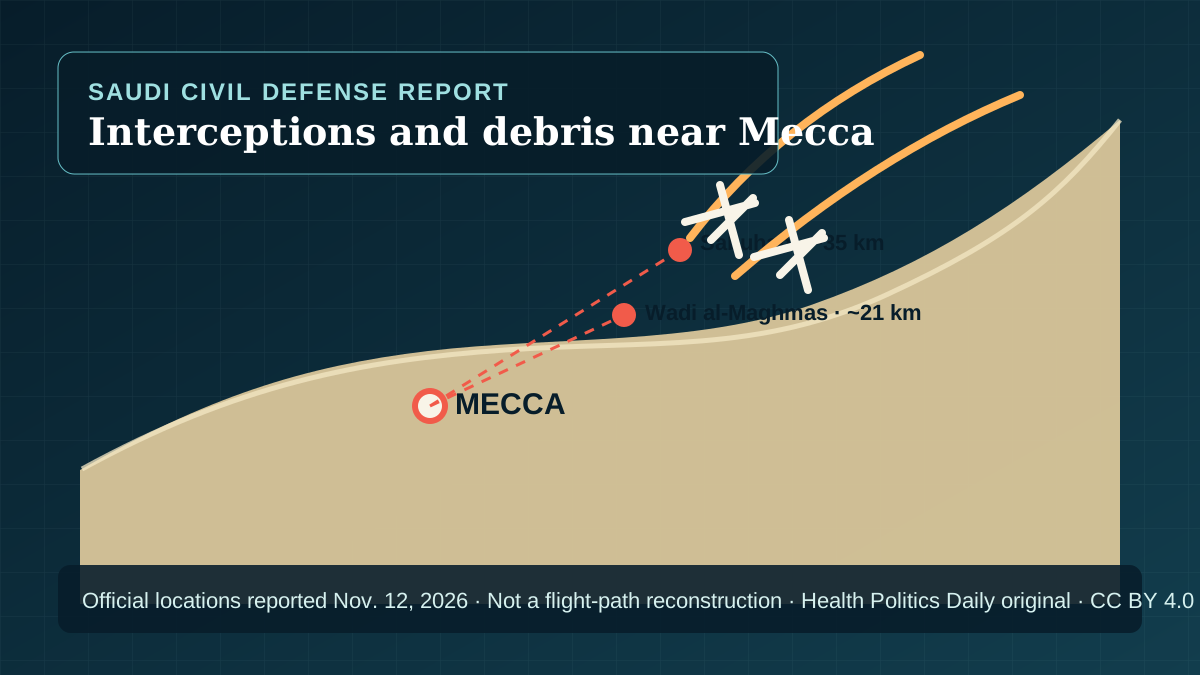
Verified baseline: interceptions and debris, with attribution disputed
Saudi Arabia’s General Directorate of Civil Defense said debris from two ballistic missiles fell in the Mecca region after the missiles were intercepted and destroyed. The Saudi Press Agency published the official statement early Thursday.
Reuters, citing Saudi state television, identified the locations as Sabuhah village, roughly 35 kilometers northeast of the Grand Mosque, and Wadi al-Maghmas, about 21 kilometers east. The reviewed statements did not announce casualties, damage at the Grand Mosque, a closure of pilgrimage sites or a general suspension of travel to Mecca.
Saudi authorities attributed the launches to Yemen’s Houthi movement and described them as attacks toward the Mecca region. Houthi military spokesperson Yahya Saree denied targeting Mecca and said the group’s operations were directed at oil facilities and military bases. Those are conflicting claims by combatants. Publicly available reporting reviewed for this article did not include independent wreckage analysis, launch-site evidence or other technical findings that settle attribution or intent.
Why proximity to Mecca carries exceptional stakes
Mecca contains Islam’s holiest site and receives pilgrims throughout the year, with much larger flows during the annual Hajj. An interception near the city therefore carries human-safety, religious and diplomatic consequences even when the incoming weapon does not reach a populated target.
The reported debris locations were outside central Mecca. A distance from the Grand Mosque is not the same as a safe perimeter: intercepted missiles can fragment unpredictably, and debris can injure people or damage buildings and vehicles. It also is not evidence that the Grand Mosque itself was struck or damaged.
The incident followed a day in which the Saudi-led coalition said it intercepted three cruise missiles headed toward the Riyadh region and two drones over the Mecca and southern regions. The Houthis acknowledged separate operations against Saudi targets while disputing the claim about Mecca. Reporting should not combine every missile, drone and debris report into one verified attack sequence unless authorities release supporting evidence.
The confrontation has moved beyond an isolated exchange
A United Nations-brokered truce in 2022 sharply reduced cross-border attacks, but Saudi-Houthi hostilities resumed this year. Recent strikes have affected airports, energy facilities and urban areas while Saudi-led forces have carried out airstrikes in Yemen. The latest incident therefore belongs to a reciprocal military escalation, not a stand-alone civil-defense event.
The site previously reported the Houthis’ claims of attacks on a Saudi oil pipeline and Riyadh airport, the partial reopening of Riyadh airport after earlier attacks, and the oil-market risk created by attacks on Saudi infrastructure. The new development is the confirmed Saudi report of interception debris near Mecca, not proof of a successful strike on the holy city.
Practical implications for residents, pilgrims and businesses
- No general pilgrimage suspension was announced: the official and major-news sources reviewed did not report closure of the Grand Mosque or a nationwide change to Umrah or Hajj rules.
- Local alerts can change quickly: residents and visitors should use Saudi Civil Defense, airport, airline and pilgrimage-authority notices for operational information rather than unverified videos or posts.
- Debris is a public-safety hazard: people should not approach or handle suspected fragments; local authorities are responsible for securing and examining them.
- Regional transport risk remains elevated: repeated attacks can disrupt flights, insurance and shipping even when a specific interception causes no reported casualty or closure.
Fact, analysis, forecast and opinion
Verified fact: Saudi Civil Defense reported two interceptions and debris in two named locations in the Mecca region; the Houthis deny targeting Mecca. Analysis: proximity to Islam’s holiest city raises political and religious pressure on both sides, which helps explain the unusually sharp dispute over intent. Forecast: additional air-defense alerts, retaliatory strikes and conflicting claims are plausible while the confrontation continues, but no public evidence establishes the timing or target of any future operation. Opinion: Health Politics Daily takes no position on the military campaign and does not infer intent from religious significance alone.
Bias Lens: holy-city attack, regional escalation or disputed attribution?
Verified baseline: Saudi authorities reported that two ballistic missiles were intercepted and that debris fell at two locations in the Mecca region. The Houthis deny targeting Mecca. No independently published technical assessment reviewed for this article resolves who launched the missiles or their intended endpoint.
Coverage availability: substantial direct coverage was not yet available from a clearly right-leaning national outlet at publication, so this lens does not force a three-way ideological comparison with older or tangential stories.
Left-leaning — Al Jazeera: foregrounds reciprocal Saudi-Houthi fighting, the denial and reported casualties inside Yemen. Center — Reuters: leads with the debris locations, reports the Saudi accusation and Houthi denial, and situates both within the renewed conflict. Saudi domestic perspective — Arab News: accepts the coalition’s attribution and emphasizes the history of attempted attacks toward the Mecca region.
The difference is mainly evidentiary and institutional framing: whether to center reciprocal warfare, carefully pair accusation and denial, or present the Saudi coalition’s account as the operative baseline. Repetition across outlets does not create independent confirmation when reports trace back to the same combatant statement.
What remains uncertain
No complete public damage assessment was available at publication. The exact missile types, launch location, flight paths, intended targets and reason debris landed at the reported sites have not been independently established. Saudi authorities may possess radar or wreckage evidence, but the reviewed public statements did not disclose it.
The duration of the escalation is also unknown. A successful interception reduces immediate danger from that projectile; it does not establish that defenses will stop every future attack or that normal travel, aviation and energy operations will continue without disruption.
Principal sources
- Saudi Press Agency — Civil Defense statement on the two interceptions and debris
- Saudi Press Agency — coalition statement on the earlier drone interceptions
- Reuters — locations, distances, denial and conflict context
- Associated Press — corroborating context on the day’s Saudi-Houthi exchanges
No directly relevant official or publisher-authorized video with clear, persistent embedding permission was available at publication, so no video was embedded.
No comments yet.