U.S. Politics · Elections · U.S. Senate
Scott Colom Wins Mississippi Senate Race as Hyde-Smith Concedes
Late county updates expanded Colom’s lead enough for news organizations to call the race, and the Republican incumbent conceded. The result flips a Senate seat, but counties still must certify their totals.
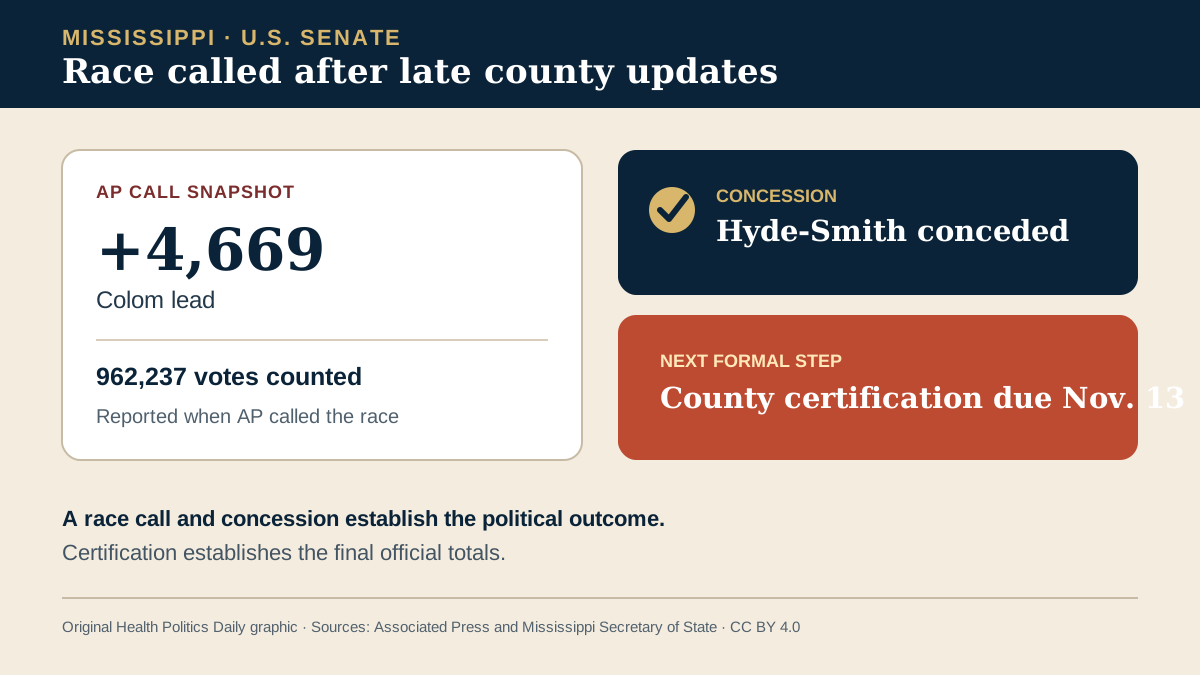
Verified baseline: a projected winner, a concession and certification still ahead
The Associated Press declared Democrat Scott Colom the winner of Mississippi’s U.S. Senate race after updated county results put him 4,669 votes ahead of Republican incumbent Cindy Hyde-Smith out of 962,237 counted. The AP estimated fewer than 12,000 ballots still required review and concluded they were not sufficient, based on their locations and the pattern of completed updates, to erase the lead.
Hyde-Smith then conceded in a public statement, saying she respected Mississippi voters’ decision and congratulating Colom. A concession is politically decisive, but it is not the same as the formal canvass. The Mississippi secretary of state says counties have until November 13 to submit certified results because elections are administered at the county level.
That distinction matters in a close race. The reported margin can still change as remaining affidavit ballots are reviewed and counties finish their work, even though both the AP call and Hyde-Smith’s concession establish that the contest is no longer regarded as unresolved.
What the result changes in Washington
Colom’s victory flips a Republican-held seat and brings the Democratic caucus to 55 seats, according to the AP count. That expands the majority Democrats won in the midterm elections and reduces the leverage of any single senator in organizing the chamber and moving nominations or legislation.
The practical effect begins with the new Congress, not immediately. Hyde-Smith remains the sitting senator during the lame-duck period. Colom must present election credentials and take the oath before exercising Senate powers, voting or serving on committees. The site’s earlier explainer on what Democratic Senate control changes for nominations describes the institutional consequences; the broader midterm overview explains how control of both chambers affects divided government.
A 55-seat caucus does not guarantee passage of every Democratic priority. Senate rules, committee schedules, individual senators’ positions, the presidential veto and—on most legislation—the 60-vote threshold for ending debate remain constraints.
Why the result is historically significant
Colom will be Mississippi’s first Black U.S. senator since Reconstruction and the first Black senator from the state elected by popular vote. Before ratification of the Seventeenth Amendment in 1913, state legislatures selected senators.
The U.S. Senate’s history office records that Hiram Revels entered the Senate in 1870 as the first Black U.S. senator. Mississippi’s legislature later elected Blanche K. Bruce, who served from 1875 to 1881 and became the first Black senator to preside over the chamber.
Colom is also the first Democrat to win a Mississippi Senate seat since John Stennis’s 1982 reelection. Those milestones describe representation and electoral history; they do not predict how Colom will vote, which committees he will receive or whether his campaign coalition can be reproduced in another election.
Practical implications for Mississippi residents
- Current constituent service continues: Hyde-Smith’s office remains responsible until the term ends and the transition occurs.
- No voter action is required: county officials, not individual voters, complete the canvass and certification process unless a local election office contacts someone about an affidavit ballot.
- Policy does not change overnight: agricultural programs, federal grants, judicial nominations and other issues still move through existing law and Senate procedures.
- Final totals may differ: unofficial live counts can update before certified results are published.
Fact, analysis, forecast and opinion
Verified fact: AP called the race for Colom after his lead widened, Hyde-Smith conceded, and county certification is due November 13. Analysis: the seat strengthens the incoming Democratic majority and marks a major change in Mississippi’s political representation. Forecast: Colom is expected to join the Senate when the new Congress begins, but committee assignments, legislative priorities and the final certified margin remain unsettled. Opinion: Health Politics Daily takes no position on either candidate, party or the election result.
Bias Lens: historic breakthrough, Democratic wave or Republican upset?
Verified baseline: AP called the race after Colom’s lead reached 4,669 votes; Hyde-Smith conceded; counties still face a November 13 certification deadline. All three elements can be true at the same time.
Left-leaning — The Guardian: emphasizes the historic racial milestone, Colom’s outreach and the broader rejection of President Trump. Center — Associated Press: explains the arithmetic behind its call, the county updates and why remaining ballots were unlikely to reverse the result. Right-leaning — Fox News Digital: frames the outcome as a historic Democratic upset in a deeply Republican state and highlights Hyde-Smith’s alliance with Trump.
The difference is emphasis, not a dispute over the winner: historical representation and campaign strategy, vote-call mechanics, or the scale of the Republican loss. None of those frames changes the pending certification step or demonstrates that one state result alone determines a permanent national realignment.
What remains uncertain
The final certified margin, the disposition of every remaining affidavit ballot and any court filing were not settled at publication. Mississippi has no automatic recount mechanism for this race; litigation would require a legal basis and a court order. Hyde-Smith’s concession makes such a challenge less likely, but it does not substitute for the official canvass.
Colom’s committee assignments, leadership relationships and first legislative priorities will be determined later. It is also too early to know whether his coalition reflects a durable shift in Mississippi politics or a candidate- and cycle-specific result.
Principal sources
- Mississippi secretary of state — county administration and November 13 certification deadline
- Associated Press — race-call methodology, count and outstanding-ballot estimate
- Reuters — independent national context and campaign reporting
- U.S. Senate Historical Office — Mississippi senators
- WAPT — Hyde-Smith concession statement
Publisher-hosted Fox News video of the race call is linked rather than embedded so playback, accessibility and licensing controls remain with the publisher.
No comments yet.