U.S. Politics · Election Law · California
Justice Department Moves to Dismiss Lawsuit Over 20,000 California Ballots
The federal government is ending its civil bid to segregate disputed ballots after courts declined emergency relief. The motion does not determine whether any person on the challenged list was eligible to vote.
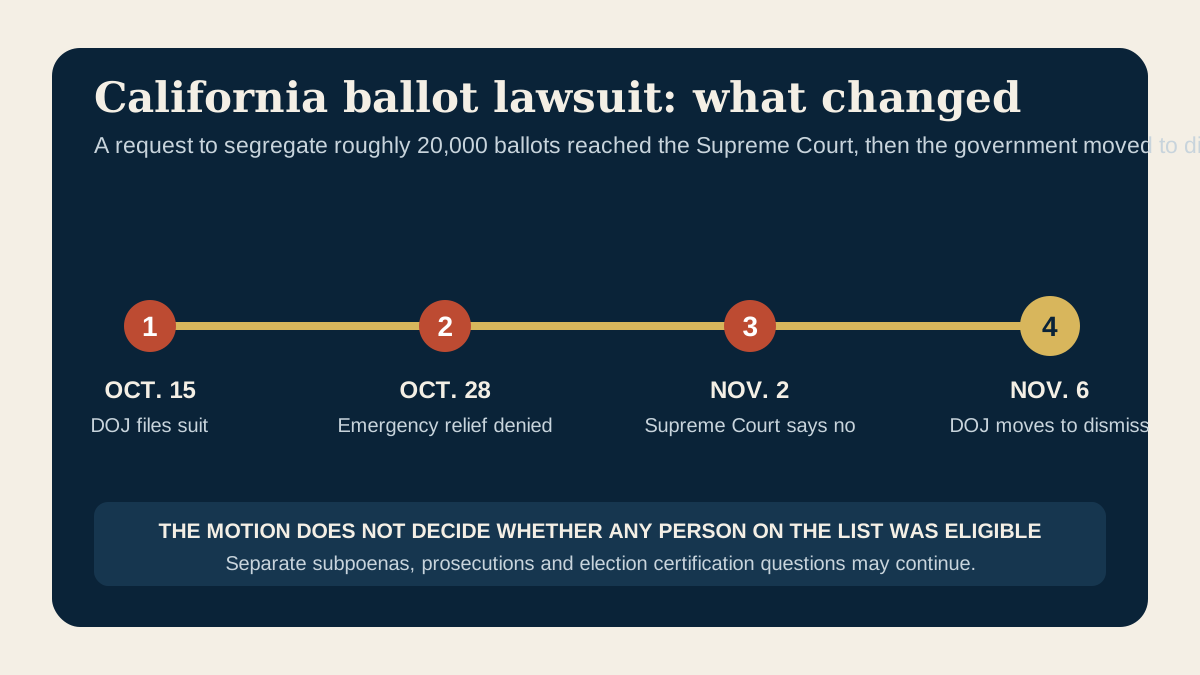
Verified baseline: the government moved to end its own case
On Friday, the Justice Department asked the U.S. District Court for the Central District of California to dismiss United States v. State of California, case 2:26-cv-12025. The lawsuit had sought to stop or segregate ballots associated with roughly 20,000 registrations that federal officials described as likely belonging to noncitizens.
The government’s original complaint alleged that California was obstructing enforcement of the federal ban on noncitizen voting. California disputed the list’s reliability and argued that the requested process could withhold lawful votes. The Associated Press reported that the government acknowledged its requested relief was no longer practicable after ballots were processed and anonymized.
A dismissal motion is not the same as a final judgment. The court must act on the request, and the filing does not itself decide the accuracy of the federal list, the citizenship of any named person or whether any illegal vote was counted.
How the case reached this point
The Justice Department sued on October 15. On October 28, U.S. District Judge David O. Carter denied emergency relief, finding that the government had not shown a likelihood of success and warning that changing election procedures after voting began could disenfranchise eligible citizens. Health Politics Daily’s report on that ruling explains the court’s reasoning and California’s ballot-secrecy process.
The government then asked the Supreme Court for an injunction pending appeal. The official Supreme Court docket records the November 2 application and denial. An emergency denial does not create a full merits ruling or establish a nationwide precedent.
What changes for voters and election officials
- Ballot counting continues: California officials do not have to create a new segregation process for the roughly 20,000 registrations in this civil case.
- Secret ballots remain anonymous: after election workers verify the return envelope and separate it from the ballot, the vote cannot be traced back to the voter. That is why the government said its requested remedy could no longer be carried out.
- No voter receives a blanket legal clearance: ending the civil suit does not determine individual citizenship, registration or criminal liability.
- Certification remains separate: county canvasses, audits and state certification proceed under California law. The motion does not certify any contest or change a reported result.
What does not automatically end
Federal prosecutors have pursued separate criminal investigations and grand-jury subpoenas involving California election records. Health Politics Daily previously reported on those subpoenas and their limits. Dismissing this civil lawsuit does not automatically withdraw a subpoena, close a criminal investigation or dismiss a prosecution.
California prosecutors have separately charged more than 30 noncitizens with illegally registering to vote, according to AP. Those cases concern specific people and allegations; they do not validate every name on the federal government’s 20,000-person list.
Fact, analysis, forecast and opinion
Verified fact: the Justice Department moved to dismiss its civil lawsuit after losing requests for emergency relief. Analysis: processing and anonymization made the requested ballot-segregation remedy unavailable, narrowing the practical value of continuing this case. Forecast: disputes over federal access to voter data and state election administration are likely to continue, but no particular new lawsuit or ruling is assured. Opinion: Health Politics Daily takes no position on the parties or election outcomes.
What remains uncertain
The court had not issued a final dismissal order at publication. It remains to be seen whether the case ends with or without conditions, whether the government pursues a different civil theory, and how courts handle related litigation over voter data and federal investigative demands.
The motion also does not resolve whether each person on the list was eligible, how many cast a ballot, or whether any charged conduct affected an election result. Those questions require person-specific evidence rather than inference from the size of a database match.
Bias Lens: voting rights, procedure or election integrity?
Verified baseline: the Justice Department moved to dismiss the civil lawsuit after courts declined to order California to segregate ballots linked to roughly 20,000 challenged registrations. The motion does not decide individual eligibility or automatically end separate investigations.
Left-leaning — CNN: framed the underlying demand as an unprecedented federal intervention in state election administration and emphasized the risk to lawful voters. Center — Associated Press: foregrounded the dismissal motion, the ballots’ anonymization and the distinction between this civil case and continuing subpoenas or individual prosecutions. Right-leaning — Fox News Digital: emphasized the Justice Department’s election-integrity claim and California’s registration safeguards while also reporting the court’s concerns about evidence and federal authority.
The coverage differs mainly in emphasis: possible disenfranchisement, the procedural posture, or enforcement against alleged noncitizen voting. Those frames do not change the verified fact that the government sought dismissal, and none establishes the eligibility of every person on the list.
Principal sources
- U.S. Department of Justice — original complaint
- U.S. Supreme Court — official emergency-application docket
- U.S. District Court — Los Angeles County motion describing ballot processing and secrecy
- Associated Press — Friday’s dismissal motion and remaining proceedings
No directly relevant official or publisher-authorized video with clear embedding permission was available at publication, so no video was embedded.
No comments yet.