U.S. Politics · Election Law · California
Judge Rejects DOJ Bid to Set Aside 20,000 California Ballots
The district court left current ballot-processing rules in place after finding the federal government’s late request risked disenfranchising eligible voters and disrupting an election already underway.
By Health Politics Daily News Desk · October 29, 2026 at 4:04 a.m. ET
Verified baseline
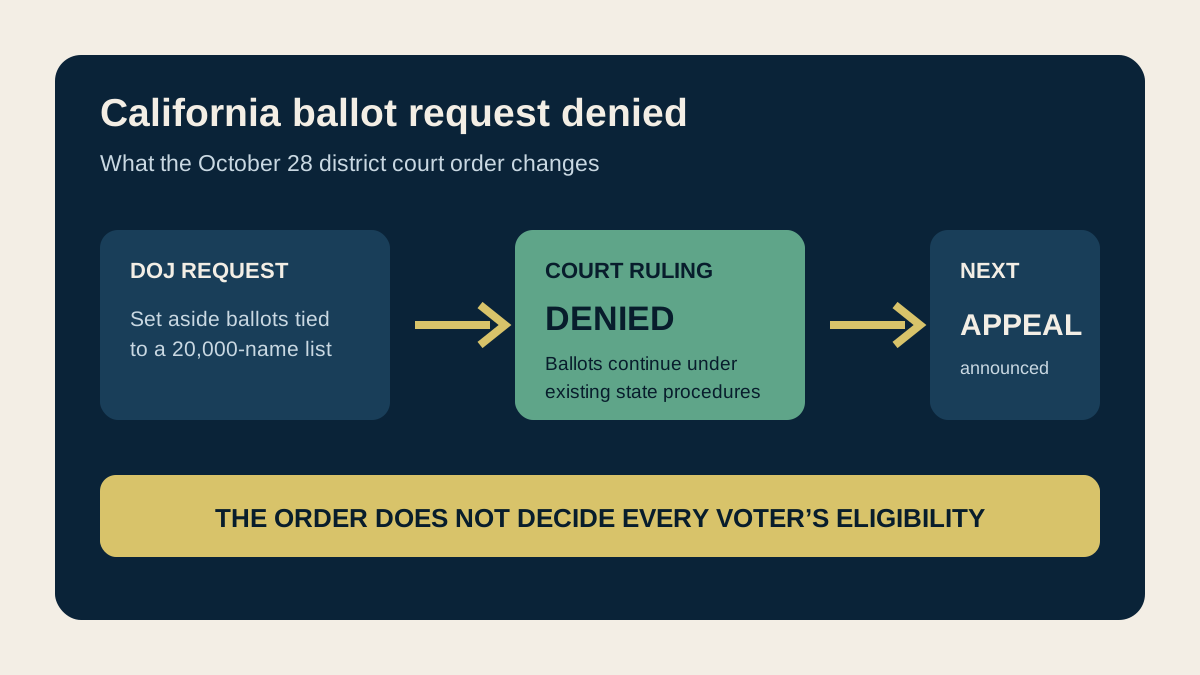
U.S. District Judge David O. Carter denied the Justice Department’s request for a temporary restraining order that would have required California to segregate and not count mail ballots associated with a federal list of more than 20,000 registered voters described as likely noncitizens. The court concluded that imposing the requested procedure after voting and ballot processing had begun could disrupt the election and risk withholding eligible citizens’ votes.
The Justice Department says noncitizen voting is illegal and argues that segregating ballots would protect citizens against vote dilution while citizenship is checked. California and Los Angeles County dispute the reliability of the federal list and say the proposed process conflicts with state election administration and federal protections. The district court denied emergency relief; it did not declare noncitizen voting lawful or make an individualized eligibility ruling for every person on the list.
What the judge decided
The court found that the federal request would substantially alter established procedures days before the November 3 election. Once officials verify a mail-ballot envelope and separate the ballot to preserve secrecy, linking that anonymous ballot back to an individual voter can become impossible. More than 500,000 ballots had already been processed, according to evidence reported by the Associated Press.
Carter also concluded that the proposed mass segregation resembled a voter-removal program within the 90-day period restricted by the National Voter Registration Act and could conflict with the Voting Rights Act and Civil Rights Act. Those conclusions were made in evaluating emergency relief; the litigation and appellate process can continue.
Why the federal list remains disputed
The government’s complaint says immigration and law-enforcement agencies used multiple records to identify likely noncitizens. It did not allege that all 20,000 people had cast ballots, and public filings acknowledge that the category could include citizens. State and county officials say a sample contained canceled or inactive registrations and possible citizens, raising false-positive concerns.
The legal dispute therefore separates three questions that political rhetoric often merges: whether a person appears in a database match, whether the person is legally eligible and registered, and whether the person actually cast an unlawful ballot. The ruling does not answer all three for every record.
Practical implications
- California voters: ballots continue to be processed under existing state and county procedures unless a higher court issues a new order.
- Flagged voters: inclusion on a federal list is not itself a final judicial finding of ineligibility. Use official election-office channels for registration or ballot-status questions.
- Election officials: the requested emergency segregation procedure is not currently in effect, though the announced appeal could change the legal posture.
- Observers: the case concerns emergency process and evidentiary reliability as well as the undisputed federal ban on noncitizen voting.
Fact, analysis, forecast and opinion
Verified fact: the district court denied the temporary restraining order and DOJ announced an appeal. Analysis: the decision prioritizes stable election procedures and the risk of disenfranchising eligible voters over a last-minute database-driven segregation process. Forecast: the appeals court could affirm, narrow, suspend or reverse the order, but no outcome is certain. Opinion: Health Politics Daily takes no position on the parties; election-law enforcement should use reviewable evidence and procedures that protect both eligibility rules and lawful voting.
Our original report on the DOJ lawsuit explains the allegations before any judge ruled. Our coverage of the separate nine-state DHS field-operations injunction concerns different plaintiffs and relief.
Bias Lens: illegal-vote risk, eligible-voter risk and federal power
Verified baseline: noncitizen voting in federal elections is illegal; DOJ’s list identifies suspected or likely noncitizens rather than 20,000 adjudicated unlawful voters; the district court denied ballot segregation and DOJ announced an appeal.
Left-leaning — The Guardian: calls the request legally thin and foregrounds the risk that it was intended to undermine confidence in the midterms. Center — Reuters and Associated Press: lead with the denial, explain both parties’ claims and distinguish suspected registration from submitted ballots. Right-leaning — Fox News: centers DOJ lawyer Bill Essayli’s defense of the list and announced appeal, emphasizing the risk of unlawful ballots. The difference is which unresolved harm receives first emphasis; the court order and current ballot-processing status are the shared baseline.
What remains uncertain
The appellate timetable and outcome are unknown. Public records do not establish how many people on the list received, returned or had ballots processed; how many are citizens; or how many records are inactive or canceled. The district court also has not issued a final judgment resolving every statutory and constitutional claim in the lawsuit.
Principal sources
- California Department of Justice — order summary and linked filings
- U.S. Justice Department — filed complaint
- U.S. Attorney’s Office — government’s stated basis for the case
- Associated Press — ruling and election-process context
- Reuters — ruling and announced appeal
Fox News’s publisher-authorized interview with the DOJ lawyer is linked in the Bias Lens. It was not embedded because persistent downstream embedding permission was unclear.
No comments yet.