U.S. elections · Federal courts · Alaska
Justice Department Sues to Block Alaska Senate Certification If Republican Loses
The unusual pre-election complaint targets a specific possible outcome; no judge has blocked voting, counting or certification.
By Health Politics Daily News Desk · October 23, 2026 at 5:56 p.m. ET
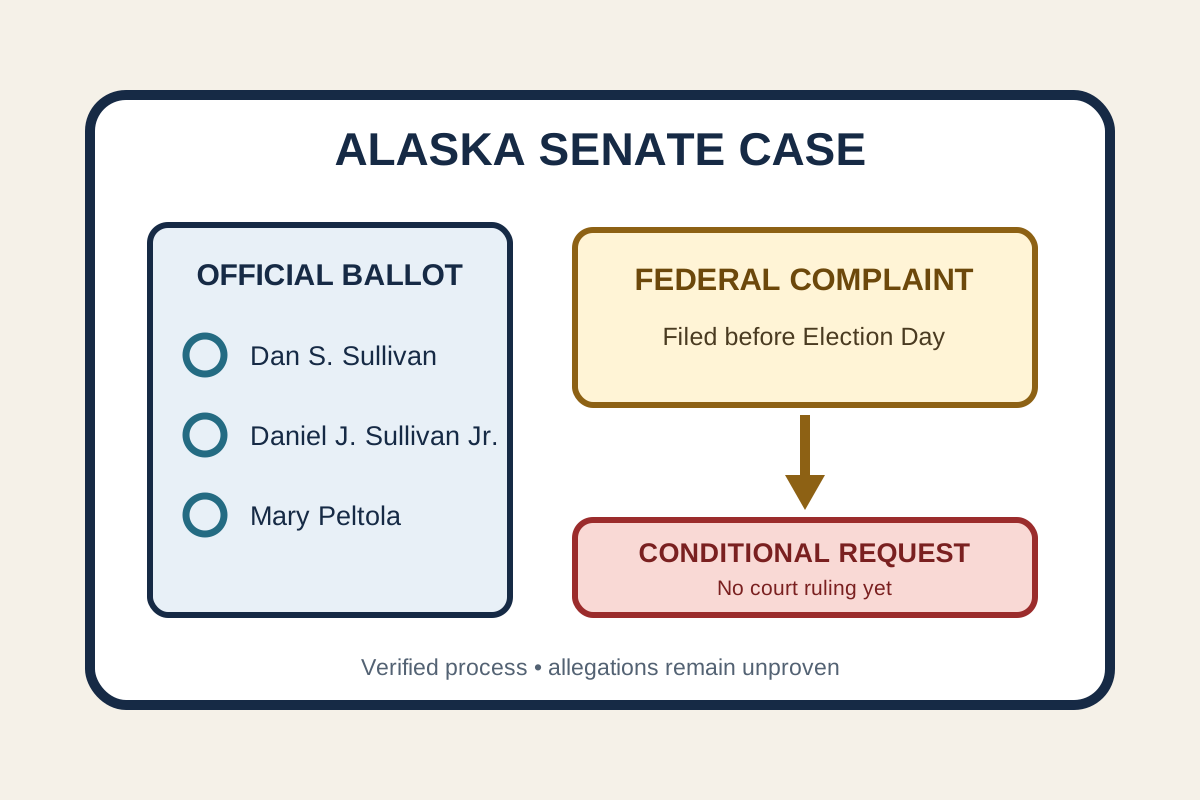
The Justice Department has asked a federal court to stop Alaska from certifying Democrat Mary Peltola as the winner of its U.S. Senate election if Republican incumbent Dan S. Sullivan loses by less than the number of votes cast for another candidate with a similar name.
President Donald Trump said Friday that he directed the lawsuit. The complaint was filed October 22, 11 days before Election Day, and alleges that candidate Daniel J. Sullivan Jr. entered the race to confuse voters and divert support from the senator. Daniel Sullivan denies coordinating with Democrats. Those allegations have not been established by a court.
What the lawsuit asks a judge to do
The requested relief is conditional. The department wants certification blocked only if Peltola leads the incumbent by fewer votes than Daniel Sullivan receives. It then seeks an investigation into whether confusion changed the result. The complaint does not cancel the election, remove a candidate or currently prevent Alaska from counting ballots.
Alaska lists the incumbent as “Dan S. Sullivan — Republican” and the other candidate as “Daniel J. Sullivan Jr.” without a party label. The state election candidate page confirms both names. Official August primary results show Daniel Sullivan received 4,107 votes, or 2.47%, while Peltola and the incumbent advanced with much larger shares.
Why it matters before November 3
The case asks a federal judge to intervene before voters have chosen a winner and after Alaska courts allowed Daniel Sullivan to remain on the ballot. Its immediate practical effect is political and legal uncertainty, not a change in how Alaskans vote.
The Justice Department invokes federal election-integrity law. Election-law specialists quoted by AP and Reuters question whether that statute authorizes the requested certification block and how officials could reliably infer voters’ private intent. The court has not ruled on either question.
What voters should know
Alaskans can review a sample ballot and candidate information through the state Division of Elections. Voters should read the full candidate name and affiliation before ranking choices. The lawsuit does not change registration, early-voting or Election Day deadlines.
Fact, analysis, forecast and opinion
Verified fact: the United States filed a federal complaint seeking conditional relief, Trump said he ordered it, both similarly named candidates are on Alaska's official list, and voting remains scheduled for November 3. Analysis: the suit could matter only under a narrow result, but it tests how far federal litigation may reach into a state's certification process. Forecast: a judge may address standing, statutory authority and ripeness before reaching the department's factual theory; the outcome cannot be predicted from the complaint alone. Opinion: public officials should explain the requested remedy precisely and avoid presenting either alleged voter confusion or the lawsuit's invalidity as already adjudicated.
For broader context, see our coverage of a federal injunction restricting election investigations, the Canada-U.S. election-interference dispute and a federal press-access injunction.
Bias Lens: voter confusion, federal power and the requested remedy
Verified baseline: two candidates with similar names appear differently on Alaska's ballot; state courts allowed Daniel Sullivan to run; the Justice Department seeks a conditional certification block; no court has found fraud, confusion or an unlawful election result.
Left-leaning — The Guardian: foregrounds Trump's direction to the department and the risk of federal interference. Center — Reuters and AP: emphasize the conditional legal request, prior state rulings and expert doubts about statutory authority. Right-leaning — Fox News and National Review: earlier coverage placed more weight on possible voter confusion and Republican claims that the candidacy was intended to siphon votes. The difference is one of emphasis; those claims remain unproven.
What remains uncertain
The public record does not establish whether any voter is confused, whether Daniel Sullivan entered the race to help another candidate, whether the court will hear the contingent claim before Election Day or how an investigation could measure hypothetical voter intent without compromising ballot secrecy. The case may become moot if the triggering margin does not occur.
Principal sources
- Alaska Division of Elections — official candidate list
- Alaska Division of Elections — official 2026 primary results
- Associated Press — complaint, presidential statement and legal context
- Reuters — requested relief and expert analysis
No suitable directly relevant official or publisher-authorized video with clear embedding permission was available, so none was embedded.