Health · FDA · Medicines
FDA Adds Rare Vision-Loss Warning to Ozempic, Wegovy and Other GLP-1 Drugs
The label change covers the entire GLP-1 class. The eye condition can be serious, but it remains rare, and FDA says the evidence shows a potential association—not proof that the medicines cause it.
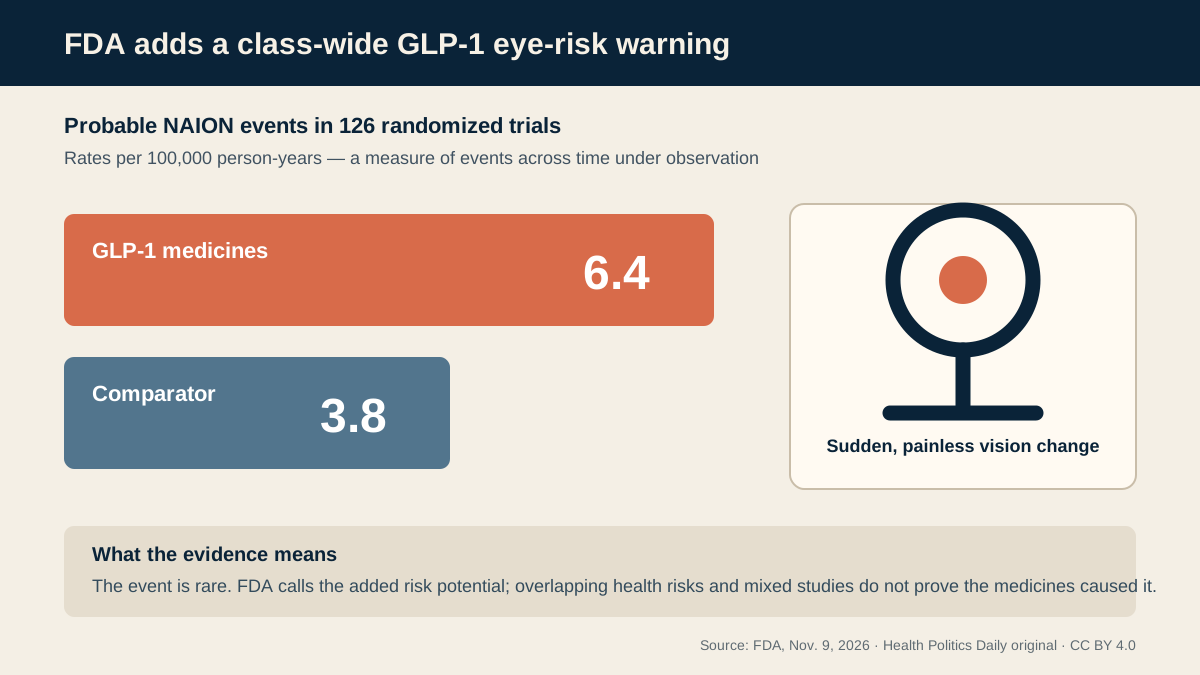
Verified baseline: FDA ordered a class-wide label change
The Food and Drug Administration is requiring manufacturers of every marketed glucagon-like peptide-1 receptor agonist to add a warning about a potential increased risk of non-arteritic anterior ischemic optic neuropathy, or NAION. The condition occurs when blood flow to the front of the optic nerve is reduced and can cause sudden, painless loss of vision, usually in one eye.
The action applies to a dozen brand-name injectable or oral products, including Ozempic, Wegovy, Mounjaro, Zepbound, Rybelsus, Trulicity, Victoza and newer medicines in the class. These products have different approved uses, including type 2 diabetes, long-term weight management and, for some products and patients, reduction of cardiovascular or kidney risks.
A warning is a required disclosure, not a recall, a ban or a finding that every user faces the same risk. FDA did not advise patients to stop treatment on their own.
How rare was the event in FDA's trial review?
FDA pooled 126 randomized controlled trials involving 134,253 patients and 288,879 person-years of observation. Reviewers identified 15 probable NAION events: 10 among patients assigned a GLP-1 medicine and five among patients assigned placebo or another glucose-lowering medicine.
That translated to 6.4 events per 100,000 person-years in the GLP-1 group and 3.8 in the comparator group. A person-year combines the number of people observed and the time each was followed; it is not the same as saying exactly 6.4 of every 100,000 individual users will develop the condition in a calendar year.
The difference is approximately 2.6 additional events per 100,000 person-years in that pooled analysis. Because only 15 probable events occurred, the estimate is imprecise and cannot show how risk varies among products, doses or individual patients.
Why the warning does not settle causation
People prescribed GLP-1 medicines often have diabetes, high blood pressure, sleep apnea or kidney disease—conditions that can also increase NAION risk. This overlap makes it difficult to separate a medicine's effect from the health conditions for which it is prescribed.
FDA's real-world study illustrates the uncertainty. Among adults with type 2 diabetes, the agency found no statistically significant increase when GLP-1 medicines were compared with SGLT-2 inhibitors, but it found an increase when they were compared with DPP-4 inhibitors. FDA's animal review did not identify a biological mechanism. Other observational studies produced evidence sufficient for a precautionary warning, but not a definitive cause-and-effect conclusion.
Drugmaker Novo Nordisk has said the available data do not establish causation, while Eli Lilly said it is evaluating the class-wide update. Those are company positions; FDA's regulatory judgment is that patients and clinicians should be informed while evidence continues to develop.
What patients can do without overreacting
The American Academy of Ophthalmology and the North American Neuro-Ophthalmology Society said Wednesday that patients should not panic or stop a GLP-1 medicine without consulting the prescribing clinician. Abruptly ending treatment may allow blood sugar, appetite or another treated condition to worsen, and the balance of benefits and risks differs from person to person.
FDA advises prompt medical contact for sudden, painless decreased vision in one eye; a new blind spot or missing part of the visual field; tunnel vision; distorted colors; or a sudden blurry or hazy area. The ophthalmology groups advise prompt evaluation by an eye specialist for those symptoms. A sudden vision change has several possible causes and should not be self-diagnosed.
For people with no symptoms, the professional groups do not recommend a special screening eye exam solely because someone is starting a GLP-1 medicine. People with diabetes should continue their regular diabetic eye examinations. Anyone with a previous NAION event should discuss the risk to the other eye with the prescribing clinician and an ophthalmologist.
This is general information, not individualized medical advice. Treatment decisions should be made with qualified clinicians who can weigh the medicine's benefits, the reason it was prescribed, eye history and other risk factors.
Why the policy matters beyond one brand
The action is broader than earlier concern focused mainly on semaglutide because FDA says NAION cases have been reported with all currently marketed GLP-1 products. A class-wide label also gives prescribers and patients a consistent warning rather than different language for medicines with related mechanisms.
It may change consent conversations and post-market monitoring, but it does not alter a product's approved indications or guarantee that insurers will change coverage. The site has separately covered WHO guidance on childhood obesity medicines and federal policy for compounded peptide drugs; neither article changes the FDA warning for approved GLP-1 products.
Fact, analysis, forecast and opinion
Verified fact: FDA ordered the warning after reviewing trials, observational research, adverse-event reports, animal data and a real-world evidence study. Analysis: the absolute event rate is low, but the potential severity makes disclosure and rapid symptom recognition important. Forecast: labels and patient materials will change, while additional studies may refine—or challenge—the estimated risk; the direction and timing of those findings cannot be predicted. Opinion: Health Politics Daily takes no position on whether any individual should use a GLP-1 medicine and rejects both minimizing a serious symptom and treating a rare potential risk as a reason for everyone to stop treatment.
What remains uncertain
FDA has not identified a mechanism, a product-specific risk ranking or a reliable test that predicts who will experience NAION. The pooled analysis cannot determine whether dose, treatment duration or speed of weight or blood-sugar change matters. It also remains uncertain whether future evidence will establish causation or show that underlying health conditions account for part of the association.
Bias Lens: warning, rarity and benefit-risk balance
Verified baseline: FDA requires a warning for a potential increased NAION risk across the GLP-1 class. The pooled trial rate was 6.4 versus 3.8 events per 100,000 person-years, and FDA did not announce a recall or establish causation.
Left-leaning — The Guardian: foregrounded the possibility of sudden permanent blindness and the rapid growth of weight-loss use, while also reporting FDA's low event counts and Novo Nordisk's causation objection. Center — Associated Press: led with the required label change, quantified the rarity and described symptoms and the evidence review in concise consumer terms. Right-leaning — Fox Business: emphasized the 126-trial review, the small number of events and the difficulty of separating drug effects from shared medical risk factors.
The meaningful difference is emphasis: possible severity, consumer action or evidentiary limits. All three accounts agree on the label change and rarity; none can resolve causation beyond FDA's current finding of a potential association.
Principal sources
- FDA — November 9 drug safety communication and evidence review
- American Academy of Ophthalmology and North American Neuro-Ophthalmology Society — November 11 patient guidance
- Associated Press — independent corroboration and consumer context
- Reuters — company responses and international context
No directly relevant official or publisher-authorized video with clear, persistent embedding permission was available at publication, so no video was embedded or linked.
No comments yet.