Finance · Technology · Cybersecurity
Binance Suspends Withdrawals After Security Incident With $6.3 Billion Estimated Impact
The world's largest cryptocurrency exchange says unauthorized withdrawal transactions followed a compromise of an engineer's laptop. Binance says customer losses will be covered, but transfers remain paused and the cause, total loss and recoverable amount are still under investigation.
By Health Politics Daily News Desk · October 30, 2026 at 12:03 a.m. ET
Verified baseline
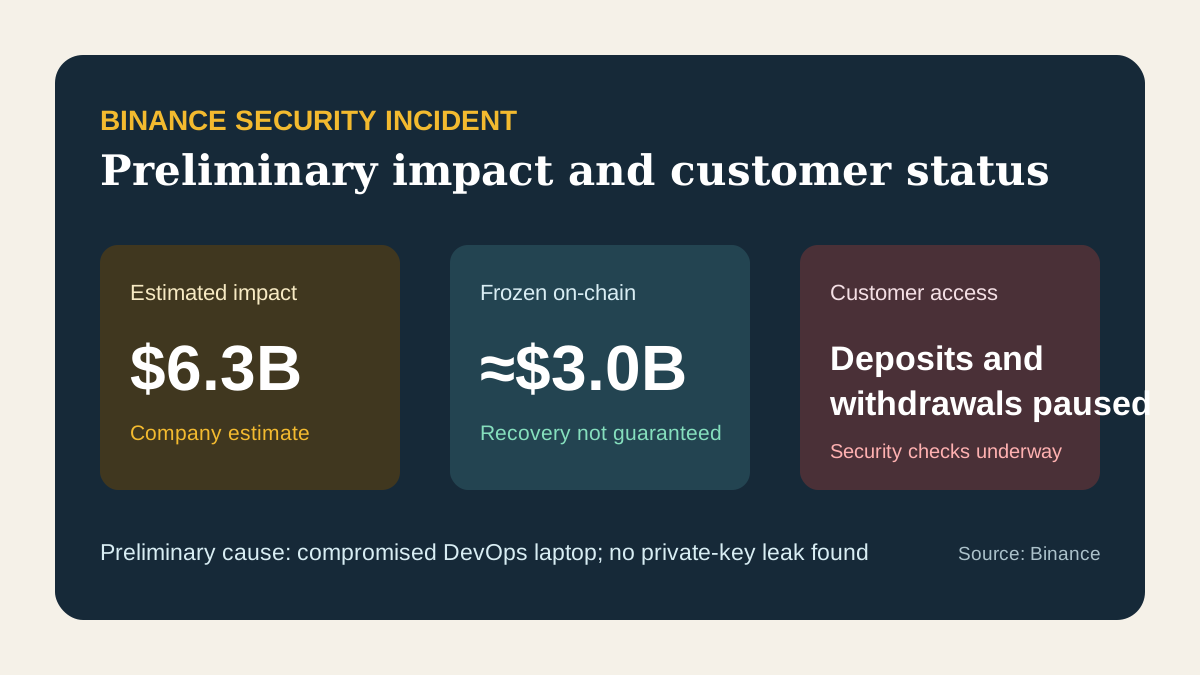
Binance said its initial investigation found that an attacker may have compromised a DevOps engineer's laptop, accessed a service container and submitted unauthorized withdrawal transactions. The company said it had found no evidence that wallet private keys were leaked.
Binance estimates the incident's total impact at approximately $6.3 billion. It says blockchain and industry partners have frozen about $3 billion on-chain. A frozen asset is not necessarily recovered cash: control, legal claims, chain rules and later court or issuer decisions can affect whether value is ultimately returned.
The exchange temporarily suspended deposits and withdrawals, revoked the affected address authorization and said it was working with law enforcement and blockchain-intelligence partners. Binance.US, a legally separate platform, told Reuters it was not affected.
What Binance has promised—and what is not yet proven
Binance said it will cover losses using its Secure Asset Fund for Users and company funds, and it maintains that user funds are safe. It also promised an updated proof-of-reserves report after remediation and a detailed technical post-mortem once facts are verified.
Those are company commitments, not independent confirmation that every account balance is immediately accessible or that reserves are sufficient under every scenario. Proof-of-reserves can show certain on-chain assets and liabilities at a point in time, but it is not the same as a full financial audit and may not establish all legal obligations.
The preliminary laptop explanation could change. Investigators have not publicly confirmed the attacker's identity, the exact authorization path, whether internal controls failed elsewhere or how much of the unfrozen value can be recovered.
Why stablecoin freezes matter
Tether, Circle, Ripple and other industry participants froze assets linked to the incident. Stablecoin issuers can often block transfers involving specific token addresses, a centralized control that can help contain theft but also demonstrates that many tokens marketed for rapid, open transfer depend on issuer-level intervention.
Reuters reported that Tether froze nearly $1.57 billion, Circle froze more than $800 million and Ripple froze about $200 million. Binance later raised its overall frozen estimate to roughly $3 billion as tracing continued. These amounts should not simply be added without checking for overlap across updates.
Market reaction is not the same as customer loss
Bitcoin fell below $79,000 after the disclosure, while ether and BNB also declined. Price changes can reflect fear, forced selling, liquidity changes and broader market conditions; they do not measure the amount stolen or determine whether an individual customer's balance is missing.
Binance's estimate is far larger than the value frozen so far, but the difference is not automatically a final loss. Some assets may be traceable, frozen later or covered by Binance; others may remain inaccessible. Only a completed forensic report and reconciled customer liabilities can clarify the outcome.
Practical implications
- Binance customers: deposits and withdrawals are paused. Use only official app and website notices; incident-themed messages and “recovery” offers are common phishing tactics.
- People with pending transfers: keep transaction IDs and screenshots, but do not share seed phrases, private keys, passwords or remote access with anyone claiming to provide support.
- Binance.US customers: the separate U.S. platform says it was not affected. Confirm status inside the official service rather than assuming all Binance-branded platforms share the same systems.
- Investors: volatile prices and an exchange security incident do not provide a reliable buy-or-sell signal. This report is not personalized financial advice.
Fact, analysis, forecast and opinion
Verified fact: Binance reported unauthorized transactions, an estimated $6.3 billion impact, roughly $3 billion frozen and a temporary pause on deposits and withdrawals. Analysis: the scale tests both Binance's financial backstop and the crypto industry's ability to coordinate freezes across issuers and chains. Forecast: Binance says it will restore services after security checks and cover losses, but has not provided a firm reopening time or independently verified recovery total. Opinion: Health Politics Daily takes no investment position; a credible response requires a public technical account, reconciled liabilities and clear evidence that customers regain access.
Our coverage of the FEC filing-system outage explains how a suspected cyber incident can disrupt a public financial system without affecting voting infrastructure. Our report on the Romance Scam Prevention Act covers another financial-fraud risk in which criminals exploit trust and digital platforms.
Bias Lens: hack, loss or contained incident?
Verified baseline: Binance reported unauthorized withdrawals and a preliminary compromise path, but a complete forensic report and final loss figure are not available.
A political left-center-right comparison is not meaningful for a developing technical incident and would force ideological labels onto largely shared facts. Associated Press emphasizes the uncertainty, frozen stablecoins and Binance's customer-fund assurance. Reuters foregrounds cross-company asset freezes and separates Binance.US. Bloomberg stresses market fear and falling token prices. These frames answer different questions; none independently verifies Binance's final liability.
What remains uncertain
The exact attack chain, the amount transferred, the amount recoverable, the reopening time and the adequacy of Binance's backstop remain uncertain. It is also unclear whether regulators will impose new requirements, whether any customer data was exposed or whether related compromises exist beyond the service container identified by Binance.
Principal sources
- Binance — official security incident update
- Associated Press — customer, stablecoin and market context
- Reuters — issuer freezes and Binance.US status
- Reuters — cryptocurrency market reaction
No suitable official or publisher-authorized video with clear persistent embedding permission was available, so none was embedded.
No comments yet.