Health Policy · FDA · Menopause Care
FDA Removes Three Risk Statements From Boxed Warnings on Estradiol Patches
Revised labels for Minivelle, Vivelle and Vivelle-Dot no longer place cardiovascular disease, breast cancer and probable dementia in the most prominent warning. The change does not mean hormone therapy is risk-free or appropriate for everyone.
By Health Politics Daily News Desk · October 31, 2026 at 3:55 a.m. ET
Verified baseline
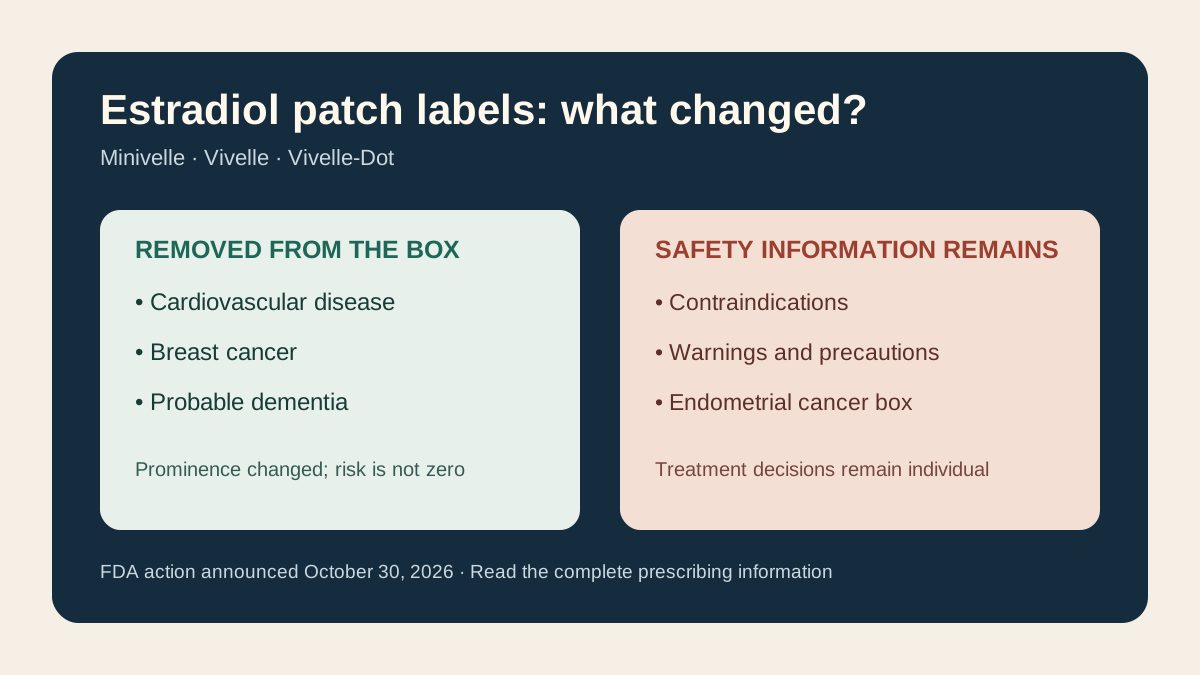
The Food and Drug Administration approved revised prescribing information for three estradiol transdermal patches: Minivelle, Vivelle and Vivelle-Dot. Statements about cardiovascular disease, breast cancer and probable dementia were removed from the boxed-warning section.
A boxed warning is FDA's most prominent prescription-drug warning. Removing a statement from that box changes how prominently it appears; it does not prove the risk is zero. FDA's public guidance says heart-disease and breast-cancer information remains elsewhere in labeling, and the boxed warning about endometrial cancer remains for systemic estrogen used without a progestogen in a person with a uterus.
Why FDA changed the labels
The original warnings were shaped by Women's Health Initiative trials begun in the 1990s. Participants averaged about 63 years old, while menopausal symptoms commonly begin between ages 45 and 55. The trials also studied oral conjugated estrogens and a particular progestin, not every modern product, dose or route.
Later analyses suggest benefit and risk can vary with age, time since menopause, formulation and route of administration. FDA says the old box applied findings too broadly and discouraged useful treatment. Critics agree that individualized counseling matters but say the agency has not publicly shown enough product-specific evidence or used a public advisory-committee process for the latest changes.
What did not change
The patches remain prescription medicines. Revised labeling continues to list contraindications that can include current or previous breast cancer, unexplained genital bleeding, active or previous blood clots, and arterial thromboembolic disease. Clinicians are still directed to evaluate vascular and thromboembolic risk factors.
The label change also does not establish hormone therapy as a preventive treatment for heart disease, dementia or other chronic conditions. People should not start, stop or switch a prescribed medicine based only on a headline. A clinician can interpret the current label in light of symptoms, age, medical history, other medicines and whether a uterus is present.
Patch access is a separate problem
Demand for menopause hormone therapy rose after FDA began revising warnings in late 2025. Patients have reported difficulty finding usual patch brands and strengths, although FDA says it is not aware of an imminent nationwide shortage. The agency says market output doubled during the past year and manufacturers added shifts and capacity.
Availability can still vary by pharmacy, geography, strength and once- or twice-weekly formulation. FDA advises people who cannot find their usual patch to contact a pharmacist and prescriber about available FDA-approved alternatives rather than changing treatment independently. The agency is also exploring, but has not approved, over-the-counter sales of vaginal estrogen products.
Practical implications
- People using Minivelle, Vivelle or Vivelle-Dot: the revised label does not itself change the prescribed dose or create a reason to stop treatment.
- People considering treatment: the benefits and risks depend on personal circumstances. This report is general information, not personalized medical advice.
- People facing supply problems: pharmacists may be able to locate another strength, brand or equivalent product; substitutions can require prescriber involvement.
- Clinicians and pharmacies: patient counseling should distinguish the removal of selected boxed statements from the safety information and contraindications that remain.
Fact, analysis, forecast and opinion
Verified fact: FDA approved revised labels for three named estradiol patches and removed three categories of risk statement from their boxed warnings. Analysis: the change may reduce an overly broad deterrent to treatment, but its clinical meaning depends on the full label and the individual patient. Forecast: demand may rise further and local access problems may persist despite higher production. Opinion: Health Politics Daily takes no position on individual treatment; accurate communication should neither exaggerate old warnings nor imply the therapies are risk-free.
For related policy context, see our report on FDA's proposed infant-formula nutrient changes and our coverage of HHS enforcement policy for compounded peptides.
Bias Lens: correction, caution or access story?
Verified baseline: three patch labels were revised; selected statements left the boxed warning, while other risks, contraindications and the endometrial-cancer box remain.
Left-leaning — The Guardian: emphasizes the absence of a public advisory-committee process and concern that patients may interpret the change too broadly. Center — Reuters: leads with the regulatory action and rising demand, with supply access as the immediate practical issue. Right-leaning — Fox News: in its coverage of the broader warning rollback, foregrounds agency arguments that the old warnings spread fear and understated treatment benefits. The frames differ in institutional trust and risk emphasis; none replaces the complete prescribing information.
What remains uncertain
FDA has not published a detailed product-by-product evidence review with this announcement. It remains unclear how quickly the new labels will reach every package and prescribing system, whether access will improve evenly, how many additional products will receive revisions and whether the agency will convene future public advisory review.
Principal sources
- HHS and FDA — October 30 labeling and supply announcement
- FDA — products with updated prescribing information
- Office on Women's Health — risks, evidence and label changes
- FDA — estradiol patch availability update
- Reuters — independent reporting on the action and supply
No suitable directly relevant authorized video with clear persistent embedding permission was available.
No comments yet.