Health Policy · FDA · Infant Nutrition
FDA Proposes New Infant Formula Limits for Iodine, Vitamins and Manganese
The first phase of a long-delayed nutrition review would revise four nutrient ranges and reaffirm four others. It is a proposal—not a recall, a final rule or a reason to change an infant’s feeding plan.
By Health Politics Daily News Desk · October 30, 2026 at 5:56 a.m. ET
Verified baseline
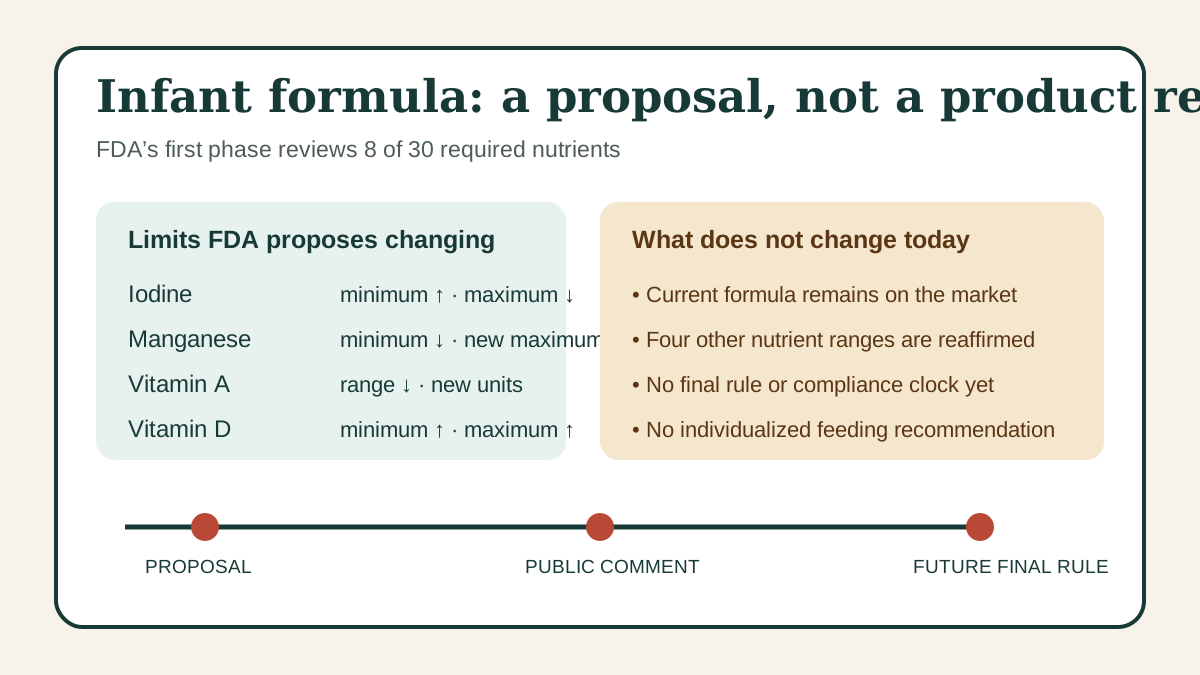
The Food and Drug Administration has proposed changing nutrient requirements for iodine, manganese, vitamin A and vitamin D in most infant formula sold in the United States. It would retain existing ranges for chloride, potassium, selenium and sodium.
This is the first phase of FDA’s first comprehensive review of the 30 required formula nutrients since 1998. The agency plans two more phases, independent peer review and one consolidated final rule. Nothing in the proposal removes formula now on shelves.
The numbers FDA wants to change
Per 100 calories of formula, FDA would triple the iodine minimum from 5 to 15 micrograms and lower its maximum from 75 to 50. It would lower the manganese minimum from 5 to 1 microgram and, for the first time, set a 50-microgram maximum.
For vitamin D, the minimum would double from 1 to 2 micrograms while the maximum would rise from 2.5 to 3 micrograms. Vitamin A would move to retinol activity equivalents, with a proposed range of 70 to 120 micrograms RAE per 100 calories and only preformed vitamin A counting toward that range.
FDA is also asking whether commonly added but currently optional nutrients—including DHA, ARA and L-carnitine—should eventually become mandatory. This first proposal does not add them to the required list.
What families should know now
FDA says current U.S. infant formulas remain safe and that the proposal is driven by updated nutrition science, not a newly identified product hazard. Caregivers do not need to replace formula because of this announcement. Product-specific recalls, if any, appear through FDA’s separate recall channels.
The proposal is general policy, not personal medical guidance. Questions about feeding, allergies, growth or switching products should go to a pediatric clinician or another qualified health professional; families should not dilute formula or alter preparation instructions.
How the rulemaking works
The public-comment period runs through February 26, 2027. FDA says the consolidated final rule would take effect 60 days after publication, with manufacturers receiving three years from that effective date to reformulate and relabel. Because two review phases remain, there is no final compliance date yet.
FDA’s economic analysis estimates annualized manufacturer costs between $8.4 million and $31.7 million, with a primary estimate of $17.6 million at a 7% discount rate. Those are regulatory estimates, not an announced price increase; retail effects and product reformulations cannot yet be predicted.
Contaminant testing is a separate track
HHS paired the nutrient proposal with new testing data on lead, arsenic, cadmium, mercury and other chemicals. The department said most tested samples had low or non-detectable concentrations. Nutrient limits and contaminant monitoring answer different questions, and the new data do not amount to a guarantee about every can, lot or future product.
Fact, analysis, forecast and opinion
Verified fact: FDA proposed four changed nutrient ranges, retained four others and has not issued a final rule. Analysis: the long lead time reduces immediate supply disruption, but manufacturers will need to model reformulation and labeling changes before the remaining phases are complete. Forecast: required nutrient levels and costs may change after public comment and peer review; no final outcome should be assumed. Opinion: Health Politics Daily takes no position on the proposed ranges; agencies should publish the evidence, explain tradeoffs and distinguish nutrition modernization from urgent product-safety alerts.
For comparison, our report on India’s proposed sugar limits for infant foods covers a separate consultation under different law. Our coverage of FDA’s individualized gene-editing proposal explains another draft pathway that is not yet final, while our compounded-peptide policy report distinguishes enforcement discretion from FDA approval.
Bias Lens: nutrition modernization or administration branding?
Verified baseline: the proposal changes four nutrient ranges, retains four, begins a three-phase review and leaves current products on the market.
Left-leaning framing: The Washington Post places the proposal in Secretary Robert F. Kennedy Jr.’s broader food-policy agenda and notes his contested health record. Center wire framing: Reuters emphasizes the specific nutrient and labeling changes, costs and next regulatory steps. Right-leaning framing: clearly original, substantive right-leaning coverage was not available at publication time. Rather than force a weak comparison, the controlling facts here come from FDA’s proposal and technical summary. The difference between policy framing and rule text should remain explicit.
What remains uncertain
FDA has not completed reviews of the other 22 currently required nutrients, potential additions or carbohydrate sources. Public comments, peer review and later phases may alter the final package. The agency has not said which brands would reformulate, whether package sizes or prices would change, or when a final rule will be published.
Principal sources
- FDA — proposed rule summary, nutrient ranges and questions
- HHS — announcement and contaminant-testing context
- Regulations.gov — rulemaking docket
- Reuters — industry cost and regulatory context
No suitable directly relevant official or publisher-authorized video with clear persistent embedding permission was available, so none was embedded.
No comments yet.