Health · FDA · Drug Compounding
HHS Eases Enforcement for Six Unapproved Compounded Peptides
The temporary policy creates a conditional pathway for licensed 503A compounders to make six popular peptides while HHS finishes rulemaking. It does not mean FDA has approved the products or established that they are safe and effective.
By Health Politics Daily News Desk · October 29, 2026 at 7:56 a.m. ET
Verified baseline
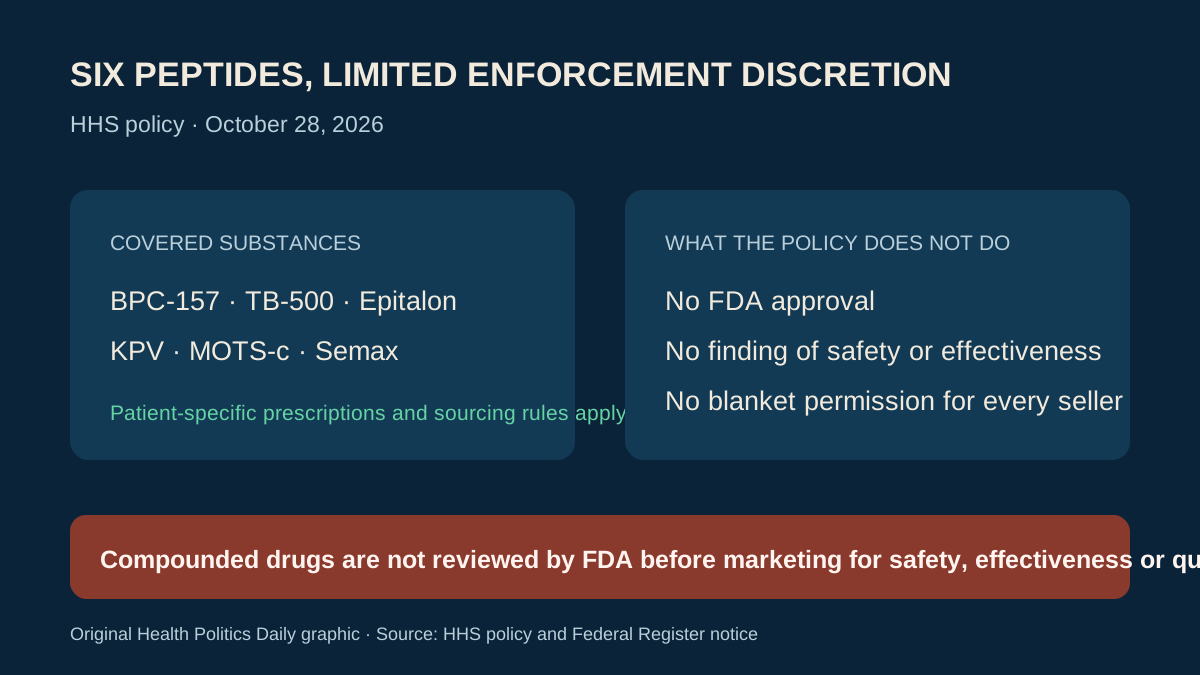
HHS says it does not intend to take enforcement action against qualifying state-licensed pharmacies, federal facilities or licensed physicians that compound BPC-157, TB-500, Epitalon, KPV, MOTS-c or Semax while a final rule on the federal 503A bulks list is pending. The policy follows a divided advisory-committee recommendation and is open to public comment through the federal docket.
The conditions include a valid patient-specific prescription, single active ingredient, specified routes, ingredient sourcing from a registered and compliant original manufacturer, certificates of analysis, labeling and reporting serious adverse events and quality problems. HHS may revisit the policy if safety or quality signals emerge.
What the policy does—and does not—change
Enforcement discretion tells the government when it presently plans not to bring an action; it is not approval. Compounded products are not reviewed by FDA before marketing for safety, effectiveness or quality, and the six substances have not completed the standard drug-approval process for the wellness and treatment claims often made online.
The policy aims to move demand away from foreign “research use only” sellers toward licensed U.S. compounders with sourcing and reporting conditions. Whether those guardrails reduce harm will depend on compliance, state oversight and federal monitoring. State pharmacy and medical rules still apply.
Practical implications
- Patients: access may expand through a prescriber and qualifying compounder, but access is not evidence of benefit. Ask what human clinical evidence supports the proposed use, what alternatives are approved and how adverse events will be handled.
- Prescribers: the policy requires a patient-specific prescription and does not erase professional, state-law or informed-consent duties.
- Pharmacies: eligibility depends on detailed ingredient, manufacturing, labeling and reporting conditions; it is not blanket permission to sell every peptide product.
- Online buyers: products labeled “research use only” or sold without a patient-specific prescription are not converted into compliant drugs by this policy.
Fact, analysis, forecast and opinion
Verified fact: HHS announced conditional enforcement discretion for six substances while rulemaking continues. Analysis: the department is trading a stricter access barrier for a controlled domestic channel, despite unresolved evidence questions. Forecast: licensed compounding and telehealth interest may rise, but uptake, adverse-event reporting and the final rule remain unknown. Opinion: Health Politics Daily takes no position on individual treatment; patient choice is most meaningful when uncertainty, alternatives and product quality are communicated plainly.
Our earlier review-stage report explains the legal route before the text became public. Our guide to the FDA mifepristone safety review offers broader context on the difference between a regulatory process and an immediate market change.
Bias Lens: access, evidence and agency authority
Verified baseline: the policy is temporary enforcement discretion with conditions, not FDA approval; the products remain unapproved and final rulemaking is pending.
Left-leaning — The Washington Post: foregrounds opposition from FDA scientific staff and the unusual HHS-led process. Center — Associated Press and Reuters: balance expanded access and black-market concerns against missing evidence and enforcement questions. Right-leaning — Fox News: earlier framed the advisory recommendation around access, patient interest and peptide-specific claims while including expert cautions. These frames emphasize different policy values; none changes the products’ unapproved status.
What remains uncertain
The final 503A bulks-list rule may differ from this temporary policy. HHS has not established population-level benefit or long-term safety for the promoted uses, and it is unclear how consistently sourcing and adverse-event rules will be enforced across states. The number of patients who will use the products and the frequency of harms are also unknown.
Principal sources
- Federal Register public-inspection notice — HHS policy availability and comment docket
- HHS Guidance Portal — federal guidance repository
- FDA — human drug compounding policies and rules
- Associated Press — policy development, staff concerns and safeguards
- Reuters — policy conditions and responses
No directly relevant official video accompanied the policy. The article therefore links the official documents and omits video.
No comments yet.