Health · FDA · Hepatitis B
FDA Approves Hibsago for Certain Adults With Chronic Hepatitis B
The first-of-its-kind treatment may let some eligible patients maintain viral control after stopping therapy. Approval is limited to a defined group and carries serious liver, bleeding and kidney risks.
By Health Politics Daily News Desk · October 20, 2026 at 8:03 p.m. ET
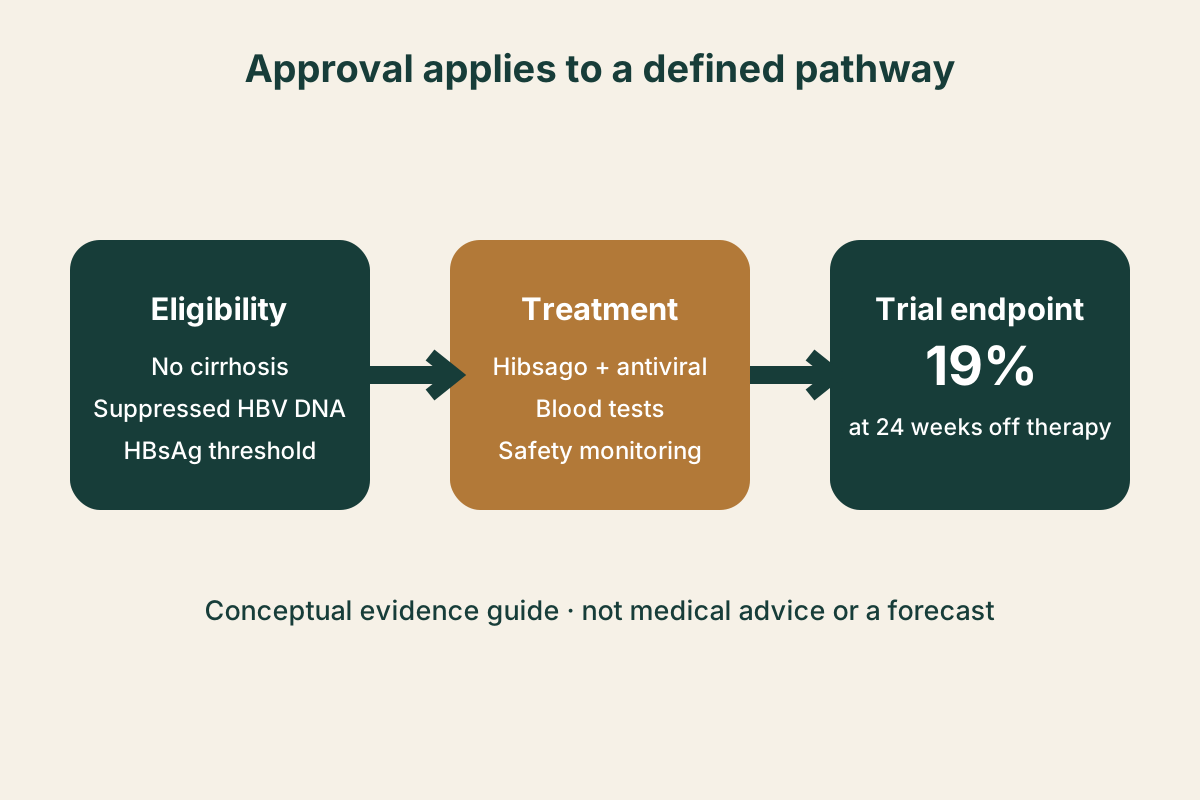
The Food and Drug Administration approved Hibsago, or bepirovirsen, alongside existing antiviral treatment for certain adults with chronic hepatitis B on October 20. It is the first FDA-approved antisense oligonucleotide for the disease. Approval creates a new option; it does not mean every patient can take the drug or safely stop current therapy.
Who is included in the approval
The FDA announcement limits Hibsago to adults without cirrhosis who have used nucleoside or nucleotide analogue therapy for at least six months, have suppressed hepatitis B virus DNA, and have hepatitis B surface antigen levels of 3,000 IU/mL or less on an FDA-authorized test.
Hibsago is injected under the skin for up to 24 weeks while the existing antiviral continues. FDA says that antiviral treatment continues for at least 24 weeks after the final Hibsago dose. Stopping later depends on specified health and laboratory requirements—not the calendar alone.
Practical implication: The approval is not a general instruction to stop hepatitis B medicine. Eligibility, monitoring and any eventual treatment change require clinician-directed assessment. This report provides general information, not personalized medical advice.
What the trials found—and did not prove
Across two placebo-controlled trials, FDA says 24% of Hibsago recipients met the requirements to stop their existing medicine, compared with none receiving placebo. Twenty-four weeks after all hepatitis B treatment stopped, 19% of Hibsago recipients still had viral control and no detectable hepatitis B surface antigen.
Analysis: That result is meaningful for a disease commonly managed with long-term viral suppression, but it also means most trial participants did not reach the same measured endpoint. The 24-week follow-up does not by itself establish lifelong control, eliminate every complication risk or show that a patient outside the approved population would benefit.
Reuters reports that standard nucleotide analogue therapies suppress the virus but rarely produce sustained clearance, and that GSK had not yet disclosed U.S. pricing or commercial availability when contacted.
Serious warnings and monitoring
FDA says Hibsago carries a boxed warning for serious liver reactions and low platelet counts that can increase the risk of potentially life-threatening bleeding. Other warnings include worsening kidney function, serious inflammatory reactions such as vasculitis, and serious harm if an injection is administered improperly.
Regular blood tests and clinical follow-up are required before and during treatment. FDA lists injection-site reactions, fever, fatigue and headache among the most common non-laboratory side effects.
Verified fact: Approval means FDA found the evidence sufficient for the labeled use with specified safeguards. It is not a finding that the drug is risk-free, suitable for cirrhosis or appropriate without the companion diagnostic and monitoring described in the label.
Why this matters beyond one approval
Chronic hepatitis B can cause cirrhosis and raise liver-cancer risk. Hibsago targets genetic instructions the virus uses to produce copies and viral proteins. FDA also authorized Roche’s Elecsys quantitative hepatitis B surface-antigen assay as a companion diagnostic to help select and monitor patients.
GSK’s release says the review received Priority Review, Breakthrough Therapy and Fast Track designations. Those regulatory designations concern development and review; they do not replace post-approval monitoring or guarantee access.
Our cancer-trial preview explainer separates company disclosures from complete clinical evidence. Our recent FDA product-approval coverage explains why authorization, availability and individual suitability remain separate questions.
What remains uncertain
Publicly reviewed materials do not yet resolve the U.S. list price, insurance coverage, initial supply or the number of patients likely to meet all eligibility criteria. Longer follow-up will be important for durability, uncommon harms and real-world adherence to monitoring.
Forecast boundary: GSK’s sales expectations and possible future approvals abroad are company and market forecasts. They do not predict an individual outcome or establish how quickly U.S. patients will obtain the medicine.
Bias Lens: “can stop treatment” needs the eligibility and outcome details
Verified baseline: FDA approved Hibsago for a defined group without cirrhosis, used with existing antiviral therapy and monitoring. In trials, 19% maintained the stated endpoint 24 weeks after stopping all hepatitis B treatment.
Center—Reuters: Leads with the possibility of ending long-term therapy and adds commercial context, competing development and the company’s sales forecast.
Primary-source framing—FDA and GSK: FDA centers the labeled population, trial endpoint and safety warnings. GSK emphasizes novelty and potential treatment-free control while also providing labeled limitations and risk information.
Comparison limit: Meaningful directly comparable left- and right-leaning coverage was not verified. Forcing partisan symmetry onto a new drug label would add little; the useful comparison is whether reports preserve eligibility, absolute response rates and safety warnings.
Sources and media
FDA materials anchor the indication, evidence and warnings; GSK supplies sponsor and regulatory context; Reuters corroborates the approval and adds market context. The original illustration is an evidence guide, not a treatment recommendation. No suitable directly relevant authorized video was verified, so none is embedded.