International Politics · Macao · Civil Liberties
Au Kam San Sentenced to 12½ Years in Macao’s First National-Security Case
The former pro-democracy lawmaker received a single combined prison term after a closed trial. The judgment establishes the first concrete sentencing precedent under Macao’s expanded national-security system.
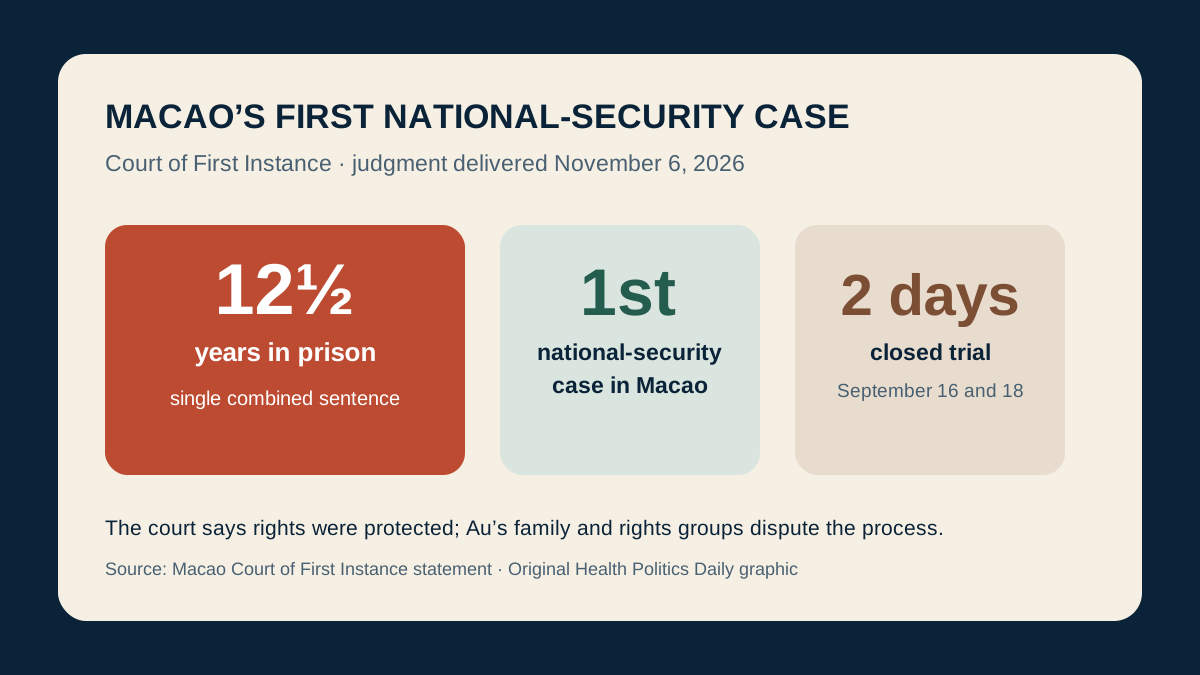
Verified baseline: a 12½-year combined sentence
Macao’s Court of First Instance sentenced former lawmaker Au Kam San, 69, to 12 years and six months in prison on November 6. It was the territory’s first case involving alleged violations of the Law on Safeguarding National Security since Macao became a Chinese special administrative region in 1999.
The court’s official statement in Portuguese says Au was convicted of one count of subversion, two separately punished counts of establishing ties with outside organizations or people to endanger national security, and one count of breaching secrecy. The bench imposed an 11-year, three-month term for subversion, three years and nine months for each outside-contact offense and nine months for secrecy, then combined them under Macao sentencing rules rather than adding them arithmetically.
Au was acquitted of two additional subversion counts. One other outside-contact offense was not punished separately because the court treated it as overlapping with the subversion offense. An English publication of the court statement provides the same breakdown.
What the court said Au did
The court said Au assisted organizations outside Macao in collecting and publishing what it called false or distorted information intended to prompt hostile foreign action, incite hatred against China’s central government and disrupt the 2024 chief-executive selection. It also found that, while serving in the legislature in 2021, he disclosed confidential discussion about the renewal of casino concessions.
The judgment says Au did not contest most underlying facts, acknowledged that some contacts constituted offenses and accepted arguments made by his court-appointed lawyer. Those descriptions come from the court; because the substantive hearings were closed, the public cannot independently compare the full evidentiary record with the defense case.
Why the trial was closed—and why that matters
The trial took place on September 16 and 18 without public access. The court said prosecutors requested closure and Macao’s Committee for Safeguarding National Security confirmed it was necessary to protect national-security interests. The November 6 sentencing was read publicly.
Macao’s government says Au’s legal rights were fully protected, that he accepted a court-appointed lawyer and maintained close contact with counsel, and that relatives received permission for regular visits. In a separate official response, the government said the ruling demonstrated judicial independence and lawful protection of the territory.
Au’s family has offered a different account. The Associated Press reported that a lawyer selected by the family was unable to see him and that relatives could not speak with him for nearly a year. Human Rights Watch said the closed proceedings and representation issues violated due-process expectations and warned that the sentence could deter peaceful criticism.
These claims are not interchangeable: the government is describing compliance with Macao law, while critics are challenging whether that process meets broader standards of transparency, lawyer choice and political expression.
Who Au Kam San is
Au served in Macao’s legislature for about two decades before stepping down in 2021. A former teacher, he advocated democratic reforms, criticized public policy and helped organize annual commemorations of the 1989 Tiananmen crackdown. His arrest in July 2025 was the first publicly known national-security prosecution under the territory’s law.
Macao returned from Portuguese to Chinese administration in 1999 under a “one country, two systems” arrangement. Its opposition movement has historically been smaller than Hong Kong’s, making the first prosecution of a long-serving, comparatively moderate critic especially important as a signal of where authorities draw the boundary between dissent and national-security offenses.
Practical implications
- For Au and his family: the judgment creates a long custodial sentence. Whether and when an appeal will be filed was not confirmed at publication.
- For lawyers and courts: the ruling supplies the first sentencing example for the expanded subversion and outside-contact provisions, but a closed record limits public guidance about what evidence proved the offenses.
- For journalists and civic groups: contacts with overseas organizations, circulation of political information and access to confidential government material now carry a visible enforcement precedent.
- For residents and businesses: the verdict does not change ordinary travel, casino operations or commercial rules. Its immediate effect is legal and political, not a general change to daily commerce.
This article provides general reporting, not legal advice. People facing questions about Macao law should consult qualified counsel with access to the official Chinese or Portuguese texts.
Fact, analysis, forecast and opinion
Verified fact: the court imposed a 12½-year combined sentence after a closed two-day trial and publicly released its account of the findings. Analysis: the decision turns broad national-security provisions into a concrete enforcement precedent and may influence how political actors assess contacts, publications and confidential information. Forecast: a chilling effect is plausible but cannot yet be measured, and the result of any appeal is unknown. Opinion: Health Politics Daily takes no position on Au’s guilt or on Macao’s constitutional relationship with China.
What remains uncertain
The full judgment and underlying evidence were not available in English at publication. It was not immediately clear whether Au would appeal, whether an appellate hearing would be public, or how courts will apply the ruling to future speech and association cases. Claims about the wider political effect therefore remain analysis rather than settled fact.
Bias Lens: security enforcement or suppression of peaceful dissent?
Verified baseline: Au received a 12½-year combined sentence in Macao’s first national-security case after closed hearings. The court convicted him of subversion, outside contacts and secrecy violations while acquitting him of two subversion counts.
Coverage note: a standard U.S. left-center-right spectrum does not map cleanly onto this case, and no responsible right-leaning outlet with original reporting was available at publication. Forcing that label would hide the more relevant divide between rights-focused, wire-service and state-aligned framing.
Rights-focused — DW: centers Au’s pro-democracy identity and the warning that the case could chill criticism. Center wire services — Associated Press and Reuters: pair the court’s allegations with Au’s biography, the closed process and rights-group objections. State-aligned — China Daily Asia: emphasizes the court’s account, government support and protection of lawful rights.
The differences concern what each source treats as the story’s center: the effect on dissent, the contested process, or state security and judicial authority. The published judgment and the fact of a closed trial are the shared baseline.
Principal sources
- Macao Court of First Instance statement — findings and sentence breakdown
- Macao SAR Government — official response to the judgment
- Macau Post Daily — English publication of the court statement
- Associated Press — family response and political context
- Reuters — independent corroboration and rights-group response
No suitable directly relevant official or publisher-authorized video with clear persistent embedding permission was available, so none was embedded.
No comments yet.