NATIONAL SECURITY — U.S.–CHINA — VERIFIED EXPLAINER
F-35 Parts Were Diverted to Hong Kong: What the Pentagon Is Investigating
A shipment from Australia did not reach its intended U.S. destination. Officials are trying to retrieve the components and determine what happened, while the sensitivity of the parts and any Chinese access remain disputed.
By Health Politics Daily News Desk · Published Thursday, September 24, 2026 at 12:00 p.m. America/New_York · Approximately 7 minutes

Watch in this article
Pumpjack operating at the Kern River Oil Field
A short CC0 field video provides visual context for reporting on oil production and fuel supply.
Thomas Farley / Wikimedia Commons · CC0 1.0 · License and source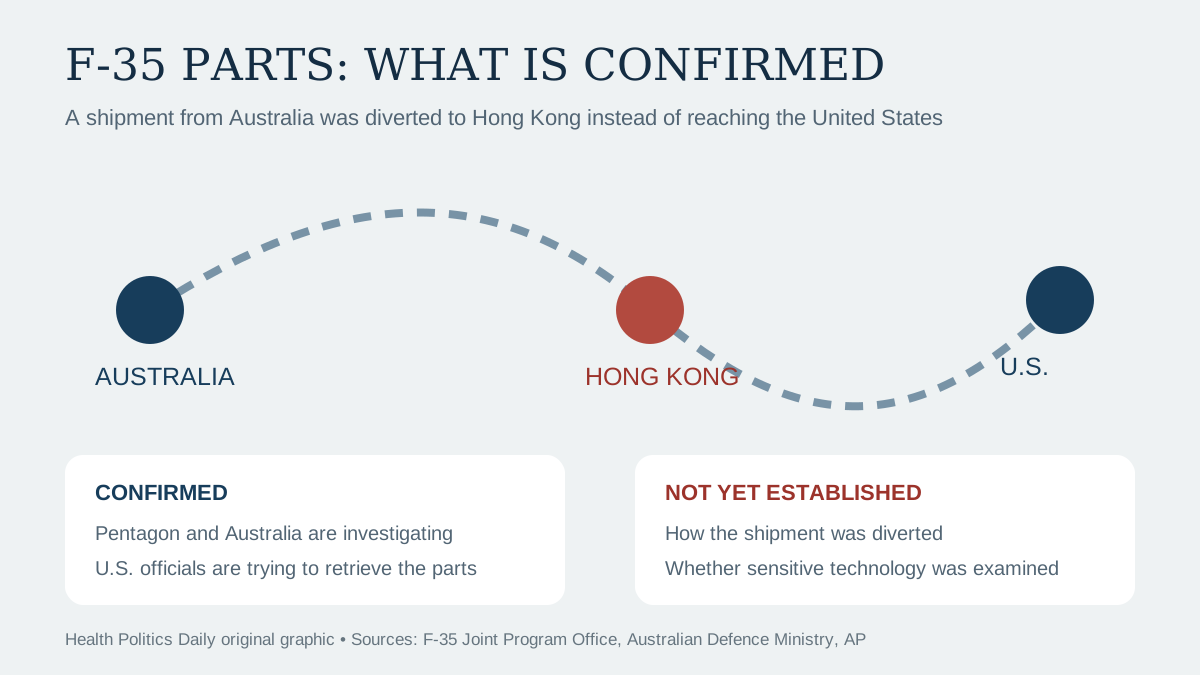
Verified Baseline
F-35 components reached Hong Kong instead of the United States
Australia’s defense minister, Richard Marles, acknowledged that F-35 components shipped from Australia were diverted to Hong Kong. The Associated Press reports that the F-35 Joint Program Office and the Pentagon are working with U.S. authorities and industry partners to retrieve the parts, investigate the incident and prevent a recurrence.
That establishes a shipment problem and an active investigation. It does not establish, on the current public record, who caused the diversion, whether Chinese authorities opened or examined the components, or what technical information was obtained.
What Was Shipped
Reports identify a canopy and weapons-bay door; officials dispute their sensitivity
Bloomberg and Politico reported that the shipment included a cockpit canopy and weapons-bay door. Marles said his understanding was that the missing items were not sensitive equipment. Other reporting has raised concern that a canopy can incorporate radar-signature technology.
Those positions are not necessarily identical measures: an item may be unclassified while still offering engineering clues, and an F-35 component can contain sensitive features without revealing the aircraft’s full stealth system. Publicly available statements do not resolve that technical question.
Why It Matters
The F-35 relies on a multinational supply and maintenance network
More than 1,200 F-35s have been produced and 19 countries have ordered the aircraft, according to the Congressional Research Service cited by AP. That scale requires parts to move among manufacturers, military operators and repair facilities. A misrouted shipment tests the tracking and security controls around that network.
For allied governments, the practical concern is larger than two components: investigators must determine where custody changed, why the routing failed, how long the parts remained in Hong Kong and whether similar shipments face the same weakness.
What Is Not Confirmed
“China obtained F-35 secrets” goes beyond the verified evidence
Hong Kong is under Chinese sovereignty, and Beijing controls its defense and foreign affairs. But physical arrival in Hong Kong is not proof that Chinese military engineers inspected the parts or extracted useful information. China’s Foreign Ministry said it was unaware of the incident, while Hong Kong authorities declined to comment on the specific case.
Analysis: the diversion creates a plausible counterintelligence risk. It should not be converted into a finding of espionage before investigators establish custody, access and handling.
What Happens Next
Retrieval, chain-of-custody review and safeguards are the immediate tests
The Joint Program Office says retrieval and prevention measures are underway. A credible public accounting would clarify the carrier and routing decisions, the parts’ classification and technical sensitivity, who possessed them, whether tamper evidence exists and what controls are being changed.
The incident surfaced as Presidents Donald Trump and Xi Jinping met in Washington, increasing attention to the story. The timing does not prove the diversion was connected to the summit or directed by either government.
Bias Lens: covering the F-35 shipment
F-35 components shipped from Australia were diverted to Hong Kong. U.S. and Australian officials are investigating and seeking retrieval; the cause, handling and degree of technical exposure are not publicly established.
The Guardian stresses supply-chain accountability and potential stealth exposure. Associated Press foregrounds the confirmed statements and unresolved facts. Fox News leads with the possibility that China is holding sensitive parts. The difference is mainly how strongly each outlet foregrounds the worst-case security implication.
Principal Sources
Evidence and reporting used
- Associated Press — Pentagon, Australian and Chinese statements
- ABC Australia — Australian defense minister’s confirmation
- The Guardian — shipment and security context
- Fox News — right-leaning coverage reference
No suitable directly relevant authorized video with clear embedding permission was available; the Fox News clip is linked only as a coverage reference.